Join us on a literary world trip!
Add this book to bookshelf
Grey
Write a new comment Default profile 50px
Grey
Subscribe to read the full book or read the first pages for free!
All characters reduced
The Rival Pitchers - cover

The Rival Pitchers

Lester Chadwick

Publisher: CLXBX

  • 0
  • 0
  • 0

Summary

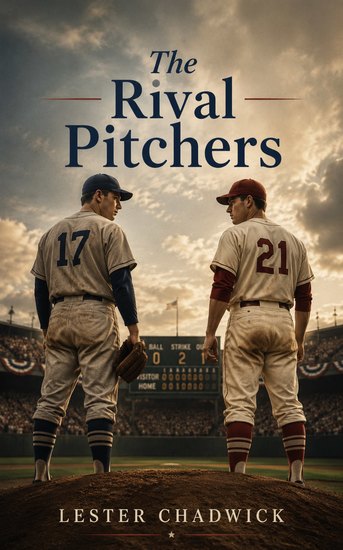
The Rival Pitchers by Lester Chadwick is a classic sports adventure that captures the excitement, determination, and competitive spirit of America's favorite pastime. Centered on talented young athletes striving to prove themselves both on and off the field, the novel delivers an inspiring story of ambition, teamwork, and personal growth.

As competition intensifies, friendships are tested, rivalries deepen, and every game presents new opportunities to demonstrate skill, discipline, and perseverance. Through victories, setbacks, and hard-earned lessons, the characters discover that true success is measured not only by athletic achievement but also by integrity, sportsmanship, and respect for others.

Lester Chadwick's engaging storytelling brings the energy of early twentieth-century athletics to life with memorable characters, exciting game action, and timeless themes that continue to resonate with readers. Blending suspense, humor, and wholesome values, this enduring classic celebrates dedication, fair play, and the enduring rewards of hard work.

Perfect for readers who enjoy classic sports fiction, coming-of-age adventures, and stories that highlight friendship, determination, and athletic competition, The Rival Pitchers remains a timeless tale that inspires readers to pursue excellence with courage, character, and unwavering commitment.
Available since: 07/10/2026.
Print length: 219 pages.

Other books that might interest you

  • Six Little Bunkers at Grandpa Ford's - cover

    Six Little Bunkers at Grandpa...

    Laura Lee Hope

    • 0
    • 0
    • 0
    "The six little Bunkers are on the move again, and this time, the fun begins at Grandpa Ford's!"
    
    The Bunker family is a lively household of six children, ranging from the industrious Russ and helpful Rose to the toddlers Margy and Mun Bun. In this installment, the children pack their bags for a trip to visit their kind-hearted Grandpa Ford. Set against the backdrop of a simpler time, the story follows their journey and the delightful, often humorous, escapades that occur when six curious siblings explore a new environment. From helping with chores to making unexpected discoveries, the Bunkers prove that the best adventures are the ones shared with family.
    
    Wholesome Family Dynamics: At its heart, the series is a celebration of sibling cooperation. Each child has a distinct personality—Russ, the oldest, is the natural leader; Rose is the "little mother"; Lad and Vi are the inquisitive middle children; and Margy and Mun Bun provide the innocent charm. Their interactions teach lessons in kindness, responsibility, and the joy of discovery.
    
    A Window into the Past: Written in 1922, the book offers a fascinating glimpse into American life a century ago. It depicts a world of train travel, handwritten letters, and the simple pleasures of a visit to a relative's home. For modern readers, it serves as a nostalgic "time capsule" of early 20th-century childhood and social etiquette.
    
    Gentle Mystery and Adventure: Like many Stratemeyer series, the plot is driven by "gentle mysteries"—small puzzles or lost items that the children must work together to solve. This keeps young readers engaged while maintaining the comforting, safe atmosphere that made the series a staple of school libraries for decades.
    
    Reconnect with a classic of American childhood. Purchase "Six Little Bunkers at Grandpa Ford's" today.
    Show book
  • Unknown Friend Nobel Prize 1933 An - cover

    Unknown Friend Nobel Prize 1933 An

    Ivan Bunin

    • 0
    • 0
    • 0
    Ivan Bunin received the 1933 Nobel Prize in Literature "for the strict artistry with which he has carried on the classical Russian traditions in prose writing." Aristocrat to the core, Bunin somehow remained connected to the land and people and keenly felt their pulse of life. His acute observations resulted in the accurate and unforgettable characters who populated his writing. His love for punctuation and punctilious choice of words is legendary. Reading Bunin's stories is one of the best ways to understand the mysterious Russian soul and begin to understand one of Russia's greatest periods of literature.
    Show book
  • Juvenilia – Volume II - cover

    Juvenilia – Volume II

    Jane Austen

    • 0
    • 0
    • 0
    "Run mad as often as you choose; but do not faint!"
    
    If Volume I was the spark, Juvenilia – Volume II is the fire. In this volume, a mid-teen Jane Austen takes aim at the "cult of sensibility" that dominated the novels of her day. The centerpiece, "Love and Freindship" (spelled intentionally with Austen's original flourish), is a brilliant epistolary parody featuring heroines who faint on every sofa they encounter and wander the countryside in a state of perpetual, melodramatic "distraction." This volume also features her iconic "History of England," where she gleefully abandons historical accuracy to defend Mary, Queen of Scots, and mock the "vile" Elizabeth I. It is a collection that proves Austen was a master of irony before she was even twenty.
    
    The Masterpiece of Parody: Love and Freindship: Through a series of letters, Austen deconstructs the romantic tropes of the era. Her characters, Laura and Sophia, believe that "feeling" is more important than "common sense," leading to a series of absurd adventures involving stolen money, secret marriages, and dying of a "chill" caught while fainting in the dew.
    
    The Bias of a Historian: In The History of England, Austen mocks the dry, "objective" historians of her time. Writing as a "partial, prejudiced, and ignorant historian," she proves that history is often just a matter of who you like and who you don't—a biting critique of how narratives are constructed that still feels modern today.
    
    A Developing Genius: From the unfinished "Lesley Castle" to the sharp "Collection of Letters," this volume shows Austen experimenting with different voices and structures. You can see the DNA of Northanger Abbey and Sense and Sensibility being formed in these rowdy, rebellious pages.
    
    Join the fun at the Austen family table. Purchase "Juvenilia – Volume II" today.
    Show book
  • The cap and gown - cover

    The cap and gown

    CHARLES REYNOLDS BROWN

    • 0
    • 0
    • 0
    Navigate the collegiate journey with The Cap and Gown by Charles Reynolds Brown. This book serves as a guide to higher education, offering advice and insights that will aid students in making the most of their university years. Browns wisdom, derived from his own experiences, provides valuable insights into academic pursuits, personal growth, and the broader aspects of university life. Prepare for your academic journey with The Cap and Gown. Order your copy today and make the most of your university experience.
    Show book
  • Richard Richard - cover

    Richard Richard

    Richard Richard

    • 0
    • 0
    • 0
    The Essays which follow represent an attempt at intellectual coöperation. No effort has been made, however, to attain unanimity of belief nor to proffer a platform of "planks" on which there is agreement. The consensus represented lies primarily in outlook, in conviction of what is most likely to be fruitful in method of approach. As the title page suggests, the volume presents a unity in attitude rather than a uniformity in results. Consequently each writer is definitively responsible only for his own essay. The reader will note that the Essays endeavor to embody the common attitude in application to specific fields of inquiry which have been historically associated with philosophy rather than as a thing by itself. Beginning with philosophy itself, subsequent contributions discuss its application to logic, to mathematics, to physical science, to psychology, to ethics, to economics, and then again to philosophy itself in conjunction with esthetics and religion. The reader will probably find that the significant points of agreement have to do with the ideas of the genuineness of the future, of intelligence as the organ for determining the quality of that future so far as it can come within human control, and of a courageously inventive individual as the bearer of a creatively employed mind. While all the essays are new in the form in which they are now published, various contributors make their acknowledgments to the editors of the Philosophical Review, the Psychological Review, and the Journal of Philosophy, Psychology and Scientific Methods for use of material which first made its appearance in the pages of these journals...FROM THE BOOKS.
    Show book
  • A Doll's House - cover

    A Doll's House

    Henrik Ibsen

    • 0
    • 0
    • 0
    Ibsen's "A Doll's House," written two years after "The Pillars of Society," became a sensation and is now widely considered his most famous play. Required reading in many secondary schools and universities, the play was highly controversial upon its release due to its sharp criticism of 19th Century marriage norms. Despite following the structure of a traditional well-made play, the play breaks convention by ending with a discussion instead of an unraveling in its final act. Although Ibsen himself denied it, "A Doll's House" is often referred to as the first true feminist play.
    Show book