Join us on a literary world trip!
Add this book to bookshelf
Grey
Write a new comment Default profile 50px
Grey
Subscribe to read the full book or read the first pages for free!
All characters reduced
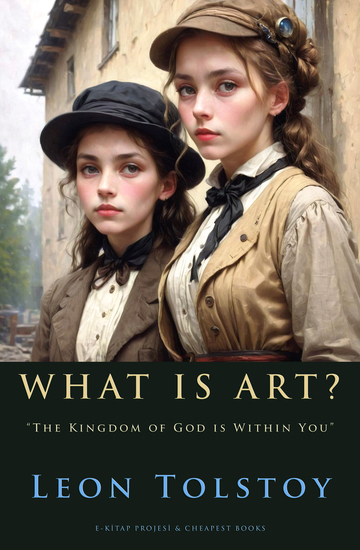
What is Art? - "The Kingdom of God is Within You" - cover

What is Art? - "The Kingdom of God is Within You"

Leon Tolstoy

Publisher: E-Kitap Projesi & Cheapest Books

  • 0
  • 0
  • 0

Summary

WHAT thoughtful man has not been perplexed by problems relating to art?

An estimable and charming Russian lady I knew, felt the charm of the music and ritual of the services of the Russo-Greek Church so strongly that she wished the peasants, in whom she was interested, to retain their blind faith, though she herself disbelieved the church doctrines.

"Their lives are so poor and bare-they have so little art, so little poetry and colour in their lives- Let them at least enjoy what they have; it would be cruel to undeceive them," said she. A false and antiquated view of life is supported by means of art, and is inseparably linked to some Manifestations of art which we enjoy and prize. If the false view of life be destroyed this art will cease to appear valuable.

Is it best to screen the error for the sake of preserving the art? Or should the art be sacrificed for the sake of truthfulness? Again and again in history a dominant church has utilised art to maintain its sway over men. Reformers (early Christians, Mohammedans, Puritans, and others) have perceived that art bound people to the old faith, and they were angry with art.

These works, in chronological order,are " My Confession ".
A Criticism of Dogmatic Theology,which has never been translated.
The Four Gospels Harmonised and Translated, of which only two parts, out of three, have as yet appeared in English. What I Believe, sometimes called My Religion.

The Gospelin Brief. What are we to do then? sometimes called in English

What to do? On Life, which is not an easy work in the original, and has not been satisfactorily translated. The Kingdom of God is within you; and The Christian Teaching, which appeared after What is Art? though it was written before it.

To these scientific works I am inclined to add The Kteutzer Sonata, with the Sequel or Postscript explaining its purpose; for though The Kreutzer Sonata is a story, the understanding of sexual problems, dealt with explicitly in the Sequel, is an integral part of that comprehension of life which causes Tolstoy to admire Christ, Buddha, or Francis of Assisi.
Available since: 02/10/2024.
Print length: 700 pages.

Other books that might interest you

  • Ancient Japan - Foundations of a Nation (3 in 1) - cover

    Ancient Japan - Foundations of a...

    Rolf Hedger

    • 0
    • 0
    • 0
    The early history of Japan was shaped by three key periods—the Kofun, Yamato, and Asuka—each playing a crucial role in laying the foundations of the Japanese nation.  
    The Kofun Period, named after the massive burial mounds built for elite rulers, saw the rise of warrior aristocracy and the early consolidation of power by influential clans. This era transitioned into the Yamato Period, during which the Yamato clan emerged as Japan’s first ruling dynasty, establishing the imperial lineage that continues to this day.  
    The Asuka Period marked a profound transformation as Buddhism, Confucian governance, and Chinese cultural influences began shaping Japan’s political and social structures.  
    The Taika Reforms introduced centralized administration, strengthening the authority of the emperor.  
    These three periods together set the stage for Japan’s evolving identity, blending indigenous traditions with foreign influences to create a distinct and enduring civilization.
    Show book
  • Audiology - The Science of Sound Hearing and Balance Disorders - cover

    Audiology - The Science of Sound...

    Mike Crawford

    • 0
    • 0
    • 0
    Audiology is the branch of science that focuses on the study of sound, hearing, and balance. It is a multifaceted field that encompasses the assessment, diagnosis, and treatment of various auditory and vestibular disorders. The role of audiologists is essential in identifying hearing impairments, providing interventions, and promoting overall ear health, which plays a vital part in communication and quality of life. 
    Sound, in its simplest form, is the vibration of molecules in the air that travel as waves to our ears. As one of the primary ways humans perceive the world around them, hearing is not only crucial for communication but also for safety, socialization, and enjoyment. Audiologists specialize in understanding these complex processes and the challenges that arise when they are impaired. Their work involves not only diagnosing hearing loss but also managing conditions related to balance and the inner ear, both of which are intricately linked. 
    The study of audiology dates back to the early 20th century, with significant advancements made throughout the decades in both technology and methodology. Today, audiology has grown into a highly specialized field that includes a range of services, from basic hearing tests to advanced procedures like cochlear implants and balance rehabilitation. Audiologists employ a variety of diagnostic tools, including audiometers, tympanometers, and specialized tests, to evaluate hearing and vestibular function. These assessments are critical in identifying the specific nature of auditory or balance problems, which can stem from a range of causes such as aging, genetics, illness, injury, or environmental factors.
    Show book
  • Motherland - A Journey through 500000 Years of African Culture and Identity - cover

    Motherland - A Journey through...

    Luke Pepera

    • 0
    • 0
    • 0
    A groundbreaking exploration of 500,000 years of African history, cultures, and identity. 


    Historian, archaeologist, and anthropologist Luke Pepera takes us on a personal journey discovering 500,000 years of African history and cultures in order to reclaim and reconnect with this extraordinary heritage. He tackles the question many people of African descent ask—Who are we? Where do we come from? What defines us? And it explores how knowledge of this deeper history might affect current understandings of African identity. 


    Through thematically-linked chapters that explore aspects of African identity from nomadic culture and matriarchal society to beliefs about the afterlife and the tradition of oral storytelling, and interwoven with Luke's own experiences of exploring his Ghanaian family history and his personal questions of identity, this is a comprehensive, relevant, and beautifully told new history of Africa, and how it has shaped the world we know today.
    Show book
  • What We Owe the Future: Book Summary & Analysis - cover

    What We Owe the Future: Book...

    Briefly Summaries

    • 0
    • 0
    • 0
    This is a concise summary and analysis of What We Owe the Future, by William MacAskill.
     
    It is not the original book and is not affiliated with or endorsed by William MacAskill.
     
    Ideal those seeking a quick and insightful overview.
     
    What We Owe the Future is a profound exploration of humanity's moral responsibility to future generations. This thought-provoking work delves into the long-term impact of our choices on the world, urging readers to consider the ethical implications of progress, technology, and the preservation of civilization. With a focus on the principles of longtermism, the book challenges us to act today to ensure a flourishing tomorrow, blending rigorous philosophy with compelling insights into practical action. It’s a call to reshape our priorities and redefine what it means to leave a meaningful legacy.
    Show book
  • The Case of Wagner and selected aphorisms - cover

    The Case of Wagner and selected...

    Friedrich Nietzsche

    • 0
    • 0
    • 0
    "The Case of Wagner and Selected Aphorisms" is a collection of essays and aphorisms by the German philosopher Friedrich Nietzsche. In this book, Nietzsche critiques the works and ideas of the composer Richard Wagner, with whom he had a complicated relationship. He delves into themes such as aesthetics, culture, morality, and the nature of art, offering sharp and often controversial insights.
    Show book
  • Four Thousand Weeks: Book Summary and Analysis - cover

    Four Thousand Weeks: Book...

    Briefly Summaries

    • 0
    • 0
    • 0
    This is a concise summary and analysis of Four Thousand Weeks, by Oliver Burkeman.
     
    It is not the original book and is not affiliated with or endorsed by Oliver Burkeman.
     
    Ideal those seeking a quick and insightful overview.


    "Four Thousand Weeks: Time Management for Mortals" is a transformative exploration of our relationship with time, urging readers to rethink traditional concepts of productivity and efficiency. Through insightful reflections and practical advice, the author delves into the paradoxes of time management, highlighting the limitations of our finite existence and encouraging a shift towards a more meaningful and intentional life. This book challenges the relentless pursuit of busyness and offers a compelling argument for embracing our mortality, simplifying our lives, and focusing on what truly matters.
    Show book