Join us on a literary world trip!
Add this book to bookshelf
Grey
Write a new comment Default profile 50px
Grey
Subscribe to read the full book or read the first pages for free!
All characters reduced
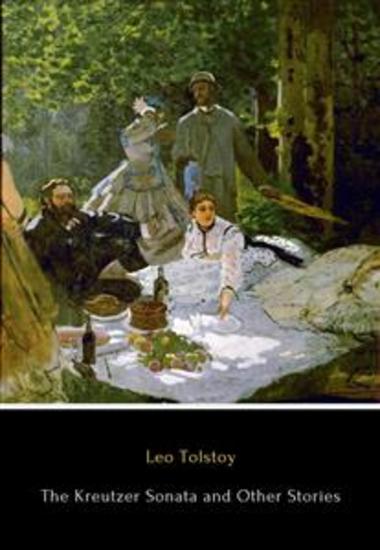
The Kreutzer Sonata and Other Stories - cover

The Kreutzer Sonata and Other Stories

Leo Tolstoy

Publisher: Carousel Books

  • 0
  • 0
  • 0

Summary

The Kreutzer Sonata and Other Stories is a collection of short stories by Leo Tolstoy, named after Beethoven's Kreutzer Sonata. The book was published in 1889 and was promptly censored by the Russian authorities. The work is an argument for the ideal of sexual abstinence and an in-depth first-person description of jealous rage.
Available since: 09/27/2022.

Other books that might interest you

  • The Ghost of The Pannell Witch - A Short Story Collection - cover

    The Ghost of The Pannell Witch -...

    Melissa Manners

    • 0
    • 0
    • 0
    A collection of spooky tales to invade the mind and explore the legend of the Ghost of The Pannell Witch. 
    Each story in this collection takes the reader on a deep dive into one of the many versions of the legend of Mary Pannell, who was executed for witchcraft in the small town of Kippax, West Yorkshire, in 1603. Her ghost is said to haunt the woods on the hill that to this day bear her name. 
    Was she the town’s wise woman, providing herbal remedies to its residents? Like many women executed for witchcraft in the 17th century, she may have been betrayed by her own friends and neighbours. But even in death, perhaps she continued to help those who needed it. 
    Perhaps she targeted by her local community because of her sexuality. What if her ghost takes it on herself to look out for the queer residents of Kippax? 
    Or is her story a darker one? Some say that whoever sees the ghost of Mary Pannell will soon have a death in the family. That Mary takes out her revenge on the young sons of Kippax. When one determined mother, who has lost everything, decides to fight back, can she manage to save the town? 
    Background music provided by Kevin MacLeod (incompetech.com) "SCP-x2x (Unseen Presence)", Licensed under Creative Commons: By Attribution 4.0 License, http://creativecommons.org/licenses/by/4.0/
    Show book
  • Watch With Me - and Six Other Stories of the Yet-Remembered Ptolemy Proudfoot and His Wife Miss Minnie Née Quinch - cover

    Watch With Me - and Six Other...

    Wendell Berry

    • 0
    • 0
    • 0
    This volume of six linked stories and the novella from which the book derives its title is set in Port William from 1908 to the Second World War. Here Wendell Berry introduces two of his more indelible and poignant characters, Ptolemy Proudfoot and his wife Miss Minnie, remarkable for the comic and affectionate range that—with the mastery of this consummate storyteller working at the height of his powers—here approaches the Shakespearean. 


    Tol Proudfoot is huge, outsized, in the tradition of the mythic. The three-hundred-pound farmer, personally imposing and unkempt, is also the most graceful of presences, reserved and gallant toward his tiny wife, the ninety-pound schoolteacher. 


    Their contrasts are humorous, of course, and recall the tall tales of rural Americana. In the novella Watch with Me, we are given a story of such depth, breadth, and importance it earns being listed as one of the most important short stories written in the American language during the twentieth century.
    Show book
  • Beast - cover

    Beast

    Judith Ivory

    • 0
    • 0
    • 0
    An exquisite American heiress, Louise Vandermeer is beautiful, brilliant. . . and bored-which is why she has agreed to a daring adventure: to travel across the ocean to marry an aristocrat abroad. Rumor has it her intended is a hideous cad-a grim prospect that propels her into a passionate, reckless affair with a compelling stranger she never sees in the light of day.Though scarred by a childhood illness, Charles d'Harcourt has successfully wooed Europe's most sophisticated beauties. For a lark, he contrived to travel incognito on his own fiancee's ship-and seduce the young chit in utter darkness. But the rake's prank backfired. It was he who was smitten-while the hot-tempered Lulu, now his wife, loves only her shipboard lover, unaware it was d'Harcourt all the time! And Charles will never have her heart-unless he can open her eyes to the prince who hides within.
    Show book
  • Top 10 Short Stories The - The Ukrainians - The top ten short stories written by - cover

    Top 10 Short Stories The - The...

    Nikolai Gogol

    • 0
    • 0
    • 0
    Short stories have always been a sort of instant access into an author’s brain, their soul and heart.  A few pages can lift our lives into locations, people and experiences with a sweep of landscape, narration, feelings and emotions that is difficult to achieve elsewhere. 
     
    In this series we try to offer up tried and trusted ‘Top Tens’ across many different themes and authors. But any anthology will immediately throw up the questions – Why that story? Why that author?  
     
    The theme itself will form the boundaries for our stories which range from well-known classics, newly told, to stories that modern times have overlooked but perfectly exemplify the theme.  Throughout the volume our authors whether of instant recognition or new to you are all leviathans of literature. 
     
    Some you may disagree with but they will get you thinking; about our choices and about those you would have made.  If this volume takes you on a path to discover more of these miniature masterpieces then we have all gained something. 
     
    Between the Russian Empire and Europe warily sits Ukraine.  Her own history has been brush stroked either by periods of independence or under the oppressive yoke of other more powerful and belligerent neighbours. 
     
    It’s authors, almost always cited as ‘Russian’, or from ‘Little Russia’ are diverse and brilliant.  Some of them stayed, some moved to other lands but always their works harbour part of their Ukrainian souls despite the ever-changing territorial borders. 
     
    01 - The Top 10 - The Ukrainians - An Introduction 
    2 - The Nose by Nikolai Gogol 
    3 - The Shades, A Phantasy by Vladimir Korolenko 
    4 - Morphine by Mikhail Bulgakov 
    5 - A Witches Den by Helena Blavatsky 
    6 - The Informer by Joseph Conrad 
    7 - The Signal by Vsevolod Garshin 
    8 - The General's Will by Vera Jelihovsky 
    9 - The Blind Ones by Isaac Babel 
    10 - The Revolutionist by Mikhail Petrovich Artzybashev 
    11 - Dethroned by Ignaty Potapenko
    Show book
  • Cain - From their pens to your ears genius in every story - cover

    Cain - From their pens to your...

    Alexander Kuprin

    • 0
    • 0
    • 0
    Alexander Kuprin was born in Narovchat, Penza in Russia on 7th September 1870. 
    At 3 his Father died and he and mother moved to Moscow. By 10 he was enrolled at the Second Moscow Military High School and there his interest in literature began. The Alexander Military Academy followed and two years later he was a sub-lieutenant and posted to an Infantry Regiment for a further four years. 
    Despite his duties he was a now a keen writer and published his first short story at this time. His military duties also garnered him experiences for his breakthrough work ‘The Duel’.  Leaving the military he left for Kiev to work for local newspapers.  He continued to publish both stories and novels and by 1901 he was in St Petersburg becoming part of a group that included Chekhov, Ivan Bunin, Maxim Gorky and Leonid Andreyev.  
    In the years that followed further controversial works and acclaim followed.  His comments on the regime meant he was also put under secret police surveillance.   
    As World War I erupted, Kuprin opened a military hospital but was then given command of an infantry company in Finland. He was soon discharged on grounds of ill health.  
    The October Revolution saw him praise Lenin, but he warned that the Bolsheviks threatened Russian culture and might cause further widespread suffering to the peasants.  As Civil War raged he took his family to Helsinki and then on to Paris. 
    Exile saw his talents decline further and his succumbing to alcoholism. He became lonely and withdrawn. The family's poverty increased his malaise.   
    In May 1937, the Kuprin’s returned to Moscow.  He now saw his work published but wrote almost nothing new.  In 1938 his health rapidly deteriorated.  Already suffering from a kidney problems and sclerosis, he had now developed cancer of the oesophagus.  
    Alexander Kuprin died on 25th August 1938.
    Show book
  • The Sycophant - cover

    The Sycophant

    Jacki Barr

    • 0
    • 0
    • 0
    When the ties of friendship bind too tightly, what do you do?
    Show book