Join us on a literary world trip!
Add this book to bookshelf
Grey
Write a new comment Default profile 50px
Grey
Subscribe to read the full book or read the first pages for free!
All characters reduced
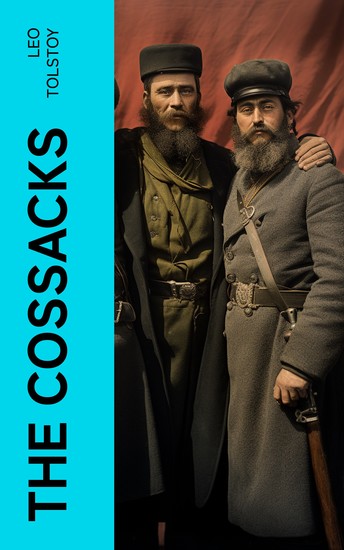
The Cossacks - cover

The Cossacks

Leo Tolstoy

Translator Aylmer Maude, Louise Maude

Publisher: e-artnow

  • 0
  • 0
  • 0

Summary

"The Cossacks" tells the story of a disillusioned Russian gentleman, Dmitri Olenin, who tries to find fulfillment among the Cossack people of the Caucasus. When Olenin begins to yield to the Cossack way of life, he realizes many things, the most significant being his sense of self. This work is partially autobiographical, based on Tolstoy's experiences in the Caucasus during the last stages of the Caucasian War.
Available since: 12/08/2023.
Print length: 149 pages.

Other books that might interest you

  • African American history - Narrative of the Life of Frederick Douglass Incidents In The Life Of A Slave Girl by Harriet Jacobs Up From Slavery by Booker T Washington - cover

    African American history -...

    Frederick Douglass, Harriet Ann...

    • 0
    • 0
    • 0
    African American history is the part of American history that looks at the history of African Americans or Black Americans.
    Of the 10.7 million Africans who were brought to the Americas until the 1860s, 450 thousand were shipped to what is now the United States.
    Most African Americans are descended from Africans who were brought directly from Africa to America and became slaves. The future slaves were originally captured in African wars or raids and transported in the Atlantic slave trade.
    Our collection includes the following of works: 
    Narrative Of The Life by Frederick Douglass. The impassioned abolitionist and eloquent orator provides graphic descriptions of his childhood and horrifying experiences as a slave as well as a harrowing record of his dramatic escape to the North and eventual freedom. 
    Incidents In The Life Of A Slave Girl by Harriet Jacobs. Powerful by portrayal of the brutality of slave life through the inspiring tale of one woman's dauntless spirit and faith. 
    Up From Slavery by Booker T. Washington. Washington rose to become the most influential spokesman for African Americans of his day. He describes events in a remarkable life that began in slavery and culminated in worldwide recognition.
    Show book
  • A Proper Marriage - A Novella - cover

    A Proper Marriage - A Novella

    Dorothy Love

    • 0
    • 0
    • 0
    From a hasty union begun in shame, a young man and woman struggle to build a lasting love. 
    Following a brief romance with George Mackenzie, Blue Gap, North Carolina’s most desirable suitor, Olivia Brooks finds herself abandoned and expecting a child. She is cast out of her father’s house and hastily weds George’s brother Luke, whom she has known since childhood. Luke hopes that giving his brother’s child a name will prove his own worth and provide a home for the woman he has long admired. 
    Determined to make a fresh start, they set off for Laurel Grove, Tennessee, but an accident on an icy mountain road forces them to take refuge with a Quaker family in Sweetbriar Creek. As Olivia and Luke recover from their injuries and await the birth of the child, they must confront their past mistakes and make peace with old hurts and betrayals if they are ever to forge a proper marriage.
    Show book
  • Lessons in Chemistry: Book Summary and Analysis - cover

    Lessons in Chemistry: Book...

    Briefly Summaries

    • 0
    • 0
    • 0
    This is a concise summary and analysis of Lessons in Chemistry, by Bonnie Garmus. It is not the original book and is not affiliated with or endorsed by Bonnie Garmus. Ideal for those seeking a quick and insightful overview.
     
    Lessons in Chemistry is a witty and heartwarming novel set in the 1960s, centered around Elizabeth Zott, a brilliant chemist whose career is derailed in a male-dominated field. Against the odds, Elizabeth becomes an unlikely television cooking show star, where she subtly teaches chemistry to housewives across America. Blending humor, feminism, and science, Lessons in Chemistry is a story of resilience, breaking societal expectations, and the power of knowledge. Garmus creates an inspiring protagonist who challenges norms and reshapes her own destiny in unexpected ways.
    Show book
  • Blood on the Crossties - The Florida Chautauqua Murders - cover

    Blood on the Crossties - The...

    James D. Brewer

    • 0
    • 0
    • 0
    Railroad detective Choctaw Parker works to solve all manner of murder-most-foul in Florida. 


    In early February of 1885, the robbery of the Pensacola and Atlantic train could not have come at a worse time for Florida panhandle railroad magnate William Chipley. He had put time, money, and both his personal and business reputation on the line to host the first Gulf Chautauqua in DeFuniak Springs. Now, with the murder of two guards, and the theft of both a payroll and a shipment of new US Army rifles, the success of the Chautauqua was at risk. Chipley hires the half-White/half-Indian L&N railroad detective Jimmy Lee "Choctaw" Parker to investigate the crime, find the culprits, and restore confidence to those who would travel from all over the eastern US to attend the first month-long Florida Chautauqua. But Parker is not the only one investigating the robbery of the P&A, for he finds out very soon that he must work with—or in spite of—a pair of Pinkertons hired by the insurance company to recover the money, as well as an aggressive, vengeful, US Army Captain determined to recover the weapons and get justice for the two murdered soldiers. Parker, along with a long-time associate and a resourceful lady gambler, must navigate a web of politics, racial tension, Civil War grudges, and greed to bring to justice the culprits in this Victorian-era historical mystery.
    Show book
  • The Game Of Logic - cover

    The Game Of Logic

    Lewis Carroll

    • 0
    • 0
    • 0
    The Game of Logic is a book written by Lewis Carroll, published in 1886. In addition to his well-known children's literature, Carroll was an academic mathematician who worked in mathematical logic. The book describes, in an informal and playful style, the use of a board game to represent logical propositions and inferences. Carroll incorporated the game into a longer and more formal introductory logic textbook titled Symbolic Logic, published in 1897. The books are sometimes reprinted in a single volume.
    Show book
  • The Devil Light - Former soldier and journalist that became a revered author and screenwriter - cover

    The Devil Light - Former soldier...

    Edgar Wallace

    • 0
    • 0
    • 0
    Richard Horatio Edgar Wallace was born on the 1st April 1875 in Greenwich, London.  Leaving school at 12 because of truancy, by the age of fifteen he had experience; selling newspapers, as a worker in a rubber factory, as a shoe shop assistant, as a milk delivery boy and as a ship’s cook.  
     
    By 1894 he was engaged but broke it off to join the Infantry being posted to South Africa. He also changed his name to Edgar Wallace which he took from Lew Wallace, the author of Ben-Hur.  
     
    In Cape Town in 1898 he met Rudyard Kipling and was inspired to begin writing. His first collection of ballads, The Mission that Failed! was enough of a success that in 1899 he paid his way out of the armed forces in order to turn to writing full time.  
     
    By 1904 he had completed his first thriller, The Four Just Men. Since nobody would publish it he resorted to setting up his own publishing company which he called Tallis Press. 
      
    In 1911 his Congolese stories were published in a collection called Sanders of the River, which became a bestseller. He also started his own racing papers, Bibury’s and R. E. Walton’s Weekly, eventually buying his own racehorses and losing thousands gambling.  A life of exceptionally high income was also mirrored with exceptionally large spending and debts.  
     
    Wallace now began to take his career as a fiction writer more seriously, signing with Hodder and Stoughton in 1921. He was marketed as the ‘King of Thrillers’ and they gave him the trademark image of a trilby, a cigarette holder and a yellow Rolls Royce. He was truly prolific, capable not only of producing a 70,000 word novel in three days but of doing three novels in a row in such a manner. It was estimated that by 1928 one in four books being read was written by Wallace, for alongside his famous thrillers he wrote variously in other genres, including science fiction, non-fiction accounts of WWI which amounted to ten volumes and screen plays. Eventually he would reach the remarkable total of 170 novels, 18 stage plays and 957 short stories. 
     
    Wallace became chairman of the Press Club which to this day holds an annual Edgar Wallace Award, rewarding ‘excellence in writing’.  
     
    Diagnosed with diabetes his health deteriorated and he soon entered a coma and died of his condition and double pneumonia on the 7th of February 1932 in North Maple Drive, Beverly Hills. He was buried near his home in England at Chalklands, Bourne End, in Buckinghamshire.
    Show book