Join us on a literary world trip!
Add this book to bookshelf
Grey
Write a new comment Default profile 50px
Grey
Subscribe to read the full book or read the first pages for free!
All characters reduced
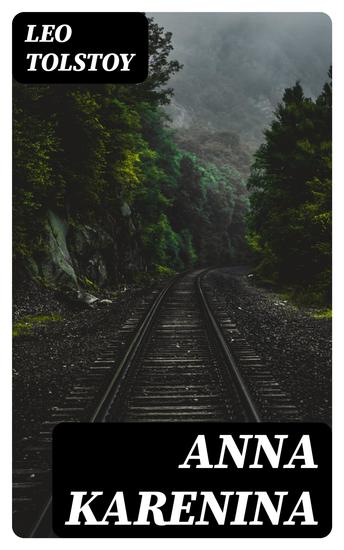
Anna Karenina - cover

Anna Karenina

Leo Tolstoy

Translator Aylmer Maude, Constance Garnett, Louise Maude

Publisher: DigiCat

  • 0
  • 0
  • 0

Summary

In 'Anna Karenina,' Leo Tolstoy crafts a profound narrative that intertwines the lives of several characters against the backdrop of 19th-century Russian society. The novel masterfully explores themes of love, infidelity, and the search for happiness, employing a rich, realistic style that delves into the complexities of human emotion. Tolstoy's use of vivid imagery, psychological depth, and social commentary reflects the moral dilemmas of his time, presenting a candid examination of the constraints imposed by societal norms and the quest for individual truth. Leo Tolstoy, a prominent figure in literature and philosophy, faced personal turmoil in his own life, which deeply influenced his writing. Born into a noble family, Tolstoy grappled with existential questions that ultimately led him to embrace moral and spiritual inquiries. His experiences in both the aristocracy and peasant life lent authenticity to his portrayals of social classes, enriching the narrative of 'Anna Karenina' with authenticity and depth. This timeless classic is highly recommended for readers who seek a profound exploration of love and societal conflict. Tolstoy's nuanced characters and intricate plotlines render 'Anna Karenina' not just a novel, but a significant exploration of the human condition, inviting readers to reflect on the nature of relationships and the struggle for genuine fulfillment.
Available since: 11/13/2022.
Print length: 900 pages.

Other books that might interest you

  • The Warlord of Mars - cover

    The Warlord of Mars

    Edgar Rice Burroughs

    • 0
    • 0
    • 0
    John Carter returns in this, his most thrilling adventure yet!  
    Continuing where The Gods of Mars left off, we see John Carter, desperately seeking to rescue his lost wife; Dejah Thoris, Princess of Helium. To this end, he pursues his two adversaries: Matai Shang, father of Therns, and Thurid the Black Dator, across the entire length of a world.  
    From the under the Mountains of Otz in the South Pole, all the way to the frozen North, where, walled in by the Ice Barrier, the cruel and mysterious Yellow Men of Mars hold sway, ruled over by the Tyrannical Jeddak of Jeddaks: Solensus Oll!  
    Join John Carter once more, as he explores the jungle cities of Kaol, the mysterious and booby trapped Tower of the Sun and foul Carrion Caves!  
    The third book in Edgar Rice Burroughs Barsoom series, The Warlord of Mars largely brings to a close the story of John Carter, afterwards concentrating mostly on other characters, such as Thuvia of Ptarth and John Carters son: Carthoris.  
    Narrated by Michael Ward.
    Show book
  • The Death Room - Former soldier and journalist that became a revered author and screenwriter - cover

    The Death Room - Former soldier...

    Edgar Wallace

    • 0
    • 0
    • 0
    Richard Horatio Edgar Wallace was born on the 1st April 1875 in Greenwich, London.  Leaving school at 12 because of truancy, by the age of fifteen he had experience; selling newspapers, as a worker in a rubber factory, as a shoe shop assistant, as a milk delivery boy and as a ship’s cook.  
     
    By 1894 he was engaged but broke it off to join the Infantry being posted to South Africa. He also changed his name to Edgar Wallace which he took from Lew Wallace, the author of Ben-Hur.  
     
    In Cape Town in 1898 he met Rudyard Kipling and was inspired to begin writing. His first collection of ballads, The Mission that Failed! was enough of a success that in 1899 he paid his way out of the armed forces in order to turn to writing full time.  
     
    By 1904 he had completed his first thriller, The Four Just Men. Since nobody would publish it he resorted to setting up his own publishing company which he called Tallis Press. 
      
    In 1911 his Congolese stories were published in a collection called Sanders of the River, which became a bestseller. He also started his own racing papers, Bibury’s and R. E. Walton’s Weekly, eventually buying his own racehorses and losing thousands gambling.  A life of exceptionally high income was also mirrored with exceptionally large spending and debts.  
     
    Wallace now began to take his career as a fiction writer more seriously, signing with Hodder and Stoughton in 1921. He was marketed as the ‘King of Thrillers’ and they gave him the trademark image of a trilby, a cigarette holder and a yellow Rolls Royce. He was truly prolific, capable not only of producing a 70,000 word novel in three days but of doing three novels in a row in such a manner. It was estimated that by 1928 one in four books being read was written by Wallace, for alongside his famous thrillers he wrote variously in other genres, including science fiction, non-fiction accounts of WWI which amounted to ten volumes and screen plays. Eventually he would reach the remarkable total of 170 novels, 18 stage plays and 957 short stories. 
     
    Wallace became chairman of the Press Club which to this day holds an annual Edgar Wallace Award, rewarding ‘excellence in writing’.  
     
    Diagnosed with diabetes his health deteriorated and he soon entered a coma and died of his condition and double pneumonia on the 7th of February 1932 in North Maple Drive, Beverly Hills. He was buried near his home in England at Chalklands, Bourne End, in Buckinghamshire.
    Show book
  • Stories - cover

    Stories

    Anton Chekhov

    • 0
    • 0
    • 0
    Anton Pavlovich Chekhov (1860–1904) was a Russian playwright and short-story writer, who is considered to be among the greatest writers of short fiction in history. His career as a playwright produced four classics, and his best short stories are held in high esteem by writers and critics. Along with Henrik Ibsen and August Strindberg, Chekhov is often referred to as one of the three seminal figures in the birth of early modernism in the theatre.Chekhov practiced as a medical doctor throughout most of his literary career: "Medicine is my lawful wife", he once said, "and literature is my mistress."
    The following works were included in the collection of stories Chekhov Anton:  The Lady with the Dog, The Wife, A Slander, The Horse-Stealers, The Petchenyeg, A Dead Body, A Happy Ending, The Looking-Glass, Old Age, Darkness, The Beggar, In Trouble, Frost, Minds in Ferment, Gone Astray, An Avenger, The Jeune Premier, A Defenceless Creature, An Enigmatic Nature, A Happy Man, A Troublesome Visitor, An Actor's End.
    Show book
  • The Blue Castle - cover

    The Blue Castle

    L. M. Montgomery

    • 0
    • 0
    • 0
    The Blue Castle is a 1926 novel by Canadian author Lucy Maud Montgomery, best known for her novel Anne of Green Gables (1908).
    The story is set during the early 1900s in the fictional town of Deerwood, located in the Muskoka region of Ontario, Canada. Deerwood is based on Bala, Ontario, which Montgomery visited in 1922. Maps of the two towns show similarities.
    This novel is considered one of L.M. Montgomery's few adult works of fiction, along with A Tangled Web, and is the only book she wrote that is entirely set outside of Prince Edward Island. It has grown in popularity since being republished in 1990. The book was adapted for the stage twice; in 1982 it was made into a successful Polish musical, and ten years later Canadian playwright Hank Stinson authored another version, The Blue Castle: A Musical Love Story.
    alancy is, at twenty-nine, the old maid of the Stirling clan, which is a reputable family that has lived in the same region for over fifty years. As an only child, her entire life has been spent with her nagging mother, her perpetually down-trodden aunt, and a gossipy extended family, who, in spirit of the Victorian and middle class, actively discourage happiness and treat Valancy like a child, telling her what to do every day and constantly comparing her with her beautiful cousin, Olive, putting her down, and calling her by the baby name "Doss." Her only respites come from daydreaming of her "Blue Castle" and the handsome men who would reside in it with her, along with reading the nature books of John Foster.
    Show book
  • Mr Reginald Peacock's Day - cover

    Mr Reginald Peacock's Day

    Katherine Mansfield

    • 0
    • 0
    • 0
    "Mr Reginald Peacock's Day" is a 1920 short story by Katherine Mansfield. It was first published in the New Age on 14 June 1917, and later reprinted in Bliss and Other Stories.
    Reginald is woken up by his wife for breakfast. He is irritated by his wife who is very polite with him. He has a bath, sings for a bit and fathoms he could be an opera singer.
    Show book
  • The Raven - A Robin Reads Audiobook - cover

    The Raven - A Robin Reads Audiobook

    Edgar Allan Poe

    • 0
    • 0
    • 0
    Edgar Allan Poe's peerless narrative poem about a forlorn lover who is visited by a mysterious raven. 
    First published in 1845. Narrated by Robin Reads.
    Show book