Join us on a literary world trip!
Add this book to bookshelf
Grey
Write a new comment Default profile 50px
Grey
Subscribe to read the full book or read the first pages for free!
All characters reduced
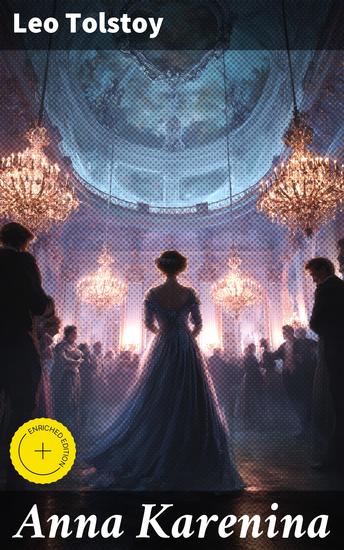
Anna Karenina - Enriched edition Love Tragedy and Societal Norms in 19th-Century Russia - cover

Anna Karenina - Enriched edition Love Tragedy and Societal Norms in 19th-Century Russia

Leo Tolstoy

Translator Aylmer Maude, Constance Garnett, Louise Maude

Publisher: Good Press

  • 0
  • 0
  • 0

Summary

Leo Tolstoy's "Anna Karenina" is a masterful exploration of love, infidelity, and the complexities of social norms in 19th-century Russia. Through the intersecting lives of its characters'—most notably the tragic affairs of Anna and Count Vronsky'—the narrative deftly weaves psychological realism with rich philosophical undertones. Tolstoy's stylistic brilliance is evident in his meticulous character development and vivid depictions of the Russian aristocracy, offering an incisive critique of societal expectations and moral dilemmas. The novel's dual plots, paralleling the turbulent romance with the steady, grounding story of Levin, illuminate the contrasting experiences of passion and duty amid a swiftly changing society. Tolstoy, rooted in his own experiences with love and the constraints of societal pressures, addresses profound questions of morality, fidelity, and the individual's place in society. His writings reflect his revolutionary thoughts on spirituality and the human condition, shaped by both personal trials and the philosophical movements of his time. Tolstoy's deep engagement with the human psyche and critical examination of societal hypocrisy mark this work as a cornerstone of realist literature. "Anna Karenina" is highly recommended for readers seeking a profound narrative that balances emotional intensity with philosophical inquiry. It invites introspection on the nature of love and the societal constructs that bind us, making it an essential read for anyone interested in the intricacies of human relationships and the moral quandaries that define them.

In this enriched edition, we have carefully created added value for your reading experience:
- A succinct Introduction situates the work's timeless appeal and themes.
- The Synopsis outlines the central plot, highlighting key developments without spoiling critical twists.
- A detailed Historical Context immerses you in the era's events and influences that shaped the writing.
- An Author Biography reveals milestones in the author's life, illuminating the personal insights behind the text.
- A thorough Analysis dissects symbols, motifs, and character arcs to unearth underlying meanings.
- Reflection questions prompt you to engage personally with the work's messages, connecting them to modern life.
- Hand‐picked Memorable Quotes shine a spotlight on moments of literary brilliance.
- Interactive footnotes clarify unusual references, historical allusions, and archaic phrases for an effortless, more informed read.
Available since: 12/28/2023.
Print length: 900 pages.
Other books that might interest you

  • Anton Chekhov - Six of the Best - Their legacy in 6 classic stories - cover

    Anton Chekhov - Six of the Best...

    Anton Chekhov

    • 0
    • 0
    • 0
    Six has always been a number we group things around – Six of the best, six of one half a dozen of another, six feet under, six pack, six degrees of separation and a sixth sense are but a few of the ways we use this number. 
     
    Such is its popularity that we thought it is also a very good way of challenging and investigating an author’s work to give width, brevity, humour and depth across six of their very best. 
     
    In this series we gather together authors whose short stories both rivet the attention and inspire the imagination to visit their gems in a series of six, to roam across an author’s legacy in a few short hours and gain a greater understanding of their writing and, of course, to be lavishly entertained by their ideas, their narrative and their way with words. 
     
    These stories can be surprising and sometimes at a tangent to what we expected, but each is fully formed and a marvellous adventure into the world and words of a literary master. 
     
     1 - Six of the Best - Anton Chekov - An Introduction 
    2 - Anton Chekhov - An Introduction 
    3 - The Lady with the Dog by Anton Chekhov 
    4 - The Kiss by Anton Chekhov 
    5 - Gooseberries by Anton Chekhov 
    6 - Misery by Anton Chekhov 
    7 - The Student by Anton Chekhov 
    8 - Volodya by Anton Chekhov
    Show book
  • Candide - cover

    Candide

    Voltaire

    • 0
    • 0
    • 0
    Candide, ou l'Optimisme is a French satire first published in 1759 by Voltaire, a philosopher of the Age of Enlightenment. The novella has been widely translated, with English versions titled Candide: or, All for the Best (1759); Candide: or, The Optimist (1762); and Candide: Optimism (1947). It begins with a young man, Candide, who is living a sheltered life in an Edenic paradise and being indoctrinated with Leibnizian optimism by his mentor, Professor Pangloss. The work describes the abrupt cessation of this lifestyle, followed by Candide's slow and painful disillusionment as he witnesses and experiences great hardships in the world. Voltaire concludes Candide with, if not rejecting Leibnizian optimism outright, advocating a deeply practical precept, "we must cultivate our garden", in lieu of the Leibnizian mantra of Pangloss, "all is for the best" in the "best of all possible worlds".
    Candide is characterized by its tone as well as by its erratic, fantastical, and fast-moving plot. A picaresque novel with a story similar to that of a more serious coming-of-age narrative (Bildungsroman), it parodies many adventure and romance clichés, the struggles of which are caricatured in a tone that is bitter and matter-of-fact. Still, the events discussed are often based on historical happenings, such as the Seven Years' War and the 1755 Lisbon earthquake. As philosophers of Voltaire's day contended with the problem of evil, so does Candide in this short theological novel, albeit more directly and humorously. Voltaire ridicules religion, theologians, governments, armies, philosophies, and philosophers. Through Candide, he assaults Leibniz and his optimism.
    Candide has enjoyed both great success and great scandal. Immediately after its secretive publication, the book was widely banned to the public because it contained religious blasphemy, political sedition, and intellectual hostility hidden under a thin veil of naïveté. However, with its sharp wit and insightful portrayal of the human condition, the novel has since inspired many later authors and artists to mimic and adapt it. Today, Candide is considered as Voltaire's magnum opus and is often listed as part of the Western canon. It is among the most frequently taught works of French literature. The British poet and literary critic Martin Seymour-Smith listed Candide as one of the 100 most influential books ever written.
    Show book
  • The Merchant of Venice - cover

    The Merchant of Venice

    William Shakespeare

    • 0
    • 0
    • 0
    Step into the rich, dynamic world of Shakespeare's The Merchant of
    Venice like never before with this immersive digital audiobook. Whether
    you're a longtime fan or new to the Bard's work, this masterful production brings every character and plot twist to life with powerful narration and vibrant performances. Experience the wit, drama, and heart of this timeless classic anywhere you go—perfect for commutes, workouts, or quiet evenings.
     
    Discover the unforgettable story of justice, mercy, and revenge through
    Shylock’s iconic speeches, Portia’s brilliance, and the complex relationships that make The Merchant of Venice one of Shakespeare’s most enduring plays. The audiobook format allows you to enjoy every layer of meaning and nuance with the ease and convenience of digital access.
    Show book
  • Black Voices on Britain - cover

    Black Voices on Britain

    Hakim Adi

    • 0
    • 0
    • 0
    A compelling anthology of Black voices from England, America, Africa and the Caribbean, from people who lived, worked, campaigned and travelled in Britain from the eighteenth to the early twentieth century. Part of the Macmillan Collector’s Library.Professor Hakim Adi, shortlisted for the Wolfson history prize, draws on a variety of published works in Black Voices on Britain, all of which describe powerful experiences: James Gronniosaw and his family endure poverty, illness and unemployment; Mary Prince is driven out by her cruel owners and turns to London charities for help; Frederick Douglass, on a lecture tour around Britain, reveals how the Christian clergy built churches with slave-owners’ money; and William Wells Brown gives his impressions of England as he travels around a country which welcomes him more readily than America. These and other voices offer a fascinating and thought-provoking portrayal of Black experiences in Britain.
    Show book
  • Strange High House in the Mist The (Unabridged) - cover

    Strange High House in the Mist...

    H. P. Lovecraft

    • 0
    • 0
    • 0
    Thomas Olney, a "philosopher" visiting the town of Kingsport, Massachusetts with his family, is intrigued by a strange house on a cliff overlooking the ocean. It is unaccountably high and old and the locals have a generations-long dread of the place which no one is known to have visited. With great difficulty, Olney climbs the crag, approaches the house, and meets the mysterious man who lives there. The only door opens directly onto a sheer cliff, giving access only to mist and "the abyss". The transmittal of archaic lore and a life-altering encounter with the supernatural ensue, as Olney is not the only visitor that day. He returns to Kingsport the next day, but seems to have left his spirit behind in the strange, remote dwelling.
    Show book
  • Landing on the Island (Unabridged) - cover

    Landing on the Island (Unabridged)

    Jean Rudolf Wyss

    • 0
    • 0
    • 0
    LANDING ON THE ISLAND: For many days we had been tempest-tossed. Six times had the darkness closed over a wild and terrific scene, and returning light as often brought but renewed distress, for the raging storm increased in fury until on the seventh day all hope was lost. We were driven completely out of our course; no conjecture could be formed as to our whereabouts.
    Show book