Join us on a literary world trip!
Add this book to bookshelf
Grey
Write a new comment Default profile 50px
Grey
Subscribe to read the full book or read the first pages for free!
All characters reduced
Albert - cover

Albert

Leo Tolstoy

Translator Aylmer Maude, Louise Maude

Publisher: DigiCat

  • 0
  • 0
  • 0

Summary

In "Albert," Leo Tolstoy masterfully explores themes of morality, existentialism, and the human condition through the lens of a fictional yet deeply relatable protagonist. The narrative is a poignant illustration of Tolstoy's trademark style, characterized by its psychological depth and philosophical inquiry, set against a backdrop that reflects the complexities of late 19th-century Russian society. The story serves as a microcosm of moral dilemmas that resonate with the reader, often challenging societal norms and expectations, thereby inviting critical reflection on personal values and ethical choices. Tolstoy, a luminary of world literature, infuses "Albert" with his own tumultuous experiences and profound introspections regarding faith, love, and the search for purpose. Having transitioned from a life of privilege to a pursuit of spiritual enlightenment, his existential journey profoundly shapes the narrative. The underlying principles drawn from his encounters with diverse cultures and philosophies lend the story a universal relevance that transcends time and place, showcasing his evolution as a thinker and writer. "Albert" is not merely a novel; it is an invitation to engage in a philosophical dialogue on what it means to live a life of meaning and authenticity. I highly recommend this text to any reader seeking an enriching experience that stimulates critical thought and encourages a deeper understanding of self within the framework of society.
Available since: 09/15/2022.
Print length: 25 pages.
Other books that might interest you

  • The White Heron - Adapted and Narrated by Querida Funck - cover

    The White Heron - Adapted and...

    Sarah Orne Jewett, Querida FUnck

    • 0
    • 0
    • 0
    The White Heron 
     Adapted from Sarah Orne Jewett | Abridged & Narrated by Querida Funck 
    In this lyrical retelling of Sarah Orne Jewett’s 1886 classic, a young girl living in rural Maine must choose between loyalty to the natural world and the approval of those around her. 
    This True Voice Shorts edition blends Jewett’s original text with thoughtful abridgment and new reflections, illuminating themes of solitude, wonder, and moral courage through a modern lens. 
    Querida Funck’s intimate narration brings added depth and resonance, honoring the heart of the original while enhancing its emotional clarity for contemporary listeners. A brief, moving story that speaks to the still, strong voices within us all.
    Show book
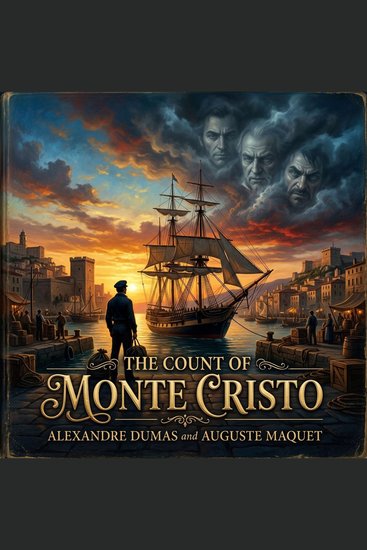
  • The Count of Monte Cristo - A sweeping Historical Adventure of ultimate betrayal unimaginable wealth and the cold pursuit of revenge that changed classic literature forever - cover

    The Count of Monte Cristo - A...

    Alexandre Dumas

    • 0
    • 0
    • 0
    Betrayal stole his life. Unimaginable wealth will buy his revenge. 
    On the eve of his wedding and a triumphant promotion to ship's captain, young and earnest sailor Edmond Dantès is framed for treason by three jealous men. Stripped of his freedom, his true love Mercédès, and his promising future, Edmond is condemned to rot in solitary confinement within the walls of the notorious island prison, the Château d'If. But in the pitch-black depths of despair, a chance encounter with a brilliant fellow captive unlocks the secret location of a staggering, mythical fortune. 
    What eventually emerges from the dungeon years later is no longer an innocent boy, but the enigmatic, infinitely wealthy, and deeply calculating Count of Monte Cristo. Methodical and merciless, he infiltrates the opulent high society of Paris to systematically destroy the lives of those who ruined his own. As the ultimate trap is set, the lines between justice and vengeance blur, threatening to consume both the guilty and the innocent. 
    Why you will love this: The Count of Monte Cristo remains the undisputed king of the Historical Adventure genre, brilliantly blending breathless swashbuckling action with an intricate, slow-burn psychological thriller. Fans of epic revenge tropes, high-stakes political intrigue, thrilling prison breaks, and classic historical fiction will be utterly captivated by this iconic, edge-of-your-seat saga of justice, patience, and redemption. 
    About the Authors: Alexandre Dumas and his collaborator Auguste Maquet forged a dynamic literary partnership in 19th-century France. Together, they mastered the art of serialized romantic fiction, weaving rich historical events into pulse-pounding, globally enduring legends.
    Show book
  • Chelkash by Maxim Gorky - A small time thief is caught up in a larger scheme testing his willpower and showing the dangers of greed - cover

    Chelkash by Maxim Gorky - A...

    Maxim Gorky

    • 0
    • 0
    • 0
    Alexei Maximovich Peshkov was born on 28th March 1868, in Nizhny Novgorod, Russia. 
     
    Better known as Maxim Gorky he was orphaned at 11 and ran away from home at 12.  At 19 he had already attempted suicide and thereafter travelled, by foot, across the Russian Empire for 5 years. 
     
    His first book ‘Essays & Stories’ in 1898 was a sensation and so began a long career as an author of short stories, novels and plays.  Gorky saw writing as a moral and political act that would help to change the unjust world around him.  He was an ardent early advocate of the emerging Marxist movement and publicly opposed the Tsarist regime leading several times to his arrest.  
     
    In 1904 he began his own theatre but the censor banned every play and Gorky was forced to abandon the project. 
     
    But Gorky was a financially successful author, editor, and playwright and gave monies to political parties as well as for civil rights and social reform.  The brutal shooting of workers, which set in motion the Revolution of 1905, pushed Gorky more decisively toward radical solutions.  
     
    In 1906 he went to the United States to raise funds for the Bolsheviks. Those experiences including a scandal over travelling with his lover and not his wife deepened his contempt for the ‘bourgeois soul.’ 
     
    Gorky now moved to Capri in Italy, both for health reasons and to escape the increasingly repressive times in Russia.  
     
    An amnesty for the 300th anniversary of the Romanov dynasty saw him return to Russia in 1914. His politics remained close to the Bolshevik cause.  But soon, after the 1918 revolution, his essays referred to Lenin as a tyrant for his senseless arrests and repression.  He was soon appealing to the outside world for food aid after the catastrophic crop failure. 
     
    In October 1921 Gorky returned to Italy, now in Fascist hands, and settled in Sorrento until 1932.  His health worsened with the onset of tuberculosis. 
     
    He wrote several successful books there but now decided to find an understanding with the communist regime. Stalin invited him home and his return was hailed as a major propaganda victory.  He was decorated with the Order of Lenin, and a province, a park, and various streets re-named in his honour. 
     
    But he had his faults too.  In 1933, Gorky co-edited a book on the White Sea-Baltic Canal and denied even a single prisoner died during its construction, but thousands had. As well, knowing that some Nazis were homosexual, a phrase was attributed to him that said ‘exterminate all homosexuals and fascism will vanish’.  Although he was himself was quoting another he was decidedly homophobic. 
     
    With the increase of Stalinist repression in 1935 Gorky was placed under unannounced house arrest. 
     
    Maxim Gorky died on the 18th June 1936 from pneumonia.  He was 68. 
     
    Stalin and Molotov were among those who carried Gorky's urn of ashes at his funeral.  
     
    In Gorky’s story, a thief, Chelkash, ensnares a young man into his scheme to steal silk from a ship.  When he then sells the stolen goods he is set upon by the young accomplice.  What happens then is as unexpected as it is remarkable.
    Show book
  • Man-Size in Marble - cover

    Man-Size in Marble

    Edith Nesbit

    • 0
    • 0
    • 0
    "They are only marble, Jack... they cannot move."
    
    Looking for a peaceful life of artistic inspiration, a young married couple moves into a charming cottage in the English countryside, nestled near an ancient church. The local villagers speak in hushed tones of a dark legend: every Halloween, the two life-sized marble effigies of knights in the church rise from their tombs to walk the earth once more. While the skeptical husband laughs off the "rural superstition," his wife Laura is consumed by an inexplicable dread. As All Saints' Eve approaches, the boundary between stone and flesh begins to blur with devastating consequences.
    
    A Masterclass in Gothic Suspense: Edith Nesbit, the creator of The Railway Children, showcases her darker genius in this quintessential Victorian horror. The story masterfully builds tension through the contrast between the sunny, domestic bliss of the newlyweds and the cold, subterranean malice of the church's inhabitants. It is a haunting exploration of the vulnerability of human happiness in the face of ancient, uncaring forces.
    
    The Terror of the Inanimate: Man-Size in Marble is celebrated for its shocking and visceral conclusion, which remains one of the most famous endings in ghost-story history. Nesbit plays on the primal fear of the uncanny—the idea that something made of stone could possess a sentient, murderous intent. It is a taut, atmospheric work that proves why Nesbit was admired by contemporary horror giants like H.G. Wells and Lord Dunsany.
    
    Stone cold and blood red. Purchase "Man-Size in Marble" today and experience the ultimate in Victorian dread.
    Show book
  • Puck of Pook’s Hill - cover

    Puck of Pook’s Hill

    Rudyard Kipling, Words and Pictures

    • 0
    • 0
    • 0
    On Midsummer’s Eve, Dan and Una enact A Midsummer Night’s Dream three times over—right under Pook’s Hill. That is how they meet Puck, “the oldest Old Thing in England,” and the last of the People of the Hills. 
    Through Puck, they are introduced to the nearly forgotten pages of old England’s history and to characters that can illuminate their own historical predicaments. The god Weland is freed from an unwanted heathen immortality by a novice monk, Hugh, who goes on to become a warrior and leader. The centurion, Parnesius, shows an insight which is absent from the higher echelons of the declining Roman Empire in cooperating with the Picts.  
    Originally published in 1906, this collection of ten stories and accompanying poems were intended for both adults and children.
    Show book
  • Les Misérables - cover

    Les Misérables

    Victor Hugo

    • 0
    • 0
    • 0
    Les Misérables is a French epic historical novel by Victor Hugo, first published in 1862, that is considered one of the greatest novels of the 19th century. Les Misérables has been popularized through numerous adaptations for film, television, and the stage, including a musical.In the English-speaking world, the novel is usually referred to by its original French title. However, several alternatives have been used, including The Miserables, The Wretched, The Miserable Ones, The Poor Ones, The Wretched Poor, The Victims, and The Dispossessed.[5] Beginning in 1815 and culminating in the 1832 June Rebellion in Paris, the novel follows the lives and interactions of several characters, particularly the struggles of ex-convict Jean Valjean and his experience of redemption.Examining the nature of law and grace, the novel elaborates upon the history of France, the architecture and urban design of Paris, politics, moral philosophy, antimonarchism, justice, religion, and the types and nature of romantic and familial love.
    Show book