Join us on a literary world trip!
Add this book to bookshelf
Grey
Write a new comment Default profile 50px
Grey
Subscribe to read the full book or read the first pages for free!
All characters reduced
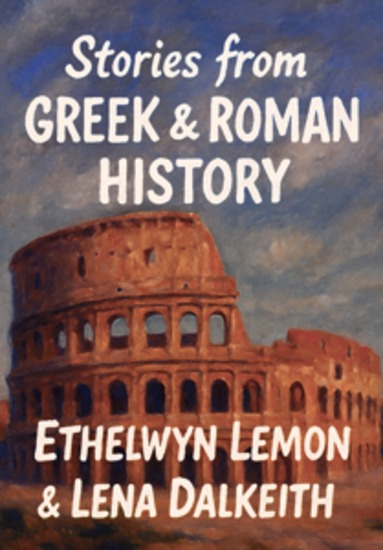
Stories from Greek & Roman History (Classicus Edition) - cover

Stories from Greek & Roman History (Classicus Edition)

Lena Dalkeith, Ethelwyn Lemon

Publisher: Classicus

  • 0
  • 0
  • 0

Summary

Stories from Greek & Roman History is a timeless journey through the ancient world, combining two beloved early 20th-century classics into one beautifully curated volume. Drawing from Ethelwyn Lemon’s Stories from Greek History (1908) and Lena Dalkeith’s Stories from Roman History (1909), this collection brings to life the great civilizations that laid the foundation for Western thought, governance, and culture. With vivid storytelling and carefully chosen episodes, the book introduces young readers to heroic battles, legendary leaders, and pivotal moments that shaped Greece and Rome.      From the fierce valor of the Spartans at Thermopylae to the grandeur of Julius Caesar’s rise to power, these stories are presented in clear, engaging language that captures the imagination without sacrificing historical integrity. Designed especially for children aged 8 to 15, the narratives are perfect for homeschooling, classical education, or anyone seeking an accessible introduction to the ancient world. Each chapter invites curiosity and encourages a deeper appreciation for the ideas and events that continue to influence our world today.      This edition, published by Classicus, carefully preserves the charm of the original texts while offering a fresh visual and editorial presentation for modern readers. Whether you're a parent, teacher, or student, Stories from Greek & Roman History is an essential resource that blends education with inspiration, sparking a lifelong interest in the epic drama of classical history.
Available since: 07/23/2025.

Other books that might interest you

  • Anarchy and Authority - Irish Encounters with Romanov Russia - cover

    Anarchy and Authority - Irish...

    Angela Byrne

    • 0
    • 0
    • 0
    From the ascent of Peter the Great to the Russian Revolution. From the Battle of the Boyne to the Easter Rising. Between these epochal events were two astounding centuries of war, diplomacy, intrigue, innovation and international radical political movements, the reverberations of which are still felt in both Ireland and the former territories of the Russian empire today.
    In Anarchy and Authority, readers follow contemporaneous accounts of Irish men and women who ventured into the Russian empire during the long centuries of Romanov rule. Human connections, political intrigues, cultural cross-pollination mesh with sweeping historical narratives in the story of the island and the empire.
    Meticulously researched and energetically told, these are the stories of Irish residents, travellers and migrants to Russia from that time, ranging from diplomats and governesses, to early tourists, travel writers, soldiers, servants and even a revolutionary music-teacher. From the Irishmen and women who benefitted from the imperial wars waged by the Russian state, to those Irish observers who bore witness to the horrors of serfdom and the oppression of dissenting voices.
    Anarchy and Authority brings to vivid life these Irish perspectives. Their fascinating insights and unique depths of field give increasing relevance to the turbulent geo-politics of modern times.
    Show book
  • Calling in Context - Social Location and Vocational Formation - cover

    Calling in Context - Social...

    Susan L. Maros

    • 0
    • 0
    • 0
    "I don't care for vocational books written in the United States; they're too American." When Susan Maros heard this comment from a Malaysian colleague, she was initially taken aback. Isn't the concept of calling universal? Why wouldn't resources with a biblical perspective on vocation apply to everyone?The reality is that each of us encounters our questions of calling from within a particular context. In this paradigm-shifting book, Maros explores how various dimensions of social location—including race, ethnicity, culture, socioeconomic status, and gender—shape our assumptions and experiences with vocation. Maros helps Christians in the United States in particular see how ideas about calling that emphasize certainty, career paths, and personal achievement arise from cultural priorities that shouldn't go unexamined, such as individualism, productivity, and meritocracy. She explains how unexamined "mental maps" can distort our perspective and refocuses our attention on biblical insights about calling as a lifelong journey. In the process, she helps us find both clarity and encouragement to explore the paths before us.God calls all people, yes—but calling is not a monolithic concept. Filled with numerous stories from Christians in diverse communities, Calling in Context invites anyone exploring questions of calling to find fresh possibilities in their own identity and engagement with God's mission. Reflection questions and Bible study prompts are included throughout.
    Show book
  • Breaking the Sound Barrier - N A - cover

    Breaking the Sound Barrier - N A

    Alice Horwill-Leech

    • 0
    • 0
    • 0
    Breaking the Sound Barrier is easy to read. It's a step-by-step instructional manual for parents and caregivers who wish to promote pre-literacy skills in pre- and beginning readers and help establish and consolidate reading, writing, and spelling proficiency in early readers. Furthermore, Breaking the Sound Barrier is an invaluable resource for established readers who do not have an understanding of the relationship between the letter and sound principle of phonemic awareness, usually illustrated by poorer spelling competency.
    Show book
  • Face Failure - Characteristics of Leaders Who Have Successfully Recovered from Significant Setbacks - cover

    Face Failure - Characteristics...

    Brittany Forrester

    • 0
    • 0
    • 0
    The etymology of the word fail is derived from the French word faillir, which means “almost to do.” Faillir is derived from the Latin word fallere, which means to deceive or lead into error. These definitions imply that when people fail, they do not follow through with their intentions, and those who believed that they would be in some way deceived. 
    People who experience failure can feel a sense of shame. This emotional response can cause them to suppress their feelings, deflect the responsibility of the failure, neglect to learn from the valuable lessons, and thwart the possibility for future success. 
    As Winston Churchill so eloquently said, “Success is not final, failure is not fatal: it is the courage to continue that counts.”
    Show book
  • Unbuttoned & Exposed - A Collection of Gay Erotica Short Stories - cover

    Unbuttoned & Exposed - A...

    Gray Wilder

    • 0
    • 0
    • 0
    Unbuttoned & Exposed is a bold and unapologetically sensual collection of gay erotica short stories by Gray Wilder. Each story plunges readers into moments of intense attraction, vulnerability, and authentic connection between men navigating desire, love, and identity. 
    From a steamy cooking session that sparks more than just flavors, to the rediscovery of passion between men in their second spring, to strangers whose lives intertwine in unexpected, heated ways—this anthology captures the full spectrum of queer intimacy. With a strong focus on consent, pleasure, and emotional resonance, Wilder’s storytelling is both raw and romantic, blending eroticism with heartfelt humanity. 
    Perfect for readers seeking character-driven, explicit gay stories that celebrate the complexity and joy of male-male intimacy. Every story is a stand-alone encounter, yet together they form a mosaic of love, longing, and lust told from a uniquely honest gay perspective.
    Show book
  • Comeback - Routing Trumpism Reclaiming the Nation and Restoring Democracy’s Edge - cover

    Comeback - Routing Trumpism...

    M. Steven Fish, Laila M. Aghaie

    • 0
    • 0
    • 0
    The fate of American democracy now hinges on the Democrats' ability to defeat the Republicans for the foreseeable future. But for the Democrats to win consistently, they must reestablish their credentials as fearless leaders, tough fighters, and fierce patriots. 
    Comeback delivers a bold new take on democracy’s crisis. Many liberals think that escalating economic anxieties and cultural backlash drove voters to Trump. But a crush of data shows this thinking to be deeply flawed. It also strikes working-class voters as condescending and repellent. And while the Democrats stick to “kitchen table” issues and showing how much they care, voters care more about strength and commitment to principle than prescription drug prices. 
    Politics is a dominance game and a contest to capture the flag. Politicians who seem to be the strongest leaders and most passionate patriots hold the advantage. The Republicans get it. The Democrats don't. 
    Republicans have a high-dominance political style. They take risks, savor conflict, and use provocative language. Democrats have a low-dominance style. They’re risk-averse, afraid to engage on cultural issues—and more than a little boring. Republicans hammer away at their patriotism, even as they betray the nation and shred American values. Democrats are loyal to American values but have grown squeamish about patriotism and have no national story. 
    Ordinary people often don’t recognize themselves in the stories liberal politicians tell about them, while the authoritarians speak a language of dominance and national greatness that connects. The Democrats need a new approach to messaging. Comeback spells it out—and provides a roadmap for trouncing Trumpism.
    Show book