Join us on a literary world trip!
Add this book to bookshelf
Grey
Write a new comment Default profile 50px
Grey
Subscribe to read the full book or read the first pages for free!
All characters reduced
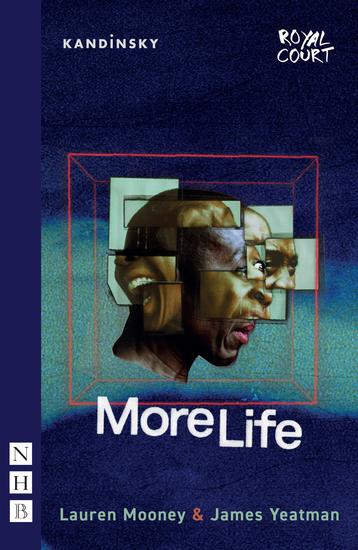
More Life - cover

More Life

Lauren Mooney, James Yeatman

Publisher: Nick Hern Books

  • 0
  • 0
  • 0

Summary

'Imagine yourself as a file on a computer: that's you. That's what you are now.'
A woman wakes up in 2075, in a body that is not her own.
Fifty years ago, Bridget died in a car accident. Now, thanks to a technological breakthrough, she is back: her mind, her consciousness, in a synthetic body. Metal. Wires. But she's still Bridget, isn't she? She must be.
More Life is a sci-fi gothic horror, set in a future where pain and death are going rapidly out of date. It premiered at the Royal Court Theatre, London, in 2025, in a production made in association with Kandinsky Theatre Company.
Available since: 02/13/2025.
Print length: 144 pages.

Other books that might interest you

  • Macbeth - cover

    Macbeth

    William Shakespeare

    • 0
    • 0
    • 0
    ""Is this a dagger I see before me?"" 
    Features a unique cover illustration by Maurice Sendak (Where the Wild Things Are), specially commissioned for the Shakespeare on Compact Disc series.
    Show book
  • A Midsummer Night's Dream - cover

    A Midsummer Night's Dream

    William Shakespeare

    • 0
    • 0
    • 0
    This is a dramatic performance of William Shakespeare's "A Midsummer Night's Dream" complete with many characters and sound effects.
    Show book
  • Republic - cover

    Republic

    Nerys Williams

    • 0
    • 0
    • 0
    Nerys Williams' new collection questions what makes a  Republic? Machinations of power? The speeches of politicians? The broad sweep of official histories? This sequence of 80 prose-poems, each constructed in 20 sentences, has arisen from the author's need to tell a more intimate history, to commit an untold oral history to paper. Williams returns to the meaning of "republic" in its Latin origins which meant "wealth of the people". 
    The poems tell the story of  a young Welsh woman growing up and coming of age in the 1980s and 90s, a time that culminated with new devolutionary powers in Wales. The explosion of the arts and culture looms large, through bands from New Order to my bloody valentine, but it is explored specifically through Cŵl Cymru', and the power of Welsh-language bands like Datblygu. This story is also about class, as we explore a family history of hard work in jobs from retail to caregiving. The poems introduce us to family influences, from a father who urges the narrator as a child to 'own the stage' in an early school Eisteddfod, to a grandmother who worked long hours in her rural shop, and a mother who was the local midwife.
    There are stories told, overheard, handed down, sometimes translated from Welsh. Together, they create an expansive portrait of the era, including the challenges for women, Welsh-speakers, and other marginalized groups. Ferocious remarks about the Welsh in the popular media are dissected with satirical humour and appalled fascination, while other poems describe being a token woman and political outsider on a TV current affairs show panel, tolerated but ostracized.
    From her more recent home, the republic of Ireland, Williams poses the possibilities of a nation looking at itself and its history from afar. Wales has not been allowed to be a republic, but is subject to a state that has military claims on its landscape and a second home explosion which has a severe impact on its communities. There is rebellion to be found in the older meaning of "republic": since the wealth of the people is a wealth of sounded stories, culture, art, and history.
    'Nerys Williams's Republic is a tour de force, a masterful account of the intellectual, political and personal development of a young woman from Welsh-speaking rural Wales and out in the world. Pitched against nostalgia, Nerys Williams's prose poems are tough-minded, shrewd and hugely evocative of the times she chronicles. She deploys details so vividly and with such a light a touch that she's created a new music all of her own. This book, like a waistcoat belt she describes, is a 'steel buckle, once harnessed to silk'.' —Gwyneth Lewis
    'The poetry of Nerys Williams is both playful and sharply preceptive, drawing on a wide range of often unexpected influences. She brings a unique set of interests to bear not just poetry in Wales, but on poetry generally.'—Zoë Skoulding
    'Nerys Williams brings precision, scrutiny, and synaesthesia to her terse, contemplative poems.' -Ben Wilkinson, The Guardian
    '…a strong imagism and an engaging 'I' voice that sometimes subverts expectations, allowing for a shift into more collective concerns. In addition, her deft handling of soundplay (especially the use of alliteration and assonance) greatly add to the experience of the poem as art.' -Michael S. Bengal  Poetry Ireland 
    Show book
  • The Garden of Eros - Poem honouring the memory of some legendary poets - cover

    The Garden of Eros - Poem...

    Oscar Wilde

    • 0
    • 0
    • 0
    Oscar Fingal O'Flahertie Wills Wilde was born on the 16th October 1854 in Dublin Ireland.  The son of Dublin intellectuals Oscar proved himself an outstanding classicist at Dublin, then at Oxford. With his education complete Wilde moved to London and its fashionable cultural and social circles.  With his biting wit, flamboyant dress, and glittering conversation, Wilde became one of the most well-known personalities of his day.  
    His only novel, The Picture of Dorian Gray was published in 1890 and he then moved on to writing for the stage with Salome in 1891.  His society comedies produced enormous hits and turned him into one of the most successful writers of late Victorian London.  
    Whilst his masterpiece, ‘The Importance of Being Earnest’, was on stage in London, Wilde had the Marquess of Queensberry, the father of his lover, Lord Alfred Douglas, prosecuted for libel.  The trial unearthed evidence that caused Wilde to drop his charges and led to his own arrest and trial for gross indecency. He was convicted and imprisoned for two years' hard labour.  It was to break him.  
    On release he left for France. There he wrote his last work, ‘The Ballad of Reading Gaol’ in 1898.  He died destitute in Paris at the age of forty-six sipping champagne a friend had brought with the line ‘Alas I am dying beyond my means’.
    Show book
  • The Route 9 Anthology - A Collection of Writing from Wesleyan Students Faculty Staff & Middlesex County Residents - cover

    The Route 9 Anthology - A...

    Oliver Egger

    • 0
    • 0
    • 0
    The Route Nine Anthology is a collection of poetry and prose from Wesleyan students, faculty, staff, and Middlesex County residents. It is the first collection of prose dedicated specifically to bridging the literary divide between the Wesleyan and Middlesex County communities.
    Show book
  • Bycatch - cover

    Bycatch

    Caroline Smith

    • 0
    • 0
    • 0
    In Bycatch, a new collection by the Ted Hughes Prize shortlisted-poet Caroline Smith, the poems ask where personhood is when memory and language are gone. They capture the faltering years of a life gradually scraped bare by the deep-sea trawler of dementia – yet find amongst the isolation and sadness, moments also of clarity, epiphany and love.
    Whilst these poems chart deep waters, they remind us also of the enduring and miraculous bond between those who have known each other for a lifetime. With grace and often with humour, Smith unravels the intricate nature of care, the symbiosis of family, and ultimately the sense of self held in the memories and personal histories of her own parents. It is in the swell of the wave, as ageing and loss threaten to engulf even the words, these extraordinary poems remain tender, unforgettable and salt-sharp.
    Show book