Join us on a literary world trip!
Add this book to bookshelf
Grey
Write a new comment Default profile 50px
Grey
Subscribe to read the full book or read the first pages for free!
All characters reduced
The Mom Experiment 5 - cover

The Mom Experiment 5

Laura Lovecraft

Publisher: _Boruma Publishing, LLC

  • 0
  • 1
  • 0

Summary

After succumbing to the effects of the T-Virus, Jo, Robin, Claire, and Amanda struggle to cope with the aftermath of the incestuous acts they were driven to commit. But when they meet, dark secrets are revealed, and they realize the seeds of taboo lust already existed in not only their sons, but them as well, leaving them questioning was it the drug, their own unspoken desires, or both?
 
~~~~~ PG Excerpt ~~~~~
 
“Your turn, Jo,” Claire gestured. “I think Robin needs a minute.”
 
“All jokes aside, I’m as boring as you think I am. Just that towel incident.”
 
“No,” Claire disagreed. “There’s more.”
 
“Like what?”
 
“When you were running down all the checkmarks to these cases, you weren’t seeing you and Alex hit every spot.” Claire went down the list.
 
“Divorced, husband abandoned you. You mope around alone. Alex becoming man of the house by helping, working, looking out for you, and he’s not dating either.”
 
“Date nights.” Amanda mentioned. “Reality is you were closer to this happening without the shot than anyone else.”
 
“Yeah,” Jo sighed. “You're right, but there's something else.”
 
She looked down at her notes.
 
“Something else. I think this thing played with memory.”
 
“How so?” Robin had regained her composure.
 
“When I mentioned the towel incident to Alex, he claimed I didn’t pull it up as quickly as I thought, and I swear I was now seeing it his way. I waited and watched him watch me.”
 
“The time I kissed Zack!” Robin snapped her fingers. “I started seeing it that I enjoyed it more than I should have. It seemed so real; I doubted my own recollection of it since it happened.”
 
Robin looked to Claire, who nodded.
 
“I thought back on when I found out the boys were masturbating into my things and recalled being flattered. Liking that my sons thought of me and saw myself as doing the wrong thing by not talking to them.”
 
“It may have avoided this you mean?” Jo asked.
 
“No, as in I should have let them have me. Kept thinking they were wasting what should have been mine. It was so lurid, like a taboo fever dream and feeling like I let them down by allowing some young tart to be their first sex when it should have been me.”
 
“Same here,” Jo added. “I was saying things that are straight out of those movies. Calling myself a mommy slut, talking about draining my son dry.”
 
“Jeez, TMI,” Robin grimaced “But me too.”
 
“No idea where it came from. I’m not even a dirty talker unless I’m drunk, let alone that nasty mom dialogue. I don’t understand how the shot could alter my behavior to that degree."
 
“It stripped every inhibition away,” Claire suggested. “Raw, primal, animal lust.”
 
“I get it, if it was random dirty talk.” Jo argued. “But like Claire said, this “A mother should be her boy’s lover,” schtick. How can it create that?”
 
“Because we were talking about it during your pitch. You’ve been studying it for months, then you got us thinking about it, including what happened with us and our kids, so there was something to feed on.”
 
Robin had spoken slowly, her eyes narrowed. “You read a horror novel you have nightmares. Have amazing sex, or watch porn, you’ll have wet dreams. Talk taboo and take a shot to enhance the sex drive and you were looking to tease for a reaction. You were in the mode so to speak.”
 
“God,” Jo leaned over the table and put her head in her hands. “This really is my fault; I not only came up with the shot but put the trigger in your minds.”
 
“That’s just a guess, Jo,” Claire told her. “There has to be more there.”
 
“Right,” Robin agreed. “I feel like there’s an explanation, but it’s eluding us.”
 
“I know what it is.” They all looked at Amanda and Jo was surprised to see tears in her eyes. “And it's because you’re all wrong about something.
 
“It’s not Jo’s fault this happened. It’s mine.”
Available since: 08/19/2024.
Print length: 98 pages.

Other books that might interest you

  • SOMATIC THERAPY FOR DEPRESSION - Transformative Mind-Body Connections for Mental Wellness - cover

    SOMATIC THERAPY FOR DEPRESSION -...

    Ashley Fitzgerald

    • 0
    • 0
    • 0
    Uniting Mind, Body, and Spirit in the Fight Against Depression. 
    In "SOMATIC THERAPY FOR DEPRESSION," readers are invited to explore a groundbreaking approach to combating depression. This compelling book delves deep into the world of somatic therapy, a transformative practice that emphasizes the powerful connection between mind, body, and spirit. 
    Through a series of carefully crafted chapters, "SOMATIC THERAPY FOR DEPRESSION" highlights the importance of listening to our body's signals and responding to emotional pain with compassion and understanding. The book emphasizes how integrating physical sensations with emotional and psychological awareness can lead to a deeper, more holistic form of healing. 
    This book is not just for those suffering from depression; it's a valuable resource for therapists, healthcare professionals, and anyone interested in holistic mental health practices. With its blend of scientific research, therapeutic insights, and personal narratives, this book offers a new perspective on treating depression, one that is centered on harmony and balance between the mind, body, and spirit. 
    Don't let depression dictate your life's story. "SOMATIC THERAPY FOR DEPRESSION" is more than just a book; it's a pathway to profound transformation. Whether you're battling depression, supporting a loved one, or a professional seeking new therapeutic approach, this book is an essential addition to your library.  
    Order your copy now, begin transforming your life with the power of somatic therapy and join a Community of Healing: Connect with others who are on the same journey towards mental wellness. 


    Show book
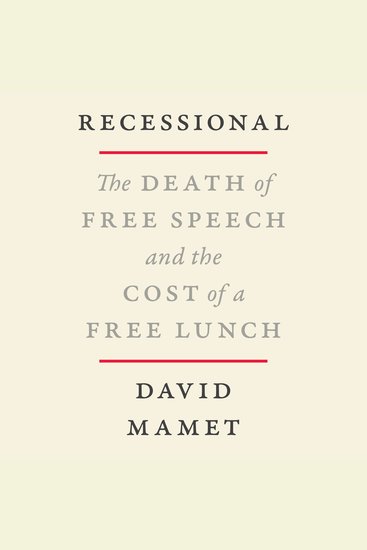
  • Recessional - The Death of Free Speech and the Cost of a Free Lunch - cover

    Recessional - The Death of Free...

    David Mamet

    • 0
    • 0
    • 0
    NEW YORK TIMES BESTSELLER! 
    “Savagery appeased can only grow. Once you give in to it, it must escalate, like a fire searching for air.” 
    The man who won the Pulitzer Prize for GLENGARRY GLEN ROSS, who wrote the classic films THE VERDICT and WAG THE DOG sounds his alarm about the Visigoths at our gates. 
    In RECESSIONAL he calls out, skewers, mocks, and, most importantly, dissects the virus of conformity which is now an existential threat to the West. 
    A broad-ranging journey through history, the Bible, and literature, RECESSIONAL examines how politics and cultural attitudes about rebellion have shifted in the United States in the last generation. By screaming down freedom of thought and expression, Mamet explains, we kill invention and democracy – the foundations of security and growth. 
    A wickedly funny, wistful and wry appeal to the free-thinking citizen, RECESSIONAL is a vital warning that if we don’t confront the cultural thuggery now, the commissars and their dupes will transform the Land of the Free into the dictatorship at which they aim.
    Show book
  • Gaius Marcus - The Controversial General Who Led the Roman Armies to Victory - cover

    Gaius Marcus - The Controversial...

    Kelly Mass

    • 0
    • 0
    • 0
    Gaius Marius was one of the most influential military commanders and statesmen of the late Roman Republic. Born into a well-off, provincial Italian family in Arpinum, Marius rose from relatively humble beginnings to become a key figure in Rome’s transformation from a republic to an empire. Known for his military prowess and political savvy, Marius served as consul an unprecedented seven times, a record that set him apart from other Roman leaders. 
    His career began in earnest during the Siege of Numantia in 134 BC, where he gained valuable military experience under the command of Scipio Aemilianus. Marius was not born into the traditional aristocracy of Rome but quickly ascended through the ranks of Roman politics. In 119 BC, he was elected as tribune of the plebs, where he passed significant legislation that aimed to curb the influence of the aristocracy in Roman elections. His political career continued to build momentum as he was elected praetor in 115 BC and later became the governor of Further Spain, where he fought against bandit forces. Marius’s personal life also intertwined with the leading families of Rome—he married Julia, the aunt of the future dictator Julius Caesar, cementing ties with one of Rome’s most powerful clans. 
    Marius’s most famous military achievements came in the course of the Jugurthine War in Numidia, which he brought to a successful conclusion in 107 BC. That same year, he was appointed to command Roman forces in the war against the Germanic tribes, the Cimbri and Teutones, who threatened Rome’s existence. He was elected consul for the second time in 104 BC, a post he would hold consecutively for five years. His victories at the battles of Aqua Sextiae in 102 BC and Vercellae in 101 BC cemented his reputation as one of Rome’s greatest military leaders, and he was hailed as the “third founder of Rome,” a title that reflected his role in securing the republic’s future.
    Show book
  • Jane Austen's Little Book of Wisdom - Words on Love Life Society and Literature - cover

    Jane Austen's Little Book of...

    Jane Austen

    • 1
    • 0
    • 0
    The ultimate companion for the Jane Austen fan filled with her penetrating insights and humor on life, love, and death. Jane Austen is one of the most popular female writers in history, best known for her stories of love, loss, and hope, which are cleverly intertwined with her witty insights into the traits and expectations of English Georgian society.   Here, in this stunning little book, you will be able to read hundreds of individual quotes from her famous works—from Pride and Prejudice and Emma to Persuasion and Sense and Sensibility—each prompting an emotional response, thoughtful musing, or even a little snigger at the wise and shrewd perceptions that Austen had of the world around her.   Utterly charming and very profound, fans of Jane Austen can revel in these much-loved quotes, while a new audience will be introduced to the joys that her books have provided since their publication many years ago. With each chapter focusing on a different theme—from Love & Longing to Female Strength—this gorgeous gift book is the perfect compilation of Austen’s funny, moving, and thought-provoking words.   Content of themes:  Love & Longing  Friendship  Society  Female Strength  Life & Death  Faith  Art & Literature “The wit of Jane Austen has for a partner the perfection of her taste.” —Virginia Woolf   
    Show book
  • The Appeasement of Nazi Germany - The History of the Western Allies’ Failed Attempts to Placate Hitler Before World War II - cover

    The Appeasement of Nazi Germany...

    Charles River Editors

    • 0
    • 0
    • 0
    A single act of arson against the famous Reichstag building proved to be the catalyst that propelled Adolf Hitler to victory in the elections of March 1933, which set the German nation irrevocably on the path towards World War II. That war would plunge much of the planet into an existential battle that ultimately cost an estimated 60 million lives. 
    Of course, the Western Europeans tried and failed in notorious fashion to prevent that war by appeasing Hitler, who only became more ambitious as France and Britain refused to push back on his growing aggression, especially in the wake of the Anschluss, which Hitler’s future enemies all but justified due to Austria’s large German population. The Munich Agreement is now notorious because its promise proved barren within a very short period of time. British Prime Minister Neville Chamberlain's actions either failed to avert or actually hastened the very cataclysm he wished to avoid at all costs. The agreement effectively signed away Czechoslovakia's independence to Hitler's hungry new Third Reich, and within two years, most of the world found itself plunged into a conflict anyway. 
    Initially, many people hailed Chamberlain's "success" at defusing Nazi aggression by handing over Czechoslovakia tamely to Hitler's control, but others remained dubious. Édouard Daladier, the French prime minister, "later told Amery that he turned up his coat collar to protect his face from rotten eggs when he arrived in Paris." A Foreign Office man, Orme Sargent, was disgusted, and he later said bitterly, "For all the fun and cheers, you might think they were celebrating a major victory over an enemy instead of merely the betrayal of a minor ally." Winston Churchill, the deal’s most famous critic, bitterly remarked, “England has been offered a choice between war and shame. She has chosen shame, and will get war.”
    Show book
  • The Economy of Rome - Trade Wealth and Commerce - cover

    The Economy of Rome - Trade...

    Rogan Fish

    • 0
    • 0
    • 0
    The Roman economy was built upon a complex and interdependent system that evolved from its agrarian roots into a vast network of trade, production, and commerce. From the early Republic to the height of the Empire, Rome’s economic foundation was shaped by its reliance on agriculture, slave labor, and a structured monetary system. These key components allowed the Roman state to sustain its military conquests, support its urban populations, and facilitate long-distance trade across the Mediterranean and beyond. 
    Agriculture served as the backbone of the Roman economy, with the majority of the population engaged in farming. Small-scale subsistence farming dominated early Roman society, but as the Republic expanded, wealthy landowners acquired vast estates known as latifundia. These estates were worked by slaves and tenant farmers, producing surplus crops such as wheat, olives, and grapes, which were essential to both local consumption and trade. The shift from independent farming to large-scale agricultural estates increased economic disparities but also enabled Rome to support a growing urban population and supply its armies. 
    Slavery played a crucial role in sustaining the Roman economy. Enslaved people were not only laborers in agriculture but also worked in mines, workshops, and domestic households. The steady influx of slaves, primarily through military conquests, allowed Rome to maintain high levels of production and economic growth. The reliance on slave labor, however, also created structural weaknesses, as the economy was dependent on a continuous supply of enslaved workers, making it vulnerable during times of military decline.
    Show book