Join us on a literary world trip!
Add this book to bookshelf
Grey
Write a new comment Default profile 50px
Grey
Subscribe to read the full book or read the first pages for free!
All characters reduced
Glacier National Parks - cover

Glacier National Parks

Laura Anderson

Translator A AI

Publisher: Publifye

  • 0
  • 0
  • 0

Summary

Glacier National Parks explores the critical role of glaciers in our national parks and the escalating threat they face from climate change. These icy landscapes are not just scenic wonders; they are vital freshwater reservoirs that sustain diverse ecosystems.

 
The book highlights how glacial retreat disrupts water availability, increases wildfire risk, and endangers alpine environments, emphasizing the urgent need for environmental stewardship.

 
The book examines glacial formation, movement, and their historical significance, making complex concepts accessible with clear diagrams and photographs. It reveals alarming evidence of glacial decline through historical data, scientific studies, and photographic comparisons, demonstrating how global warming is specifically impacting various park regions. The study of these glaciers shows that they have been shaped over millennia.

 
Progressing from the introduction of glacial environments to the examination of retreat evidence and finally to mitigation strategies, the book presents potential policy recommendations and actions for protecting these landscapes.

 
By combining scientific rigor with accessible storytelling, Glacier National Parks inspires readers to understand and act on the climate challenges facing these irreplaceable natural treasures.
Available since: 02/21/2025.
Print length: 55 pages.

Other books that might interest you

  • Neurology - Understanding Brain and Nerve Disorders - cover

    Neurology - Understanding Brain...

    Ava Westwood

    • 0
    • 0
    • 0
    The human brain is often described as the most intricate and remarkable organ in the known universe. It serves as the control center for every thought, emotion, movement, and sensation we experience, seamlessly integrating billions of neural connections to create the essence of who we are. Despite centuries of scientific inquiry, the brain remains a profound mystery—an organ that not only governs our basic survival but also fuels creativity, innovation, and the very consciousness that allows us to ponder its complexity. 
    What makes the brain so fascinating is its duality: it is both fragile and resilient, capable of extraordinary feats yet vulnerable to a wide range of disorders. Its 86 billion neurons form networks that enable everything from the rhythmic beating of the heart to the abstract contemplation of art, philosophy, and science. This complexity has driven countless researchers to explore its depths, seeking to understand how such a compact structure can hold the vastness of human thought, memory, and emotion. 
    Throughout history, our understanding of the brain has evolved dramatically. Early civilizations believed that the heart was the seat of intelligence, while the brain was considered secondary. It wasn’t until the work of ancient scholars like Hippocrates and later neurologists such as Thomas Willis and Santiago Ramón y Cajal that the brain was recognized as the epicenter of human experience. Today, advanced imaging technologies allow us to observe the brain in action, mapping areas responsible for speech, movement, and even complex emotions. Yet, for all our progress, we have only begun to scratch the surface of its potential.
    Show book
  • Better Never to Have Been - The Harm of Coming into Existence - cover

    Better Never to Have Been - The...

    David Benatar

    • 0
    • 0
    • 0
    Most people believe that they were either benefited or at least not harmed by being brought into existence. Thus, if they ever do reflect on whether they should bring others into existence—rather than having children without even thinking about whether they should—they presume that they do them no harm. Better Never to Have Been challenges these assumptions. David Benatar argues that coming into existence is always a serious harm. Those who never exist cannot be deprived. However, by coming into existence one does suffer quite serious harms that could not have befallen one had one not come into existence. Drawing on the relevant psychological literature, the author shows that there are a number of well-documented features of human psychology that explain why people systematically overestimate the quality of their lives and why they are thus resistant to the suggestion that they were seriously harmed by being brought into existence. The author then argues for the "anti-natal" view—that it is always wrong to have children—and he shows that combining the anti-natal view with common pro-choice views about fetal moral status yield a "pro-death" view about abortion. Although counter-intuitive for many, that implication is defended, not least by showing that it solves many conundrums of moral theory about population.
    Show book
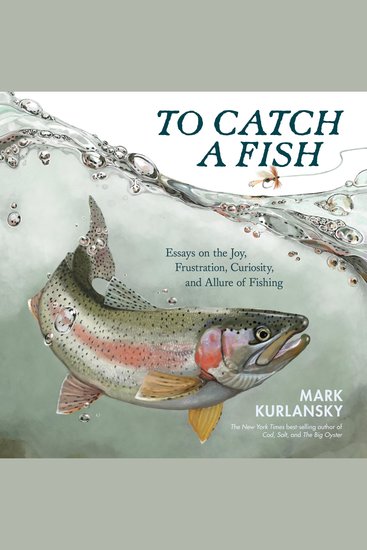
  • To Catch a Fish - Essays on the Joy Frustration Curiosity and Allure of Fishing - cover

    To Catch a Fish - Essays on the...

    Mark Kurlansky

    • 0
    • 0
    • 0
    From the award-winning, New York Times best-selling author of Cod and Salt, To Catch a Fish is an entertaining and beautifully written illustrated collection of essays that explore a lifetime fascination with fishing.    For as long as there have been humans, there have been humans trying to catch fish. The two species—fish and man—live in constant tension. One chases the other. One tries to get away. Some of us—author Mark Kurlansky included—are hard-wired for that chase. Guiding readers through the waters and into the mind of the fish, Kurlansky considers who fish are and why they behave the way they do, and along the way delves into the many approaches to catching a fish, their ecology, and the ins and outs of cooking and eating your catch.      Whether you’re a seasoned angler or a novice, or simply want to explore the world of fish, the forty short essays in this collection and the dazzling illustrations by Bri Dostie, shed new light on these creatures and our relationship to them.  
    Show book
  • Fireplace Sleep Sounds - 5 Hours of Crackling Fire and Gentle Embers - cover

    Fireplace Sleep Sounds - 5 Hours...

    Sleeptime Publications

    • 0
    • 0
    • 0
    Drift Off to the Sound of a Cozy Fireplace—Without the Smoke, Mess, or Fire Hazard. 
    Struggling to fall asleep at night? Tossing and turning while your mind races through tomorrow’s to-do list? Do you crave the calming crackle of a fireplace but live in an apartment… or just don’t want to deal with chopping wood? 
    This immersive 5-hour audio experience brings the soothing comfort of a real fireplace straight to your ears—no firewood or chimney required. Whether you're trying to wind down after a stressful day or create a peaceful background ambiance, this audiobook is designed to lull you into deep relaxation and restful sleep.✅ 5 distinct one-hour tracks featuring a variety of natural fireplace sounds—from glowing embers to lively hearths✅ Realistic audio textures that mimic the warmth and crackle of wood-burning fires✅ Perfect for sleep, meditation, reading, or cozy evenings at home✅ No music or narration—just pure, uninterrupted fire sounds 
    Even if you've tried white noise, rain sounds, or sleep meditations that didn’t work, this might be the warm, nostalgic soundscape you’ve been missing. Just press play, close your eyes, and let the gentle crackle transport you to your own peaceful cabin in the woods. 
    🎧 Hit play tonight and experience the warmth and calm of a fireplace—anytime, anywhere.
    Show book
  • The Universe's Hidden Blueprint - Understanding Dark Energy's Influence - cover

    The Universe's Hidden Blueprint...

    Dirk Fallon

    • 0
    • 0
    • 0
    The universe, a vast and ever-expanding expanse, has fascinated humanity for centuries. From the first glimmering stars to the complex galaxies that stretch across the sky, the cosmos has been a subject of study and wonder. The exploration of the universe is a journey that continues to reveal new insights into the nature of existence, the forces at play, and the structures that govern the cosmos. Understanding the universe's hidden blueprint, particularly the role of dark energy, is central to understanding how it operates on the largest scales. 
    The birth of the universe, often referred to as the Big Bang, marked the beginning of everything we observe today. This singularity was not just the origin of matter and energy, but also of the very fabric of space and time. As the universe expanded, it cooled, and matter began to form. Over billions of years, stars, galaxies, and other cosmic structures developed, with gravity playing a key role in shaping the distribution of matter. However, this gravitational pull, which typically brings things together, began to reveal an unexpected and mysterious aspect of the cosmos in the 20th century. 
    One of the most significant discoveries in modern cosmology was the realization that the universe’s expansion is accelerating. This observation shook the foundations of astrophysics, as scientists had long assumed that the universe's expansion would slow down due to gravitational forces. Instead, what they found was that galaxies were moving apart faster than ever, suggesting the presence of an unknown force. This force was later dubbed "dark energy," and it has become one of the most crucial elements in understanding the universe’s large-scale behavior.
    Show book
  • Zetetic Astronomy - Earth Not A Globe - cover

    Zetetic Astronomy - Earth Not A...

    Samuel Rowbotham

    • 0
    • 0
    • 0
    Brought to you by Altrusian Grace Media and narrated by Matthew Schmitz. THE DEFINITIVE FLAT EARTH DOCUMENT! The unabridged and enhanced 2nd edition of Zetetic Astronomy, formulated in the 19th century by Samuel Rowbotham, presents a flat-earth cosmology grounded in direct sensory observation rather than theoretical abstraction. Rejecting Newtonian and Copernican astronomy, Rowbotham argued that the Earth is a flat, stationary plane with the Sun, Moon, and stars moving in circular paths above it, asserting that empirical evidence—such as the apparent flatness of horizons and the behavior of water surfaces—supports this model. The Zetetic method emphasizes skepticism toward authority and deductive reasoning, claiming truth arises only from firsthand, verifiable observation. This approach positioned itself as an “inquiry-based” science in opposition to what it viewed as speculative mathematics, laying the philosophical foundation for later flat-earth movements and epistemological distrust of institutionalized science.
    Show book