Join us on a literary world trip!
Add this book to bookshelf
Grey
Write a new comment Default profile 50px
Grey
Subscribe to read the full book or read the first pages for free!
All characters reduced
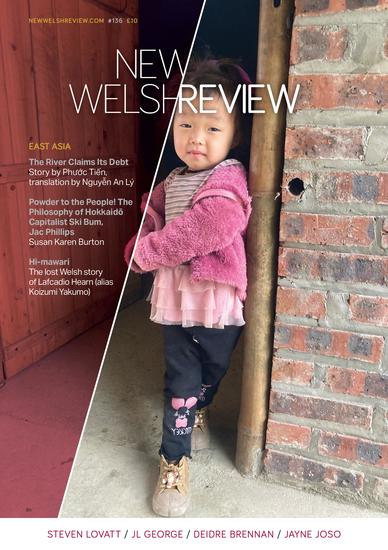
New Welsh Review 136 (winter 2024) - East Asia - cover

New Welsh Review 136 (winter 2024) - East Asia

Lafcadio Hearn, Jayne Joso, Phước Tiến, Susan Karen Burton

Publisher: Parthian Books

  • 0
  • 0
  • 0

Summary

EDITORIAL by Gwen Davies


EAST ASIAN LITERATURE


'The River Claims Its Debt' – Story by Phước Tiến, translated from the Vietnamese by Nguyễn An Lý

'Powder to the People! The philosophy of Hokkaido capitalist ski bum, Jack Philips' – Biography/oral history by Susan Karen Burton

'Hi-Mawari', the lost Welsh story of Lafcadio Hearn (alias Koizumi Yakumo) –Translated from the Japanese

Jayne Joso on how Japan shapes her work


FURTHER FICTION


'The Banana Banshee' – Story by Deidre Brennan, translated from the Irish by the author


REVIEW-ESSAYS


Steven Lovatt on restoring natural and cultural ecologies in the work of Ruth Bidgood, Rae Howells and Carwyn Graves

JL George on trauma and the magical child in recent novels by Lloyd Markham, Carly Holmes and Vajra Chandrasekera
Available since: 11/01/2024.
Print length: 80 pages.
Other books that might interest you

  • Women with ADHD - The Ultimate Guide to Overcome the Struggles of Living with ADHD Rewire Your Anxious Brain with Practical and Effective Tips to Positively Transform Your Life - cover

    Women with ADHD - The Ultimate...

    Benjamin Cristopher Ross

    • 0
    • 0
    • 0
    Looking for a valuable and informative audiobook to help you deal with and get past the problems of ADHD? Look no further than "Women with ADHD" by Benjamin Cristopher Ross. 
    This audiobook gives a complete look at ADHD in women and talks about the unique problems that women with ADHD face every day. Ross provides a wealth of practical and effective tips to help you rewire your anxious brain and improve your life. 
    With "Women with ADHD," you'll learn how to identify your ADHD symptoms, manage your time more effectively, improve your relationships, and develop a positive mindset. Whether you've just been diagnosed with ADHD or have lived with it for years, this audiobook is an invaluable resource to help you take control of your life and thrive.
    Show book
  • Vocabulary Voyage - Expanding Word Usage For 10th Graders - cover

    Vocabulary Voyage - Expanding...

    Sophia Mitchell

    • 0
    • 0
    • 0
    This audiobook is intended to develop understanding and comprehension of more advanced vocabulary for a 10th grader looking to broaden their exposure to the English language. The sort of words that are included in this title, for example, are pragmatic, meticulous and harbinger. One must be exposed to a word multiple times in different context to start to understand it and use it correctly. That's why this 10-session audiobook uses a number of different techniques to describe words from their definitions to using them in context in stories and sentences, providing synonyms as well as antonyms and many other methods. This repeated interaction with the words in the course, means that you approach vocabulary from different angles making it easier to retain the words that are learned and promoting a broader understanding of meaning in context. This course will expand the listeners' vocabulary by over 100 age-appropriate and challenging words. This content may also be useful in preparation for parts of certain standardized testing where vocabulary is tested, as well as advanced learners of English as a Second Language (ESL). This proven course is an ideal, effective and age-targeted way to broaden vocabulary.
    Show book
  • War of the Keys The: The History and Legacy of the Military Conflict Between the Holy Roman Empire and the Vatican - cover

    War of the Keys The: The History...

    Editors Charles River

    • 0
    • 0
    • 0
    It has been famously pointed out that the Holy Roman Empire was neither holy, nor Roman, but it was also not an empire in the sense people expect when hearing the term. In theory, the emperor was the highest prince in Christendom, and his dominion extended the length and breadth of Western Europe. The empire had been created by the papacy when Pope Leo III famously crowned the supposedly unwitting Charlemagne in Saint Peter’s Basilica, intending to recreate the Western Roman Empire. In truth, the imperial power did not extend beyond central Europe, which by the beginning of the 16th century included Germany, northern Italy, and the Netherlands. Even in these lands, however, the emperor struggled to command obedience. His dominion over northern Italy was theoretical only, the cities of the Netherlands were deeply conscious of their ancient rights and privileges, and Germany had long ceased to be compliant. The latter had become a collection of principalities, dukedoms and bishoprics which vied with each other and pursued their own agendas. They were, however, united in only one sense: denying the emperor power and resisting attempts to centralize the government. 
    The clergy occupied a privileged place in medieval society. Europe had inherited Christianity from the Roman Empire, and the concept of a united Christendom and empire were practically synonymous. Indeed, there was no real consciousness of the Roman Empire ever having ended. After the Western Roman Empire collapsed in the late 5th century, the Germanic rulers of Western Europe continued to recognize the Eastern Emperor in Constantinople until Charlemagne, and after the dissolution of the Frankish Empire, the imperial seat was transferred to Otto I, King of East Francia in modern Germany. 
    By the late 10th century, however, the emperor’s reach was rarely felt beyond Germany and northern Italy, and the question of who was supposed to be the imperial head was unresolved.
    Show book
  • Founding an Empire - cover

    Founding an Empire

    Santiago Machain

    • 0
    • 0
    • 0
    From the wind-swept plains of Anshan to the terraced palaces of Persepolis, Founding an Empire follows how a cluster of royal ambitions became the ancient world’s most sophisticated superstate. Opening with Cyrus the Great’s audacious conquests and his radical politics of legitimacy—liberation, local autonomy, and measured mercy—the narrative moves through Cambyses II’s Egyptian campaign at the edge of the known world and into the turbulence of succession that nearly cracked the young empire. It culminates with Darius I’s disciplined counterrevolution: a reforming king who turned roads, taxes, languages, and law into a scalable system.
    Show book
  • Consciousness - How Our Brains Turn Matter Into Meaning - cover

    Consciousness - How Our Brains...

    John Parrington

    • 0
    • 0
    • 0
    What is the material basis of the thoughts that occur inside our heads? 
     
    Where do imaginative, creative, or spiritual thoughts come from - can these really be the product of nerve impulses in the brain? And is the human mind radically different from that of other species, or is our uniqueness more superficial than real? 
     
    In this audiobook, Oxford biologist John Parrington proposes a radical new theory of human consciousness, arguing that a qualitative leap in consciousness occurred during human evolution as language and tool use transformed our brains. Rejecting outdated views of the brain as a hard-wired circuit diagram, he draws on the latest insights from neuroscience to show that meaning is created within our heads through a dynamic interaction of oscillating brain waves. 
     
    This new model of consciousness not only provides a material basis of our innermost thoughts but also explains why the mind can sometimes go wrong, causing deep mental distress.
    Show book
  • Ballers of the New School - Race and Sports in America - cover

    Ballers of the New School - Race...

    Thabiti Lewis

    • 0
    • 0
    • 0
    Ballers of the New School is one of the first and best books to come along that effectively explains contemporary athletes and the public response to them.  It asks readers to consider the role of race in the sweaty as well as the sweat-free zones of sport. It challenges the well-worn narrative of sport as America's most significant site of racial progress by scrutinizing the true role of sport in mobilizing and shaping definitions, social relations, and public life.American sport culture performs and propagates rituals, symbols, and expressions of fear and difference that sustain racism, and notions of racial supremacy and block bridges to racial progress.  
     The text encourages a restructuring of the power of the racial subtexts thrust into sporting arenas, upon the bodies of athletes of color, and into the mind and hearts of spectators via the racial contract.  The book's impetus is for readers to emerge with more truthful narratives, more honest dialogues, better American values, better social relations, and hopefully, using this new vision of sports culture as a model, real change.
    Show book