Join us on a literary world trip!
Add this book to bookshelf
Grey
Write a new comment Default profile 50px
Grey
Subscribe to read the full book or read the first pages for free!
All characters reduced
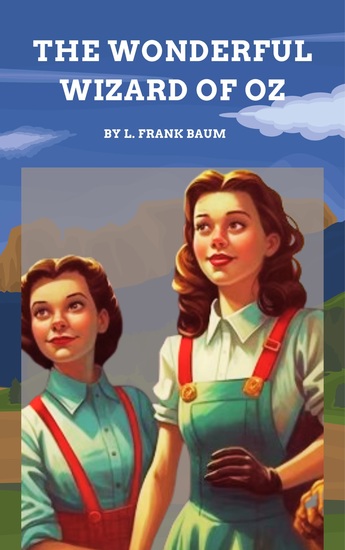
The Wonderful Wizard of Oz - A Magical Journey to the Emerald City - cover

The Wonderful Wizard of Oz - A Magical Journey to the Emerald City

L. Frank Baum, Zenith Crescent Moon Press

Publisher: Zenith Crescent Moon Press

  • 0
  • 0
  • 0

Summary

🌈 Step into the world of wonder and adventure! Join Dorothy Gale, a brave young girl from Kansas, and her loyal dog Toto as they are swept away by a cyclone to the enchanting Land of Oz. Along the Yellow Brick Road, Dorothy befriends the Scarecrow, the Tin Man, and the Cowardly Lion, all seeking the great Wizard in the Emerald City to grant their heart's desires. 🌟

📖 The Wizard of Oz by L. Frank Baum is a timeless tale of courage, friendship, and self-discovery. With dazzling adventures, vibrant characters, and unforgettable lessons, this classic story has captured the hearts of readers for generations. Whether you're revisiting this childhood favorite or discovering it for the first time, its charm never fades. ✨

👥 An enduring masterpiece of children's literature, The Wizard of Oz has inspired countless adaptations and continues to bring joy and imagination to readers of all ages. 📚

🎯 Follow the Yellow Brick Road today! Click "Buy Now" to join Dorothy and her friends on their extraordinary journey to Oz! 🦁🌟
Available since: 03/17/2025.
Print length: 200 pages.

Other books that might interest you

  • Being Cosmopolitan - A Political Approach - cover

    Being Cosmopolitan - A Political...

    Luke Ulas

    • 0
    • 0
    • 0
    What does it mean to be cosmopolitan? Typically, cosmopolitanism is understood as a broad moral orientation, involving some kind of commitment to global moral equality. On this understanding, to be cosmopolitan is simply to evidence that moral orientation oneself. By contrast, Being Cosmopolitan takes up a thoroughly political approach. The focus is on what it might mean, and what it is like, to be political in a distinctly cosmopolitan form. What it means to be cosmopolitan in this thoroughly political sense cannot involve appeal to any particular moral orientation, because politics is about, inter alia, the contestation of such orientations and commitments. Instead, this book offers an account that is based upon the internalization of particular kind of global "social imaginary," involving the imagination of a global public to which certain issues—or global public affairs—are understood to pertain. 


    Within which kind of global order is it possible, or comfortable, for a cosmopolitical agent to live? In answer to this question, the book argues against the viability of both a world of self-determining peoples, and of "pluralist" global visions—both of which are popular with moral cosmopolitan theorists.
    Show book
  • Plato's Apology - cover

    Plato's Apology

    Plato

    • 0
    • 0
    • 0
    Socrates is on trial for his life. He is charged with impiety and corrupting young people. He presents his own defense, explaining why he has devoted his life to challenging the most powerful and important people in the Greek world. The reason is that rich and famous politicians, priests, poets, and a host of others pretend to know what is good, true, holy, and beautiful, but when Socrates questions them they are shown to be foolish rather than wise.
    Show book
  • How We See Us - Young People Imagining a Path to Their Futures - cover

    How We See Us - Young People...

    Michaela M. Leslie-Rule, Nancy...

    • 0
    • 0
    • 0
    In How We See Us, Michaela Leslie-Rule amplifies the voices of young people approaching adulthood as they consider their experiences, needs, and goals for their education, early careers, and lives. Leslie-Rule encourages adults who support young people to listen more closely to youth voices so that their perspectives are centered in interventions made on their behalf. 


    Based on in-depth interviews, surveys, and focus groups of nearly 4,000 students from Black and Hispanic communities and low-income households in both urban and rural regions across the United States, the book finds thoughtful self-reflection and an optimistic mindset in the stories of the youths' successes and challenges. The rich accounts of how they experience their identities, communities, education, and employment refute dominant narratives that so often frame their abilities in terms of deficits and that suggest that young people, and students of color especially, live in a perpetual state of crisis. 


    Leslie-Rule advocates for listening more deeply to young people and provides a framework to improve practice. Such consideration, she argues, enables educators, policymakers, and researchers to better address the barriers students experience in building and navigating pathways to education, career, and adulthood.
    Show book
  • A World More Concrete - Real Estate and the Remaking of Jim Crow South Florida - cover

    A World More Concrete - Real...

    N.D.B. Connolly

    • 0
    • 0
    • 0
    Many people characterize urban renewal projects and the power of eminent domain as two of the most widely despised and often racist tools for reshaping American cities in the postwar period. In A World More Concrete, N. D. B. Connolly uses the history of South Florida to unearth an older and far more complex story.  Connolly captures nearly eighty years of political and land transactions to reveal how real estate and redevelopment created and preserved metropolitan growth and racial peace under white supremacy.  Using a materialist approach, he offers a long view of capitalism and the color line, following much of the money that made land taking and Jim Crow segregation profitable and preferred  approaches to governing cities throughout the twentieth century.A World More Concrete argues that black and white landlords, entrepreneurs, and even liberal community leaders used tenements and repeated land dispossession to take advantage of the poor and generate remarkable wealth.  Through a political culture built on real estate, South Florida’s landlords and homeowners advanced property rights and white property rights, especially, at the expense of more inclusive visions of equality. For black people and many of their white allies, uses of eminent domain helped to harden class and color lines.  Yet, for many reformers, confiscating certain kinds of real estate through eminent domain also promised to help improve housing conditions, to undermine the neighborhood influence of powerful slumlords, and to open new opportunities for suburban life for black Floridians. Concerned more with winners and losers than with heroes and villains, A World More Concrete offers a sober assessment of money and power in Jim Crow America.  It shows how negotiations between powerful real estate interests on both sides of the color line gave racial segregation a remarkable capacity to evolve, revealing property owners’ power to reshape American cities in ways that can still be seen and felt today.
    Show book
  • Kickstart Your American Accent - Step-by-Step Accent Training for American English - cover

    Kickstart Your American Accent -...

    American English Tutoring

    • 0
    • 0
    • 0
    You're frustrated with not being understood. You're tired of shying away from conversations and presentations that hinder your career progress and social connections.  
    Kickstart Your American Accent has the “mysterious secrets” that non-native speakers seek on their journey to speaking clear, fluent American English. These are secrets even native speakers often overlook!  
    This audiobook offers top-notch, in-depth instruction paired with the easiest-to-follow practice activities ever! We’re talking step-by-step guidance here…because a little extra help never hurt anyone!Structured Learning: Focuses on listening and “feeling” your mouth positions first, ensuring you can confidently correct yourself when speaking.Comprehensive Practice: Includes exhaustive exercises that start at the simplest sound level and gradually progress to syllables, words, phrases, sentences, reading, and ultimately, conversation practice, so you don’t get stuck.Clear Instructions: Provides easy-to-understand guidance without all the confusing jargon. 
    Make today the day you choose to have clear, articulate American pronunciation!
    Show book
  • Emperor Nero - The Treacherous Lustful Cruel Emperor Who Killed His Own Mother - cover

    Emperor Nero - The Treacherous...

    Kelly Mass

    • 0
    • 0
    • 0
    Nero Claudius Caesar Augustus Germanicus, the fifth and final emperor of the Julio-Claudian dynasty, ruled the Roman Empire from AD 54 to 68. He was thrust into the highest seat of power at the age of sixteen after being adopted by Emperor Claudius, his stepfather. While Nero enjoyed popularity among the lower classes and the Praetorian Guard, who benefited from his patronage, the Roman aristocracy and Senate viewed him with contempt. Ancient historians portray him as a tyrannical and self-indulgent ruler, notorious for his extravagance, cruelty, and disregard for tradition. His reign ended in disgrace when the Senate declared him a public enemy, leading to his suicide at the age of thirty.  
    Born in AD 37 in the coastal town of Antium, Nero was the son of Gnaeus Domitius Ahenobarbus and Agrippina the Younger, a great-granddaughter of Emperor Augustus. His father died when he was only two years old, and his mother soon remarried, securing a position of influence at the imperial court. When Agrippina married Emperor Claudius, she maneuvered to have her son adopted as his heir, ultimately sidelining Claudius’ biological son, Britannicus. Following Claudius’ suspicious death in AD 54—widely believed to have been orchestrated by Agrippina—Nero ascended the throne with the backing of the Senate and the powerful Praetorian Guard.  
    In the early years of his reign, Nero was heavily influenced by a triad of advisers: his ambitious mother Agrippina, the philosopher and statesman Seneca the Younger, and the Praetorian prefect Sextus Afranius Burrus. Initially, the empire benefited from their guidance, as Nero enacted policies that were generally seen as moderate and pragmatic. However, as he grew older, he sought to rule independently, resenting the influence of his mother.
    Show book