Join us on a literary world trip!
Add this book to bookshelf
Grey
Write a new comment Default profile 50px
Grey
Subscribe to read the full book or read the first pages for free!
All characters reduced
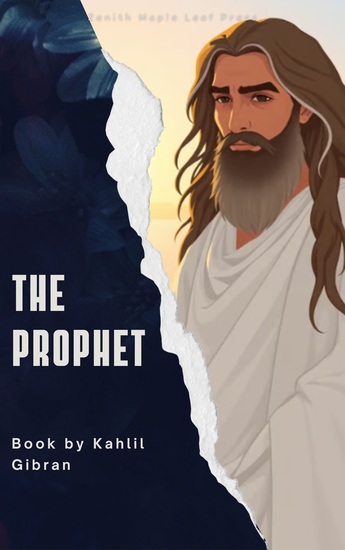
The Prophet - A Timeless Masterpiece of Love Wisdom and Spiritual Reflection - cover

The Prophet - A Timeless Masterpiece of Love Wisdom and Spiritual Reflection

Kahlil Gibran, Zenith Maple Leaf Press

Publisher: Zenith Maple Leaf Press

  • 0
  • 0
  • 0

Summary

"Your children are not your children. They are the sons and daughters of Life's longing for itself."

Few books in history have touched hearts across cultures and generations quite like Kahlil Gibran's The Prophet. First published in 1923, this slim volume of poetic essays has become one of the most beloved works of modern spiritual literature.

In 26 lyrical meditations, the Prophet Almustafa shares profound insights on life's deepest themes: love, marriage, freedom, work, joy, sorrow, beauty, and death. Written in poetic, almost biblical language, the book invites readers to pause, reflect, and reconnect with universal truths.

🌍 Translated into more than 100 languages
📖 Sold over millions of copies worldwide
❤️ Cherished by leaders, thinkers, and everyday readers alike

Whether read as a source of daily wisdom, a gift for a loved one, or a companion during life's transitions, The Prophet continues to inspire with its simplicity, beauty, and timeless wisdom.

✅ Why You'll Love This Edition:

🌟 A literary and spiritual classic for seekers of truth

💬 Poetic meditations that speak directly to the soul

🎁 Perfect as a gift for weddings, graduations, or milestones

🎯 Let Gibran's timeless words guide you—Click 'Buy Now' and experience the wisdom of The Prophet today.
Available since: 08/18/2025.
Print length: 89 pages.
Other books that might interest you

  • The Ten Commandments In Poems - cover

    The Ten Commandments In Poems

    Ron E. Hignite

    • 0
    • 0
    • 0
    Ronald E. Hignite - author of The Beatitudes in Poems - demonstrates in The Ten Commandments in Poems his poetic skills and provides greater understanding and meaning for God's laws for mankind. 
    Listeners will be inspired by the manner and design by which the events at Mt. Sinai are described in poetry and rhyme. This audio-book contains 12 poems, with one on each of the Ten Commandments, along with an introductory and closing poem. 
    Ronald E. Hignite was born in North Carolina and grew up in Connersville, Indiana. He returned to North Carolina with his family after high school and attended East Carolina University in Greenville, NC. There he earned both his undergraduate and graduate degrees. Following college, he taught English at Fork Union Military Academy in Fork Union, VA. After two years in Fork Union, he moved back to northeastern North Carolina where he spent most of his educational career in the towns of Washington, Camden, Murfreesboro, and Ahoskie. His interest in writing poetry was sparked while in college with his readings of the English poets, Byron, Shelley, and Keats. 
    ©2013 Ronald E. Hignite (P)2013 Ronald E. Hignite
    Show book
  • Eumenides - cover

    Eumenides

    Aeschylus

    • 0
    • 0
    • 0
    The final play of the Oresteia, called The Eumenides (Εὐμενίδες, Eumenídes), illustrates how the sequence of events in the trilogy ends up in the development of social order or a proper judicial system in Athenian society. 
    In this play, Orestes is hunted down and tormented by the Furies, a trio of goddesses known to be the instruments of justice, who are also referred to as the "Gracious Ones" (Eumenides). They relentlessly pursue Orestes for the killing of his mother. However, through the intervention of Apollo, Orestes is able to escape them for a brief moment while they are asleep and head to Athens under the protection of Hermes. Seeing the Furies asleep, Clytemnestra's ghost comes to wake them up to obtain justice on her son Orestes for killing her.
    Show book
  • A Ballad of Death - A poetic examination of grief and lost love - cover

    A Ballad of Death - A poetic...

    Algernon Charles Swinburne

    • 0
    • 0
    • 0
    Algernon Charles Swinburne was born on April 5th, 1837, in London, into a wealthy Northumbrian family.  He was educated at Eton and at Balliol College, Oxford, but did not complete a degree.  
    In 1860 Swinburne published two verse dramas but achieved his first literary success in 1865 with Atalanta in Calydon, written in the form of classical Greek tragedy. The following year "Poems and Ballads" brought him instant notoriety. He was now identified with "indecent" themes and the precept of art for art's sake.  
    Although he produced much after this success in general his popularity and critical reputation declined. The most important qualities of Swinburne's work are an intense lyricism, his intricately extended and evocative imagery, metrical virtuosity, rich use of assonance and alliteration, and bold, complex rhythms.  
    Swinburne's physical appearance was small, frail, and plagued by several other oddities of physique and temperament. Throughout the 1860s and 1870s he drank excessively and was prone to accidents that often left him bruised, bloody, or unconscious. Until his forties he suffered intermittent physical collapses that necessitated removal to his parents' home while he recovered.  
    Throughout his career Swinburne also published literary criticism of great worth. His deep knowledge of world literatures contributed to a critical style rich in quotation, allusion, and comparison. He is particularly noted for discerning studies of Elizabethan dramatists and of many English and French poets and novelists. As well he was a noted essayist and wrote two novels. 
    In 1879, Swinburne's friend and literary agent, Theodore Watts-Dunton, intervened during a time when Swinburne was dangerously ill. Watts-Dunton isolated Swinburne at a suburban home in Putney and gradually weaned him from alcohol, former companions and many other habits as well.  
    Much of his poetry in this period may be inferior but some individual poems are exceptional; "By the North Sea," "Evening on the Broads," "A Nympholept," "The Lake of Gaube," and "Neap-Tide."  
    Swinburne lived another thirty years with Watts-Dunton. He denied Swinburne's friends access to him, controlled the poet's money, and restricted his activities. It is often quoted that 'he saved the man but killed the poet'.  
    Swinburne died on April 10th, 1909 at the age of seventy-two.
    Show book
  • Routes - cover

    Routes

    Rhiya Pau

    • 0
    • 0
    • 0
    At the core of this debut collection is a question – what is worth holding onto?
    Through poetic experiments that blend the academic and the artistic, Rhiya Pau queries complex characters and tender landscapes. Routes journeys from Ba's kitchen in Sonia Gardens to Independence hour in Delhi, across the pink shores of Nakuru, to meet a painter on Lee High Road.
    Celebrating fifty years since her community arrived in the UK, Pau chronicles the migratory histories of her ancestors and simultaneously lays bare the conflicts of identity that arise from being a member of the East African-Indian diaspora. In this multilingual discourse exhibiting vast formal range, Pau wrestles with language, narrative and memory, daring to navigate their collective fallibilities to architect her own identity.
    '[Routes]...holds up to the light the wisdom of the past, and asks what else is passed down along with it...a work of humane intelligence, formal experiment and linguistic verve' - Sarah Howe, Judge of Eric Gregory Awards 2022
    Show book
  • Encyclopaedia - cover

    Encyclopaedia

    Chloe Elliott

    • 0
    • 0
    • 0
    Chloe Elliott's Encyclopaedia is playful and visceral, exploring boundaries of identity and the search for meaning in poems that delight with richly tactile language. Formally varied, these poems are unflinching in their physicality.
    Show book
  • Unwoven - Poetry of Form and Release - cover

    Unwoven - Poetry of Form and...

    Steven Chisnell

    • 0
    • 0
    • 0
    What difference in a little poetic structure?  Across 17 traditional forms of poetry–from ballad and sonnet to ghazal and ZaniLa Rhyme–writer, podcaster, and educator Steve Chisnell juxtaposes similar poems in both traditional styles and free verse, "Poetry of Form and Release," to explore the effects of poetic construction on meaning itself. Along the way, his speakers find their lives torn, unraveled, or dangling as they wrestle with aging, memory, love, myth, and the promise of language. From Waywords Studio, Chisnell's first book is a layered and provocative collection rich in ironies and meanings found not merely in its words but in the patterns beneath them, not merely in the verse but in the spaces between. The book includes an extensive section of author notes on the inspiration for the poems and as a primer on the meaning in forms. More extensive materials for classroom students and teachers are also available.
    Show book