Join us on a literary world trip!
Add this book to bookshelf
Grey
Write a new comment Default profile 50px
Grey
Subscribe to read the full book or read the first pages for free!
All characters reduced
History of the CIA in the New Century - Knowing Everything and Understanding Very Little - cover

History of the CIA in the New Century - Knowing Everything and Understanding Very Little

Kenny Hart

Publisher: MKT

  • 0
  • 0
  • 0

Summary

STOP THINKING INFORMATION EQUALS CONTROL. START LEARNING WHY IT DOESN’T.In the new century, the CIA built machines to collect everything—calls, data, signals, movements. Satellites watched. Algorithms listened. Files multiplied. Yet the world grew more unstable, not less. This is the story of an intelligence agency that knew more than any institution in history—and still struggled to predict what actually mattered.THIS ISN’T A SPY THRILLER. IT’S A STUDY IN LIMITS.Inside, discover how technological dominance collided with human complexity, how mountains of data obscured judgment, and how speed replaced understanding. From counterterrorism to cyber conflict, the agency faced a paradox: perfect visibility without clear insight, action without certainty.POWER WITHOUT CONTEXT IS NO POWER AT ALL.This book reveals how the CIA’s modern era exposed the gap between surveillance and wisdom, between knowing facts and understanding people. It’s a history of intelligence in an age of noise—and a warning about what happens when seeing everything still isn’t enough. 
Available since: 12/14/2025.
Other books that might interest you

  • The Impact of Populism - How Populist Policies Affect Global and National Governance - cover

    The Impact of Populism - How...

    Arlo Holders

    • 0
    • 0
    • 0
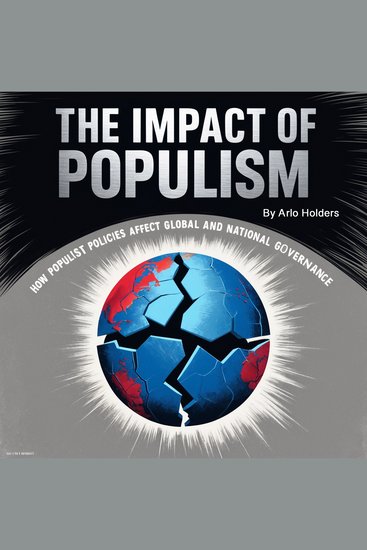
    Populism has become one of the most significant political phenomena of the 21st century, influencing governance on a global scale. The term "populism" has been used to describe a wide range of political movements, parties, and ideologies, but its meaning often remains fluid and context-dependent. At its core, populism is a political approach that seeks to represent the interests of "the people" against a perceived elite or establishment that is seen as corrupt, self-serving, and out of touch with the common citizen. While this core idea is consistent, the ways in which populism is expressed and implemented vary dramatically depending on the political, cultural, and economic context. 
    The roots of populism stretch back to the 19th century, with early movements advocating for the empowerment of ordinary citizens, particularly in agricultural societies. However, the modern manifestation of populism began to take shape in the mid-20th century and accelerated in the 21st century, fueled by growing disillusionment with traditional political elites. The rise of social media, economic inequality, and a globalized world have all contributed to populism's recent resurgence, particularly in Western democracies. 
    Contemporary populism is often characterized by a charismatic leader who claims to speak directly for the people, bypassing traditional political institutions and sometimes challenging the rule of law. These leaders often portray themselves as outsiders, positioned against the political establishment, and frequently use simple, direct rhetoric that resonates with disaffected voters. The populist narrative, which pits the common people against the elite, is one of the most powerful tools in shaping public opinion and driving political discourse.
    Show book
  • Public Safety: A Necessity - cover

    Public Safety: A Necessity

    O. T. Osawaru

    • 0
    • 0
    • 0
    A community without public safety will be like the land of Israel in those days when there was no king in Israel—everyone does what seems good to them. They kill at will, rape both men, women, and children at will, steal at will, and whatsoever seems good to them, just like the animal kingdom. 
    I, O. T. Osawaru, the author of this book, observed that our societies are gradually becoming lawless. The police and other public safety departments were defunded while empowering criminals and making them heroes. Hence the need to write this book. And to shift our focus on the consequence of these acts and bring back law and order in our societies to preserve lives and properties. 
    After listening to this book, I pray you will become an advocate for the need for public safety and the funding of every public safety body—furthermore, to encourage every public safety officer for their noble service in our societies.
    Show book
  • The Postmodern Predicament - Existential Challenges of the Twenty-First Century - cover

    The Postmodern Predicament -...

    Bruce Ackerman

    • 0
    • 0
    • 0
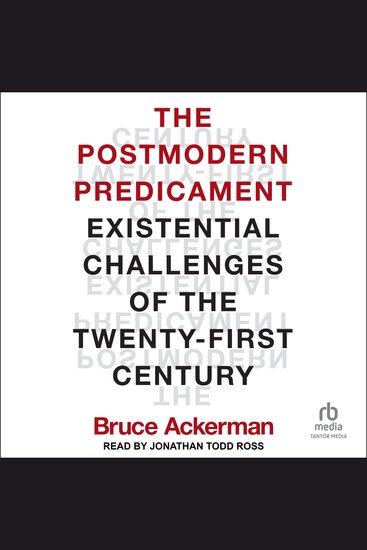
    Human beings have taken one thing for granted since our earliest days: we are bodily creatures dealing with one another on a face-to-face basis. The internet has shattered this fundamental feature of human existence. We are suddenly living our lives in two worlds at once—shifting endlessly from virtual to physical reality as we reach out to others. 


    Worse yet, we are developing different personal identities in our two worlds. We say and do things in virtual reality that flatly contradict our face-to-face commitments to family, friends, and fellow-workers—and vice versa. The Postmodern Predicament explores these dilemmas at each phase of the life cycle, beginning at the moment a young child picks up a cell phone. 


    The existentialist tradition of the twentieth century provides a precious perspective on our postmodern dilemmas. Thinkers and doers like Simone de Beauvoir and Jean-Paul Sartre considered the fragmentation of modern life as a central source of contemporary anxieties. Like them, Ackerman views the challenges of the internet age as a political, no less than personal, problem—and proposes concrete reforms that that could mobilize broad-based support for democracy against demagogic assaults on its very foundations.
    Show book
  • NATO After Russia's Invasion of Ukraine - Threat Perceptions and Their Consequences - cover

    NATO After Russia's Invasion of...

    Jason W. Davidson

    • 0
    • 0
    • 0
    A revealing look at differing threat perceptions in six key NATO countries 
     
    When Russia began its full-scale invasion of Ukraine in February 2022, analysts and policymakers highlighted the unifying shock that NATO members experienced. However even before the return of US president Donald Trump, beneath this seeming cohesion lay deep-seated differences in how member states perceive and prioritize security threats. 
     
    NATO after Russia's Invasion of Ukraine analyzes the six most influential members of the alliance: the United States, the United Kingdom, France, Germany, Poland, and Italy. Through extensive interviews with current and former policymakers and a detailed examination of public statements and policies, Jason W. Davidson delivers a unique assessment of how divergent threat perceptions influence the NATO allies' major defense decisions, such as defense spending, and whether the alliance addresses each ally's most important threat and its view of NATO's most important challenges. With the rise in tumultuous geopolitical challenges posed by Russia, China, terrorism, mass refugee flows, and nationalism, this book provides the crucial context needed to navigate NATO's evolving role in international security.
    Show book
  • A Room of One's Own - cover

    A Room of One's Own

    Virginia Woolf

    • 0
    • 0
    • 0
    'Women have served all these centuries as looking glasses possessing the magic and delicious power of reflecting the figure of man at twice its natural size.'
    
    Based on two lectures Woolf delivered at the University of Cambridge, A Room of One's Own compellingly argues for women's intellectual freedom and the importance of financial independence. It is still considered one of the most powerful pieces of feminist writing to this day.
    
    Published in 1929, A Room of One's Own asserts a simple message: in order for women to reach their full creative potential, they must have their own money and space with which to do it with. Drawing from the careers of the extraordinary female authors who came before her – such as Jane Austen, the Brontë sisters and Aphra Behn – Woolf stresses just how crucial access to education is, particularly in an environment which fails to support women's liberty. She cleverly asks us to imagine that Shakespeare had a sister – equal in genius, talent – and poses the question: would her legacy be the same if her means to create were stumped? As incisive as it is intelligent, A Room of One's Own is a searing social commentary for the ages. This audiobook edition is brilliantly read by Karen Cass.
    Virginia Woolf (1882 – 1941) was one of the most significant novelists of the twentieth century. A modernist writer and progressive thinker, she is known for her stream of consciousness narrative style and influence on feminist criticism. Her works have been translated into over fifty languages and are widely read and adapted to this day.
    Show book
  • India's Turn - cover

    India's Turn

    Suyash Gupta

    • 0
    • 0
    • 0
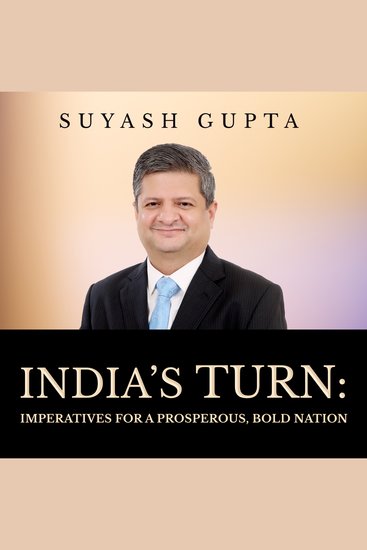
    The decade has clearly seen India regain its mojo with the nation, well on its way to a $5 trillion economy - almost an obligatory pursuit, for the world’s most populous country – a nation of 1.4 billion aspirations. 
    In "India’s Turn: Imperatives for A Prosperous, Bold Nation”, author Suyash Gupta offers a gripping narrative of India's journey - to claim its rightful place in the global world order. 
    Gupta talks about 31 key contexts as pillars, towards India’s emergence as a global leader. He discusses key impact areas like education, public health, energy security and more. He highlights the necessity of pushing structural reforms across several sectors – with a consistent focus to ensure inclusivity, in each policy decision.  
    From governance to infrastructure, the role of leadership, gender equality, youth potential, push for sustainability, smart cities, social and commercial entrepreneurship, and the promise of research and development, the book covers all. 
    Gupta talks about the role of not just the government, but the citizenry as well, in ‘Nation Building’.  
    This must-read book isn't just about identifying challenges; it’s a call to action. Gupta crisply discusses the musts and underlines the need for a shared, progressive vision and that of a collective effort for a brighter, bolder future of a nation in transformation, for - it indeed is, “India’s Turn”. 
    Show book