Join us on a literary world trip!
Add this book to bookshelf
Grey
Write a new comment Default profile 50px
Grey
Subscribe to read the full book or read the first pages for free!
All characters reduced
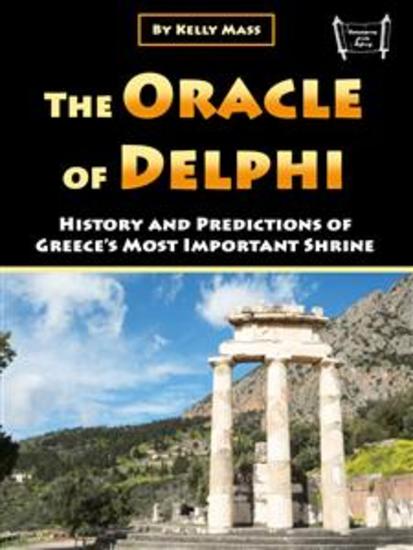
The Oracle of Delphi - History and Predictions of Greece’s Most Important Shrine - cover

The Oracle of Delphi - History and Predictions of Greece’s Most Important Shrine

Kelly Mass

Publisher: Efalon Acies

  • 0
  • 0
  • 0

Summary

An oracle is an individual or entity believed to convey wise and prophetic advice, particularly regarding precognition of the future, with inspiration drawn from divine sources. It falls within the realm of divination.

The term "oracle" originates from the Latin verb rre, signifying "to speak," and denotes the priest or priestess responsible for delivering the prophecy. In a broader context, "oracle" encompasses both the physical location of the oracle and the prophetic utterances, known as khrsm 'tresme' in Greek.

Walter Burkert notes the existence of "frenzied women through whose lips the God speaks" in the Near East, tracing back to Mari in the second millennium BC and Assyria in the first millennium BC.
In Egypt, the goddess Wadjet, depicted as a snake-headed woman or one with two snake-heads, held her oracle at the renowned temple of Wadjet, known as Buto in Greek. The oracular tradition believed to have traveled from Egypt to Greece is thought to find its roots in Wadjet's oracle. Arthur Evans drew parallels between Wadjet and the "Minoan Snake Goddess."
Available since: 12/13/2023.


Other books that might interest you

  • The US COVID-19 Crisis - What Experienced 2020 What Learned 2021 What Now 2022? - cover

    The US COVID-19 Crisis - What...

    tim allston

    • 0
    • 0
    • 0
    The Washington Post, April 27, 2022:  
    When White House Chief Medical Advisor Dr. Anthony Fauci declared then and there that the U.S. was finally “out of the pandemic phase” of COVID-19, . . . 
    . . . That pushed tim allston - probably the world’s first COVID-19 victim-turned-Victorious - to publish his experiences in print, digital, audio, and video book formats beginning in mid-July, the week following his 68th birthday, . . .  
     . . . And to make The U.S. COVID-19 Crisis: What Experienced 2020 . . . What Learned 2021 . . . What Now 2022? available also as a fundraiser for charitable and nonprofit organizations*, to recoup revenues lost during coronavirus’ two-year pandemic phase. 
    WHY THIS AUTHOR? 
    A two-time Amazon best-selling author, allston represents and intersects three of the most vulnerable groups to COVID-19: people of color, males, and over 65.  
    He tested COVID-19 positive in 2020, recovered successfully in 2021, and now shares his journey and the lessons he learned. - against the backdrop of current events and newsmakers, and in the light of Biblical best practices. 
    Available for only a limited time as a 2-for-1 print(or digital)/audiobook combination, let The U.S. COVID-19 Crisis: What Experienced 2020 . . . What Learned 2021 . . . What Now 2022? become now your GPS for 2022 and beyond – written, narrated, and now made visual by this COVID-19 victim-turned-Victorious! 
    *For more information, visit info@timallston.com.
    Show book
  • Investigating the Pied Piper of Hamelin - cover

    Investigating the Pied Piper of...

    Michael Finney

    • 0
    • 0
    • 0
    The Pied Piper of Hamelin is a legendary figure from medieval Germany. This enigmatic character has been shrouded in mystery for centuries, with various interpretations and adaptations appearing across literature, art, and popular culture. 
    “Investigating the Pied Piper of Hamelin" takes readers on a journey through the history and folklore surrounding this perhaps mythical figure. The book examines how the legend has evolved over time, influenced by various cultural and literary traditions as well as connections to the larger canon of fairy tales. 
    This audiobook provides an insightful look at:The historical context of Hamelin's rat infestation and its possible connections to real-life eventsThe symbolism and significance of the Pied Piper as a figure representing both good and evil forces
    Show book
  • Scotland’s Forgotten Past - A History of the Mislaid Misplaced and Misunderstood - cover

    Scotland’s Forgotten Past - A...

    Alistair Moffat

    • 0
    • 0
    • 0
    Entertaining and provocative, this book from an expert on Scotland's cultural heritage reveals the lost history of an ancient, proud nation. 


    While Scotland's history cannot be separated from its kings and queens, saints, and warriors, there is a rich story to tell about the country's lesser-known places, people, and events. This colorful history of Scotland from award-winning writer Alistair Moffat chooses episodes, half-forgotten or misunderstood, that have been submerged by the wash of history. Bringing these stories to light and to life, this entertaining book reveals the richness and complexity of this nation on the northwest edge of Europe. 


    He takes us from the geological formation of the land that makes up Scotland to the first evidence of human habitation and then up to modern times. In the process our discoveries include: the cave of headless children; the origins of the Scottish kings and the real heroes of Scottish independence; the invention of tartan and the romance of the Highlands; Scotland's answer to Shakespeare; the many US presidents with Scottish heritage, and other fascinating tales. Even the most knowledgeable history buff will experience a sense of newfound knowledge and appreciation for this unique country, its history, and its people.
    Show book
  • Operation Fortitude: The History of the Deception Campaign that Confused the Nazis Ahead of the Normandy Landings - cover

    Operation Fortitude: The History...

    Editors Charles River

    • 0
    • 0
    • 0
    During the first half of 1944, the Americans and British commenced a massive buildup of men and resources in the United Kingdom, while Allied Supreme Commander Dwight D. Eisenhower and military brass planned the details of an enormous and complex amphibious invasion of Europe. The most obvious place for an invasion was just across the narrow English Channel, and the Germans had built coastal fortifications throughout France to protect against just such an invasion. 
    Cloaking the vastest amphibious landing in history in layers of shrouding misdirection represented an undertaking second only in ambitiousness to the grand seaborne invasion itself, yet with Operation Bodyguard, the Allies attempted precisely that task in regards to 1944's D-Day. Bodyguard would, if successful, confuse the Wehrmacht occupiers of France about the actual place where Operation Overlord would ultimately come ashore. A further element of Bodyguard was Operation Fortitude. Fortitude marked one of the most ambitious deception plans in the history of warfare. Fortitude was divided into two parts, North and South. Both parts involved the creation of fake armies, one based in Edinburgh in the north and one on the southeast coast of England which threatened Pas de Calais, the most obvious area of France for invasion. The Allies went to remarkable lengths to ensure the success of the operation. A fictional U.S. Army group under George Patton was created in the south. Every effort was made to ensure operational security while also allowing the Germans to see the dummy war material. 
    The success or failure of these planned misdirections would have deadly serious consequences for the men wading ashore through the Normandy surf in early summer of 1944. Put simply, the difference in the number and deployment of German forces facing them could determine if they succeeded or failed.
    Show book
  • Francisco Pizarro: A short biography - 5 Minutes: Short on time – long on info! - cover

    Francisco Pizarro: A short...

    5 Minutes, 5 Minute Biographies,...

    • 0
    • 0
    • 0
    Francisco Pizarro, Spanish explorer and conqueror: Life and work in a short biography! Everything you need to know, brief and concise. Infotainment, education and entertainment at its best!
    Show book
  • 5 Biggest Civil War Battles The: The History of the 5 Deadliest Battles Between the Union and Confederacy - cover

    5 Biggest Civil War Battles The:...

    Editors Charles River

    • 0
    • 0
    • 0
    Americans have long been fascinated by the Civil War, marveling at the size of the battles, the leadership of the generals, and the courage of the soldiers. Since the war's start over 150 years ago, the battles have been subjected to endless debate among historians and the generals themselves. 
    By 1863, the Civil War had reached a level of ferocity not yet seen, and the 5 biggest battles would take place in 1863-1864, starting with Chancellorsville. Of all the Civil War battles fought, and of all the victories achieved by Robert E. Lee at the command of the Confederate Army of Northern Virginia, the Battle of Chancellorsville is considered the most tactically complex and ultimately the most brilliant Confederate victory of the war. Despite being outnumbered by over 2-1, Lee's army won a battle that saw 30,000 casualties inflicted upon the two sides. 
    Less than 2 months later, the Army of the Potomac and Army of Northern Virginia faced off in the most famous and biggest battle of the war at Gettysburg. Day 1 of the battle would have been one of the 25 biggest battles of the Civil War itself, and it ended with a tactical Confederate victory. But over the next two days, Lee would try and fail to dislodge the Union army with attacks on both of its flanks during the second day and Pickett’s Charge on the third and final day. Meade’s stout defense held, barely, repulsing each attempted assault, handing the Union a desperately needed victory that ended up being one of the Civil War’s turning points. 
    The second bloodiest battle of the Civil War came in September 1863 at Chickamauga, which saw George H. Thomas save the Union Army of the Cumberland from a disaster on the second day of the battle after a Union blunder had created a gap in the line. After nearly 35,000 casualties suffered by the two sides, Thomas prevented the destruction of the Union army by Braxton Bragg's Army of Tennessee.
    Show book