Join us on a literary world trip!
Add this book to bookshelf
Grey
Write a new comment Default profile 50px
Grey
Subscribe to read the full book or read the first pages for free!
All characters reduced
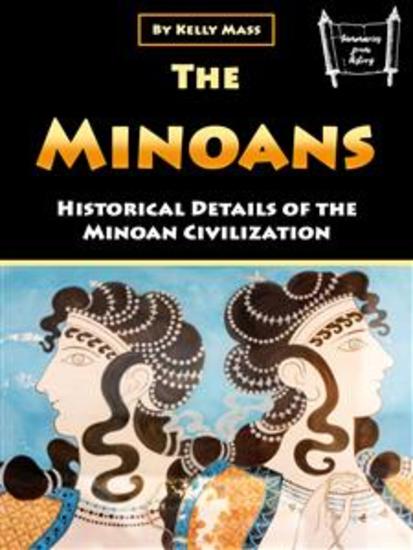
The Minoans - Historical Details of the Minoan Civilization - cover

The Minoans - Historical Details of the Minoan Civilization

Kelly Mass

Publisher: Efalon Acies

  • 0
  • 0
  • 0

Summary

Around 3500 BC, the Minoan civilization emerged in the Bronze Age Aegean, taking root on Crete and neighboring Aegean Islands. The development of a complex urban society started around 2000 BC, reaching its peak and later declining from approximately 1450 BC to around 1100 BC during the early Greek Dark Ages.

This civilization marked Europe's inaugural advanced society, leaving behind monumental architectural complexes, intricate art, and written systems. Their economic prosperity was fueled by an extensive commercial network spanning much of the Mediterranean.

Sir Arthur Evans, a British archaeologist, rediscovered the civilization in the early twentieth century and coined the term "Minoan," drawing inspiration from the legendary King Minos and associating it with the labyrinth of the Minotaur at Knossos. Historian Will Durant hailed the Minoans as "the first link in the European chain" and described them as pioneers in Europe.
The Minoans constructed expansive palaces featuring advanced plumbing systems and towering frescoes, with the palace of Knossos ranking as the most impressive, followed by Phaistos. Despite the grandeur of these structures, the exact purpose of the palaces, along with other aspects of Minoan governance and religion, remains uncertain.

Trade played a pivotal role in Minoan society, connecting Crete with Aegean and Mediterranean settlements, particularly in the Near East. Their cultural influence extended to the Cyclades, the Old Kingdom of Egypt, Cyprus with its copper resources, Canaan, the Levantine coast, and Anatolia, facilitated by traders and artists. The preserved city of Akrotiri on Santorini, though devastated by the Minoan eruption, offers a glimpse into Minoan artistry.
Available since: 12/13/2023.
Other books that might interest you

  • In Our Truck and Camper We Traveled to the States - cover

    In Our Truck and Camper We...

    Larry D. Oliverson

    • 0
    • 0
    • 0
    In the heart of America's vast wilderness, two men and a loyal dog embark on a journey that goes beyond the physical terrain they travel across. Jim Hanson, a seasoned auto mechanic, and his best friend Ted Jones, a ruggedly charming "bad boy," pack up Jim's trusty Ford Bronco and head into the northern mountains for a weekend of camping. But this trip is more than just an escape from their city lives. It's a journey through the maze of memories, dreams, and the enduring bond of friendship. As they drive through the challenges of the wild, from unexpected encounters with bears to the simple joy of sitting around a campfire, they reflect on their pasts and confront the realities of their future. In our Truck and Camper, We Traveled to the States is a memoir, a tale of adventure, resilience, and self-discovery. Through vivid storytelling, Larry D. Oliverson captures the essence of friendship and the unyielding spirit of those who seek solace in nature's embrace.
    Show book
  • The New Kingdom of Egypt - Empire and Expansion - cover

    The New Kingdom of Egypt -...

    Omar Khalil

    • 0
    • 0
    • 0
    The rise of the New Kingdom marks one of the most pivotal periods in Egyptian history, signaling the transformation of Egypt from a regional power to an expansive empire. This era began with the fall of the Middle Kingdom, a time of political instability and foreign invasions. As Egypt struggled with weak leadership and incursions from Asiatic and Nubian forces, the foundations were laid for the emergence of a new, more robust regime. 
    The decisive moment came with the reign of Ahmose I, who is credited with founding the 18th Dynasty and expelling the Hyksos invaders from the Delta region. Ahmose's victory over these foreign rulers was symbolic not only of military prowess but also of a reassertion of Egyptian identity and unity. This victory allowed the pharaohs of the New Kingdom to solidify their power and embark on territorial expansion that would characterize much of their rule. 
    Ahmose's successors built upon his military success. They began to push Egypt's borders further into Nubia to the south and the Levant to the north, extending Egypt’s reach and influence. The New Kingdom was thus defined by an ambitious policy of imperial expansion, which required a well-organized military and a stable central government. The initial successes of the 18th Dynasty laid the groundwork for the period's most famous rulers, such as Thutmose III, whose campaigns in Syria and Palestine created an empire that stretched far beyond Egypt’s traditional borders.
    Show book
  • More - Life on the Edge of Adventure and Motherhood - cover

    More - Life on the Edge of...

    Majka Burhardt

    • 0
    • 0
    • 0
    As one of the world’s leading female professional rock and ice climbers, Majka Burhardt and her husband led globe-trotting, adventure-seeking lives. When she learns that she’s pregnant—with twins—Burhardt at first tries to justify her insistence on pursuing extreme risk in the face of responsibility. But she is ultimately forced to grieve the avalanche of emotions that accompanies any major life transitions along with the physical changes in her own body. 
    Based on the letters and journals Burhardt diligently kept over the course of those six years, More takes the reader on an around-the-world journey as Burhardt explores the transformative, identity-shifting experience of motherhood and its irreversible impact on career, identity, marriage, and self. 
    In the early weeks of her children's lives, Burhardt immerses herself in adoration for her twins and grappling with the tremendous guilt and struggle around having to return to risk-laden work and that ever elusive balance mothers everywhere seek amidst it all.  
    As the newness of her twins fades into a permanent reality, Burhardt turns her attention towards her marriage and the collateral damage as she and her husband, Peter, struggle to navigate their new normal. As anger and resentment threaten the foundation of her family, Burhardt courageously looks to her past—and her own mother's tumultuous and confusing history of success, violence, and ragged divorce—to better understand her own way forward. How will she break free from the legacy of her own childhood to start fresh with her own family?  
    Raw, candid, and galvanizing, More is a passionate and poignant testament to the enduring power of love and our lifelong journey to understand ourselves as we strive to always pursue more.
    Show book
  • Discovering India: A Guide for First Time International Travelers in 2025 - cover

    Discovering India: A Guide for...

    M V

    • 0
    • 0
    • 0
    Planning your first trip to India? "Discovering India: A Guide for First-Time International Travelers in 2025" is your guide to navigating this vibrant and diverse country. From iconic landmarks like the Taj Mahal to serene backwaters in Kerala, we cover the must-visit destinations, practical tips, and cultural insights to make your journey unforgettable. Perfect for first-time travelers, this guide ensures a safe, meaningful, and enriching experience in one of the world’s most captivating destinations. Listen now and embark on the adventure of a lifetime!
    Show book
  • Spotting Danger Before It Spots You - Build Situational Awareness To Stay Safe - cover

    Spotting Danger Before It Spots...

    Gary Dean Quesenberry, Lt. Col....

    • 0
    • 0
    • 0
    Spotting danger before it happens is a skill that can be developed and may even save your life.
    
    Understand the threat
    
    Build situational awareness
    
    Develop personal defenses
    
     
    A mother dropping her teenager off at the mall, a young man leaving home for college, a family about to head out on their first trip overseas. What do all of these people have in common? They all have a vested interest in their personal security and the wellbeing of those they love. According to the FBI’s Uniform Crime Report, there were an estimated 1.25 million violent crimes committed in the United States in 2018. 
    
     
    Make no mistake; in a world filled with crime and violence, you are your own last line of defense. 
    
     
    Continuing on the path of The Gift of Fear (Gavin deBecker), Spotting Danger Before It Spots You, author Gary Quesenberry breaks down the basic techniques necessary to help you develop good situational awareness and increase your levels of personal safety. Gary calls upon his extensive background as a Federal Air Marshal and defensive tactics instructor to explain these methods in simple terms that will greatly improve your general understanding of how, when and where violence occurs. He will then take the next critical step—providing you with the tools you need to properly identify and evade danger before it ever has a chance to materialize.
    
     
    You will learn
    
    The common traits of predatory behavior
    
    How to conduct a personal “safety check”
    
    How to develop strong awareness skills
    
    What to do when you spot potential trouble
    
    Staying safe and living life free of worry and fear


    “Today more than ever, it is imperative that we pay close attention to our surroundings and learn how to interpret what’s happening around us. Tragic events can often be both predictable and preventable.” — Federal Air Marshal Gary Quesenberry
    Show book
  • Venetian Empire - The Grand History of the Venetians - cover

    Venetian Empire - The Grand...

    Kelly Mass

    • 0
    • 0
    • 0
    When we think of Venice, we think of masks, canals, murals and frescoes, and little “gondoliers” with picturesque boats. Venice, indeed, has an impressive artistic history. But did you know that Venice was also, for a while, a considerably-sized empire? 
    Although no enduring historic records associate with the creation of Venice, the Republic of Venice's history is typically said to start at 12 a.m. on Friday, March 25th, AD 421, when authorities from Padua established the city to develop a trading center in that area of northern Italy. 
    The creation of the Venetian republic is said to have accompanied the starting of the church of St. James at the exact same time. Still, the church (which is believed to be that of Saint Giacomo di Rialto) dates no earlier than the l lth century, and no after the mid-twelfth century. 
    According to legend, the area's first residents were Hun and Germanic refugees escaping succeeding waves of Hun and Germanic intrusions from the mid-second to mid-fifth centuries, who originated from near Roman cities like Padua, Aquileia, Treviso, Altino, and Concordia (contemporary Concordia Sagittaria), and the undefended countryside. 
    Let’s dive deeper into the history of the Venetian Empire. Let’s find out what made them so unique and successful at what they did.
    Show book