

Join us on a literary world trip!
Add this book to bookshelf
Grey
Write a new comment Default profile 50px
Grey
Subscribe to read the full book or read the first pages for free!
All characters reduced
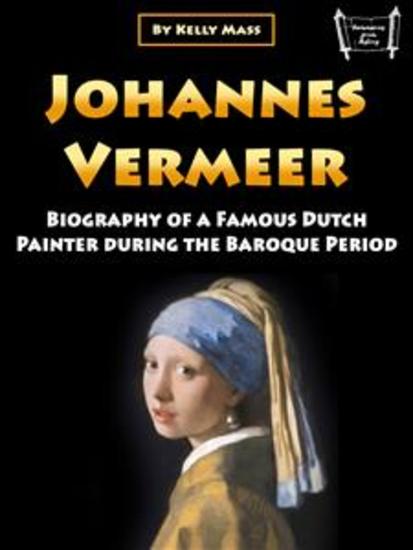
Johannes Vermeer - Biography of a Famous Dutch Painter during the Baroque Period - cover

Johannes Vermeer - Biography of a Famous Dutch Painter during the Baroque Period

Kelly Mass

Publisher: Efalon Acies

  • 0
  • 0
  • 0

Summary

Johannes Vermeer, a Dutch painter renowned for his nuanced portrayals of intimate interior scenes depicting middle-class life, left an indelible mark during the Baroque Period. Despite being a moderately successful provincial genre painter, he enjoyed recognition in Delft and The Hague.

However, his financial circumstances did not mirror his artistic acclaim, and at the time of his demise, Vermeer left his wife and children grappling with debts.

Vermeer's artistic process was characterized by a deliberate and meticulous approach, where he employed a palette of expensive colors. His distinct mastery of light became a hallmark of his work, setting him apart as an artist of exceptional skill and vision.

Hans Koningsberger observed that Vermeer's paintings predominantly unfolded within two small rooms of his Delft residence. These compositions featured recurring furniture and settings, often highlighting the same individuals, primarily women. This thematic consistency added a unique signature to Vermeer's body of work.

Posthumously, Vermeer's celebrity waned into obscurity, leading to his exclusion from notable surveys of Dutch art for over two decades. Arnold Houbraken's influential source book on 17th-century Dutch painting, the "Grand Theatre of Dutch Painters and Women Artists," barely acknowledged Vermeer.

However, a resurgence occurred in the 19th century, spearheaded by Gustav Friedrich Waagen and Théophile Thoré-Bürger. In their influential essay, they attributed 66 paintings to Vermeer, a number that contrasts with the 34 universally recognized today. This rediscovery propelled Vermeer into the limelight, establishing him as one of the preeminent painters of the Dutch Golden Age.
Available since: 01/09/2024.

Other books that might interest you

  • Something Worth Saving - A Memoir of Secrets Betrayals Resilience and Love - cover

    Something Worth Saving - A...

    Mary Means

    • 0
    • 0
    • 0
    “Powerful, vivid, often stunning, along with a warm, friendly, reflective tone.  Amazing.” - Reader, Virginia 
    “… your courage gave me permission to reflect more honestly on my own experience.” - Reader, Michigan                                                                   
    “I can’t express fully what this book means to me. Your words gave voice to experiences I’ve struggled to articulate, and your courage gave me permission to reflect more honestly on my own experience. An honest conversation with my mother was possible because of the truth you shared in yours.” - Reader, Maine 
    What does it take to overcome deeply embedded family traumas, career-ending betrayals, and failed relationships? What is the personal cost of keeping secrets—and staying in the closet? These are questions that Mary Means explores in her memoir, as she navigates growing up as a young closeted lesbian in Georgia during the 1960s and learning to 
    love—and be loved—as an adult. Through the deaths of loved ones, the fear of discovery, and the budding of a legacy that would come to change lives across the nation, Something Worth Saving tells a story of resilience and self-discovery perfect for anyone who has ever struggled to maintain a flawless facade when inside they were crumbling. 
    Mary Means is an award-winning leader, founder of the Main Street revitalization movement that has brought vitality back to countless town centers. Her candor and vulnerability permeate her remarkable story.
    Show book
  • American Legends: The Life of Roy Rogers - cover

    American Legends: The Life of...

    Editors Charles River

    • 0
    • 0
    • 0
    In the early 20th century, Westerns were one of the most popular genres in Hollywood, and one of the young stars at the forefront was Roy Rogers, who had come from an Ohio farm to transform himself into a cowboy. Regardless of his background, Rogers certainly looked the part of the quintessential cowboy, along with his wife Dale Evans and his horse Trigger. His versatile singing and acting abilities made him successful both on radio and on the screen. 
    Rogers came of age at a time when the “singing cowboy” was at the apex of his popularity, and that was favorable because he actually got his start in show business as a singer. In the early ‘30s, he bounced around several groups as a country music singer before earning national attention as a member of the Sons of the Pioneers, who were signed to Decca and had a couple of hits. As a result, when he first appeared in movies in 1935, it was usually in bit roles that required singing, but when Gene Autry threatened to quit acting in 1938, Rogers was viewed as a suitable replacement for lead roles. As it turned out, he became the premiere “singing cowboy” in Autry’s stead, and from 1939-1954, he was one of the Top 10 Western stars in Hollywood, and a Top 10 movie star overall during some of those years. 
    As Rogers evolved into the “King of the Cowboys”, he became a pop culture icon, and he was shrewd enough to capitalize on his image. All sorts of Roy Rogers merchandise hit stores, from action figures to comic strips, and Rogers even banked on the popularity of his horse Trigger by featuring him enough to make the horse a household name as well. Even today, people can find the name Roy Rogers all over the place, if only because he eventually had his name lent to a popular fast food chain in later years.
    Show book
  • Being There - Backstories from the Political Front - cover

    Being There - Backstories from...

    Tony Leon

    • 0
    • 0
    • 0
    ‘On Sunday 2 June 2024, I received a phone call that propelled me again into the swirl of a political drama, with plenty of subplots and prima donnas and lesser villains. In just four weeks, it changed the course of the country.’ 
    In Being There, Tony Leon goes behind the scenes, reflecting on how history is made, both here and around the world, through his unique mixture of anecdote and informed opinion. His vantage point ranges from a ringside seat in the formation of the government of national unity (GNU) – recounted in detail here for the first time – to close encounters with the likes of Harry Oppenheimer, Yasser Arafat and Boris Johnson, and reappraisals of FW de Klerk, Nelson Mandela and Mangosuthu Buthelezi. Leon writes of the dangers of modern politics, from the purgatory of social media to the perils of political fundraising in tough times. The challenge of leadership, in a world often led by populist grifters, runs like a golden thread through the book. Leon reflects on the nostalgia we often feel, through pain and pride, for childhood and schooldays, and the many ‘what-ifs’ that inform a well-lived and varied life on the frontlines of South Africa. Written with his customary blend of humour and flair, and with an eye to the future and what the present and the past can tell us about it, Being There is both important and highly readable
    Show book
  • Exchange is Robbery - From their pens to your ears genius in every story - cover

    Exchange is Robbery - From their...

    Richard Marsh

    • 0
    • 0
    • 0
    Richard Bernard Heldmann was born on 12th October 1857, in St Johns Wood, North London.  
    By his early 20’s Heldmann began publishing fiction for the myriad magazine publications that had sprung up and were eager for good well-written content.  
    In October 1882, Heldmann was promoted to co-editor of Union Jack, a popular magazine, but his association with the publication ended suddenly in June 1883.  It appears Heldman was prone to issuing forged cheques to finance his lifestyle.  In April 1884 he was sentenced to 18 months hard labour. 
    In order to be well away from the scandal and the damage that this had caused to his reputation Heldmann adopted a pseudonym on his release from jail.  Shortly thereafter the name ‘Richard Marsh’ began to appear in the literary periodicals.  The use of his mother’s maiden name as part of it seems both a release and a lifeline. 
    A stroke of very good fortune arrived with his novel ‘The Beetle’ published in 1897.  This would turn out to be his greatest commercial success and added some much-needed gravitas to his literary reputation.   
    Marsh was a prolific writer and wrote almost 80 volumes of fiction as well as many short stories, across many genres from horror and crime to romance and humour.   His unusual characters, plotting devices and other literary developments have identified his legacy as one of the best British writers of his time.   
    Richard Marsh died from heart disease in Haywards Heath in Sussex on 9th August 1915.  He was 57.
    Show book
  • Still No Word from You - Notes in the Margin - cover

    Still No Word from You - Notes...

    Peter Orner

    • 0
    • 0
    • 0
    A new collection of pieces on literature and life by the author of Am I Alone Here?, a finalist for the NBCC Award for Criticism 


    From the acclaimed fiction writer about whom Dwight Garner of the New York Times wrote, "You know from the second you pick him up that he's the real deal," comes Still No Word from You, a unique chain of essays and intimate stories that meld the lived life and the reading life. For Orner, there is no separation. Covering such well-known writers as Lorraine Hansberry, Primo Levi, and Marilynne Robinson, as well as other greats like Maeve Brennan and James Alan McPherson, Orner's highly personal take on literature alternates with his own true stories of loss and love, hope and despair. In his mother's copy of A Coney Island of the Mind, he's stopped short by a single word in the margin, "YES!"—which leads him to conjure his mother at twenty-three. He stops reading Penelope Fitzgerald's The Beginning of Spring three quarters of the way through because he knows that finishing the novel will leave him bereft. Orner's solution is to start again from the beginning to slow the inevitable heartache. 


    Still No Word from You is a book for anyone for whom reading is as essential as breathing.
    Show book
  • The Shield of Heracles - cover

    The Shield of Heracles

    Hesiod

    • 0
    • 0
    • 0
    The Shield of Heracles is an archaic Greek epic poem that was attributed to Hesiod during antiquity. The subject of the poem is the expedition of Heracles and Iolaus against Cycnus, the son of Ares, who challenged Heracles to combat as Heracles was passing through Thessaly.It has been suggested that this epic may reflect anti-Thessalian feeling after the First Sacred War (595–585 BCE): in the epic, a Thessalian hero interfering with the Phocian sanctuary is killed by a Boeotian hero (Heracles), whose mortal father Amphitryon had for allies Locrians and Phocians. This was a pastiche made to be sung at a Boeotian festival at midsummer at the hottest time of the dogstar Sirios.To serve as an introduction, fifty-six lines have been taken from the Hesiodic Catalogue of Women. The late 3rd- and early 2nd-century BCE critic Aristophanes of Byzantium, who considered the Catalogue to be the work of Hesiod, noted the borrowing, which led him to suspect that the Shield was spurious.
    Show book
