Join us on a literary world trip!
Add this book to bookshelf
Grey
Write a new comment Default profile 50px
Grey
Subscribe to read the full book or read the first pages for free!
All characters reduced
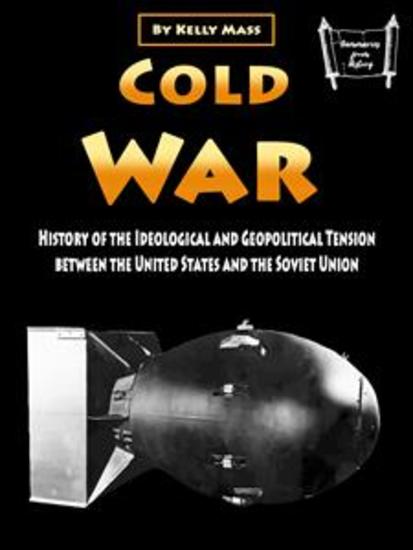
Cold War - History of the Ideological and Geopolitical Tension between the United States and the Soviet Union - cover

Cold War - History of the Ideological and Geopolitical Tension between the United States and the Soviet Union

Kelly Mass

Publisher: Efalon Acies

  • 0
  • 0
  • 0

Summary

Between 1947 and 1991, the United States and the Soviet Union engaged in an escalating geopolitical confrontation known as the Cold War. Historians differ on the exact start and end dates of this period, with some pointing to the Truman Doctrine in 1947 and the dissolution of the Soviet Union in 1991. Throughout this era, there was no direct large-scale warfare between the two superpowers, but they sponsored significant regional conflicts, often referred to as proxy wars, which earned the title of a "cold war." The rivalry began after their temporary alliance and victory over Nazi Germany in 1945, as both countries sought global dominance based on their respective ideologies and geopolitical interests. While nuclear weapons and conventional military forces played a role in this struggle for supremacy, other methods, such as psychological warfare, propaganda, espionage, extensive embargoes, and competition in areas like sports and the Space Race, were also employed.

The Western Bloc, led by the United States and other First World nations, was generally characterized by liberal democratic principles. However, they were often allied with authoritarian regimes, many of which were former colonies of Western powers. On the other hand, the Eastern Bloc, dominated by the Soviet Union and its Communist Party, had a significant influence on the world during and after World War II. Russia supported communist parties and revolutions worldwide, while the United States backed right-wing regimes and movements. The Cold War's battleground extended to nearly every colonial state as they gained independence between 1945 and 1960.
Available since: 01/16/2024.
Other books that might interest you

  • Epic Endurance: Discovering the Secrets of Ultimate Runners - Unlock the secrets of elite runners with thrilling audio lessons for ultimate endurance achievements! - cover

    Epic Endurance: Discovering the...

    Carter Finch

    • 0
    • 0
    • 0
    Epic Endurance: Discovering the Secrets of Ultimate Runners 
    Looking to advance in your career and enhance your expertise by mastering the secrets of elite runners' unmatched endurance? 
    In search of a detailed guide offering all the elements you need to unlock elite runner secrets for unmatched endurance? 
    Your quest ends here! 
    This audiobook is your essential companion for expanding your knowledge, honing your skills, and engaging in practical exercises. With this, you’re set for success. 
    Updated for the latest insights into the world of elite endurance runners. 
    Key features of this enriched guide: 
    - Profound insights into the secrets of ultimate runners 
    - Detailed explanation of unlocking elite runner secrets for unmatched endurance 
    - Effective strategies for preparation and application 
    Our guide stands out with comprehensive coverage vital for your understanding and mastery. Concepts aren’t just touched upon; they are thoroughly examined. 
    Please note that this guide is an independent resource created for your benefit and is not affiliated with any official entity. 
    Structured clearly and articulated in easy-to-understand language, our guide ensures smooth progression through topics. Say goodbye to dense jargon and embrace clear, precise, and technically accurate content. 
    So, why wait? Click the BUY NOW button, secure your guide, and start your journey to uncover the secrets of elite endurance!
    Show book
  • Gold - The Metal That Rules The World - cover

    Gold - The Metal That Rules The...

    Tony Lee Moral

    • 0
    • 0
    • 0
    Explore the fascinating history of gold with this book. 
     
    Why are we so mesmerized by gold? Why is it so revered and so valued? From the earliest times to the present day, humans have been attracted by this sun-coloured metal, sometimes worshipping it, always prizing it. Gold: The Metal that Rules the World investigates the history of this versatile element, examining what it is, how it came to be found on Earth and why it has played such an important part in human history. 
     
    A precious commodity that still rules the world of finance, gold has taken many forms: from statues and beautiful, intricate jewellery to playing a vital role as a delicate component in highly sophisticated technology and, as medical science advances, as part of ever-more crucial treatments for serious illnesses.
    Show book
  • The Magnificent Mischief of Tad Lincoln - cover

    The Magnificent Mischief of Tad...

    Raymond Arroyo

    • 0
    • 0
    • 0
    Read by the author with an audiobook-exclusive Q&A! 
    From New York Times bestselling author and news anchor Raymond Arroyo comes a fun picture book biography of Tad Lincoln, his relationship with his father President Abraham Lincoln, and a story about a parent’s love for his son and the wisdom of a child. Full of humor, this romp through history will teach children about the power of curiosity, imagination, friendship, empathy, determination…and even a little mischief!  
    Tad Lincoln was forever getting into trouble. He bounced around the White House making mischief and annoying almost everyone but the president. Yet Tad was his father’s joy and comfort amidst a brutal war, a family tragedy, and the toll of holding the nation’s highest office. When Tad befriends a turkey meant to be holiday dinner, his plea for the pet to be spared teaches Abe a lesson about mercy. It also starts the tradition of the presidential turkey pardon, a tradition that presidents carry on to this day. 
    In The Magnificent Mischief of Tad Lincoln readers 4-8 will:learn about the larger-than-life personality of Tad Lincoln and his father President Abe Lincoln, highlighting the importance of familysee the impact of empathy and understanding towards othersbe inspired by Tad’s resilience and determination, as he overcomes challenges learning to read and dealing with a speech impedimentenjoy Tad’s mischievous and adventurous spirit, encouraging children to embrace their curiosity, explore new ideas, and make a difference in the lives of others by being themselves
    Show book
  • The Short Story - A Very Short Introduction - cover

    The Short Story - A Very Short...

    Andrew Kahn

    • 0
    • 0
    • 0
    What defines a modern short story is much more than a question of length. Despite the efforts of early pioneers like Edgar Allan Poe, the genre was originally synonymous with the anecdote or tale and seen more as entertainment than art. However it has become far more than that, and this Very Short Introduction considers afresh the form's ongoing innovations in plot construction, capacity for psychological insight, and ability to offer intensely concentrated perceptions. 


    This book charts the rise of the short story from its original appearance in magazines and newspapers. For much of the nineteenth century, tales were written for the press, and the form's history is marked by engagement with popular fiction. From the later nineteenth century, the short story earned a reputation for its skillful use of plot design and character study. After the First World War it found outlets in high-brow publications, and single-author collections, as well as anthologies. 


    Exploring the form's techniques and themes, Andrew Kahn considers the continuity and variation in key structures and techniques such as the beginning, the creation of voice, the ironic turn or plot twist, and how writers manage endings. Throughout he draws on examples from an international and flourishing corpus of work, with close analysis of classic and lesser-known stories.
    Show book
  • Novelty - A History of the New - cover

    Novelty - A History of the New

    Michael North

    • 0
    • 0
    • 0
    If art and science have one thing in common, it’s a hunger for the new—new ideas and innovations, new ways of seeing and depicting the world. But that desire for novelty carries with it a fundamental philosophical problem: If everything has to come from something, how can anything truly new emerge? Is novelty even possible? In Novelty, Michael North takes us on a dazzling tour of more than two millennia of thinking about the problem of the new, from the puzzles of the pre-Socratics all the way up to the art world of the 1960s and ’70s. The terms of the debate, North shows, were established before Plato, and have changed very little since: novelty, philosophers argued, could only arise from either recurrence or recombination. The former, found in nature’s cycles of renewal, and the latter, seen most clearly in the workings of language, between them have accounted for nearly all the ways in which novelty has been conceived in Western history, taking in reformation, renaissance, invention, revolution, and even evolution. As he pursues this idea through centuries and across disciplines, North exhibits astonishing range, drawing on figures as diverse as Charles Darwin and Robert Smithson, Thomas Kuhn and Ezra Pound, Norbert Wiener and Andy Warhol, all of whom offer different ways of grappling with the idea of originality. Novelty, North demonstrates, remains a central problem of contemporary science and literature—an ever-receding target that, in its complexity and evasiveness, continues to inspire and propel the modern. A heady, ambitious intellectual feast, Novelty is rich with insight, a masterpiece of perceptive synthesis.
    Show book
  • Social and Political Philosophy - Investigating the Philosophy of Society Justice and Gender (2 in 1) - cover

    Social and Political Philosophy...

    Hector Davidson

    • 0
    • 0
    • 0
    This book contains these philosophical topics: 
    - Feminist Philosophy: Feminist philosophy has emerged as a critical lens for understanding and deconstructing gender roles, power structures, and the ways in which societal norms shape individual identities. At its core, feminist philosophy challenges traditional, patriarchal systems that often position women and marginalized genders as secondary to men. It is not merely a critique of these systems but an exploration of alternative ways of thinking about power, justice, and equality. Feminist philosophers have sought to unravel the deep-rooted assumptions about gender, questioning how these assumptions limit the full potential of individuals and societies. 
    - Political Philosophy: Political philosophy plays a central role in the development of societies, offering profound insights into the principles and ideas that shape governance and human relations. At its core, political philosophy seeks to understand the fundamental questions of power, authority, justice, and the rights of individuals within a collective. By examining these issues, political philosophy provides a framework for interpreting and evaluating the structures that govern our lives, from the most intimate social arrangements to the global political order. It is through political philosophy that we come to grips with the nature of justice, equality, freedom, and the role of the state in promoting the common good.
    Show book