Begleiten Sie uns auf eine literarische Weltreise!
Buch zum Bücherregal hinzufügen
Grey
Einen neuen Kommentar schreiben Default profile 50px
Grey
Jetzt das ganze Buch im Abo oder die ersten Seiten gratis lesen!
All characters reduced
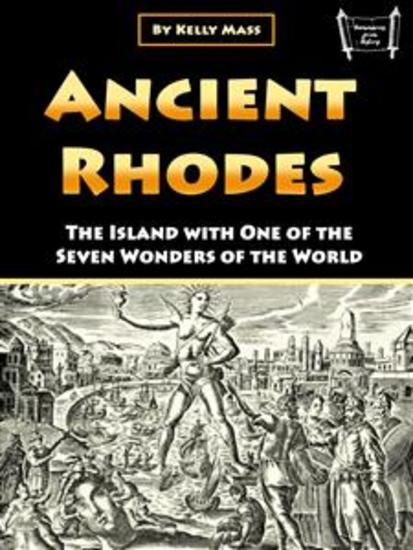
Ancient Rhodes - The Island with One of the Seven Wonders of the World - cover

Ancient Rhodes - The Island with One of the Seven Wonders of the World

Kelly Mass

Verlag: Efalon Acies

  • 0
  • 0
  • 0

Beschreibung

Rhodes, the chief of Greece's Dodecanese archipelago, stands as the historic capital of the cluster. The island operates as a separate municipality within the regional unit of Rhodes, a constituent part of the administrative sector of the South Aegean. Serving as both the largest town and the seat of the municipality is Rhodes.

To put it in perspective, in 2011, the population of the city of Rhodes was 50,636. It's located to the northeast of Crete and southeast of Athens. Rhodes has earned various monikers such as The Island of the Sun, paying homage to its patron sun god Helios, The Pearl Island, and The Island of the Knights, a nod to the Knights of Saint John of Jerusalem who held sway over the island from 1310 to 1522.

An ancient marvel, the Colossus of Rhodes, part of the Seven Wonders of the Ancient World, graces the island's landscape. The Medieval Old Town of Rhodes has garnered
UNESCO's recognition as a World Heritage Site, solidifying its status as one of Europe's premier tourist destinations.

Around the 16th century BC, the Minoans made their presence known on Rhodes, and Greek mythology weaves tales of the Telchines, a native Rhodian race, linking the island with Danaus. It was often referred to as Telchinis. The Mycenaean Greeks entered the scene around the 15th century BCE, marking the end of the Bronze Age collapse, with initial external engagements involving Cyprus.
Verfügbar seit: 13.12.2023.

Weitere Bücher, die Sie mögen werden

  • Anxiety hacks - proven techniques tools and tips to calmness - cover

    Anxiety hacks - proven...

    Kate Hudson-Hall

    • 0
    • 0
    • 0
    Are you exhausted by constantly feeling anxious or worried? 
      
    Are you looking for easy strategies to help you overcome your explosive anxiety? 
      
    In this conversational and life-changing book, anxiety psychotherapist Kate Hudson-Hall will teach you step by step the techniques, tools, and tips taught to thousands of her anxiety clients. 
      
    You will learn how to: 
      
    • Take yourself from being completely overwhelmed by your anxiety to showing you easy ways you can learn to cope with your anxiety behaviors and instantly calm yourself, some in less than 90 seconds. 
    • Use the globally recognized and proven successful "C.A.L.M. Your Alarm" technique to reduce your anxiety instantly. 
    • Improve your life with the support of the FREE companion course containing downloadable worksheets and bonus videos of Kate demonstrating each powerful strategy revealed throughout the book. 
    By the end of Anxiety Hacks, you'll understand why YOU have these challenging anxiety behaviors and HOW you can break through these to a calmer new you. 
    If you are looking for empowering tools to unlock your anxiety and change these painful behaviors then take a read. 
      
    About Kate Hudson-Hall, Dip. AdvHYP (N-SHAP) 
    Personally having suffered from anxiety since age 5, Kate has been an anxiety therapist for the last 22 years. She believes you can reduce and overcome your anxiety with the right tools.
    Zum Buch
  • A Classic Interview with Music Icon Tiny Tim - cover

    A Classic Interview with Music...

    Tiny Tim

    • 0
    • 0
    • 0
    Herbert Butros Khaury (April 12, 1932 - November 30, 1996), also known as Herbert Buckingham Khaury, and known professionally as Tiny Tim, was an American musician and musical archivist. He is especially known for his 1968 hit recording of "Tiptoe Through the Tulips," a cover of the popular song from the 1929 musical Gold Diggers of Broadway. Tiny Tim was renowned for his wide vocal range, in particular his far-reaching falsetto. The following interview was recorded in July 1988.
    Zum Buch
  • A Rare Recording of Orson Welles - cover

    A Rare Recording of Orson Welles

    Orson Welles

    • 0
    • 0
    • 0
    George Orson Welles (May 6, 1915 – October 10, 1985) was an American actor, director, screenwriter, and producer who is remembered for his innovative work in film, radio, and theatre. He is considered to be among the greatest and most influential filmmakers of all time, creating such classics as Citizen Kane, The Third Man and The Magnificent Ambersons.
    Zum Buch
  • Vietnam Combat - Firefights and Writing History - cover

    Vietnam Combat - Firefights and...

    Robin Bartlett

    • 0
    • 0
    • 0
    The year 1968 was arguably the most significant year of the war. It was the height of the American involvement, and because officer casualties had been so great after the Tet Offensive of January 1968, all prior officer assignments were canceled. 


    1st Lieutenant Robin Bartlett suddenly found himself at the "repo-depo" in Bien Hoa reassigned to the 1st Cavalry Division. The unit had more helicopter support than any other unit in Vietnam. Immediate support from artillery, helicopter gunships, and ARA was only minutes away to support a firefight. Wounded troops could be medevaced even in dense jungle using "jungle penetrators." It also meant that Bartlett's platoon could deploy through helicopter combat assaults into hot LZs (landing zones) at a moment's notice if an enemy force had been spotted. And they did. 


    It was with extreme anxiety that Bartlett made his way to join his battalion and company—it was the worst of times to be a platoon leader in Vietnam. Bartlett also had to cope with personal issues of commitment to a war that was rapidly losing support not only back home but among the soldiers he was leading. Fifty years later, Bartlett's vivid combat experiences are brought to light in a fast-moving, well-written, first-person narrative expressing the horror, fear, anguish, and sometimes illogical humor of that war.
    Zum Buch
  • Slave Girls: The Cutting Girl - cover

    Slave Girls: The Cutting Girl

    Louise Allen

    • 0
    • 0
    • 0
    Slave Girls, a new series by bestselling author Louise Allen, reveals a shocking modern-day scandal of County Lines – the single most dangerous form of systematic child abuse prevalent today. 
     
    Charlotte - The Cutting Girl - comes from a family of high achievers. Her father is a politician, and her mother is a senior medical officer. 
     
    When she moves from her prestigious boarding school she is groomed by a girl two years her senior, spiralling into a cycle of drugs, self-harm and sexual abuse. 
     
    When she goes missing, five other girls do, too. A nationwide media campaign sets out to track them down, but can Charlotte ever escape the gang behind the abduction and abuse?
    Zum Buch
  • Archaic Humans: The History of the Different Prehistoric Species in the Genus Homo - cover

    Archaic Humans: The History of...

    Editors Charles River

    • 0
    • 0
    • 0
    The evolutionary path from the original primates to modern man is a long one and has taken many twists and turns, but naturally, as the fossil record grows, scientists gain a more complete understanding of our own mental and physical history in terms of genetics and anatomy. However, the correct order and relationships of the various specimen types are difficult to pin down. Many representative samples have been found in such minute amounts as to not preclude anomalies. They have been discovered in various stages of wear. Modern features did not occur simultaneously or uniformly, taking millions of years to become manifest in later types. Up to the present day’s Homo sapiens, examples of the main types have been hybrids of older and more modern features. 
    	One of the earliest species of the genus Homo to be discovered is Homo habilis, which basically means “handy man.” The name comes from the belief at the time of its discovery that this species was the first to start using stone tools. The first fossils to be uncovered in Olduvai Gorge were from the same stratigraphic layer as simple stone tools. Fossils of the crania and postcranial skeleton for this species have been found in both eastern and southern Africa and date to around 2.5–1.6 million years ago.  
    	Features of Homo erectus suggest an evolution toward modern humans, and the features which separate Homo erectus from the other Homo species are found in the skull. The size of the brain was approximately 900 cc, making it larger than the brain size of Homo habilis. Homo erectus would not have the largest brain capacity of the Homo genus during its existence, with the emergence of Homo heidelbergensis approximately 800,000 years ago. The larger brain size may not matter much when the size of the brain is considered with the size of the body, which also increased. 
    Zum Buch