Join us on a literary world trip!
Add this book to bookshelf
Grey
Write a new comment Default profile 50px
Grey
Subscribe to read the full book or read the first pages for free!
All characters reduced
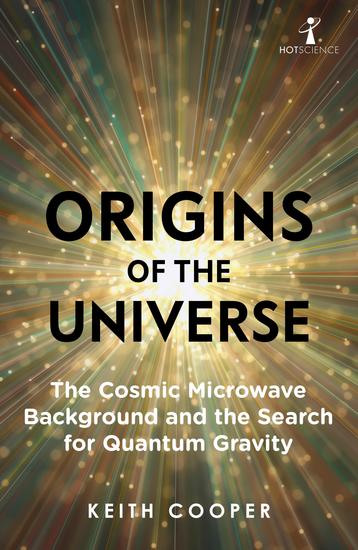
Origins of the Universe - The Cosmic Microwave Background and the Search for Quantum Gravity - cover

Origins of the Universe - The Cosmic Microwave Background and the Search for Quantum Gravity

Keith Cooper

Publisher: Icon Books

  • 0
  • 2
  • 0

Summary

The quest to find a theory of quantum gravity that could potentially explain everything.


Nearly 60 years ago, Nobel Prize-winners Arno Penzias and Robert Wilson stumbled across a mysterious hiss of faint radio static that was interfering with their observations. They had found the key to unravelling the story of the Big Bang and the origin of our universe.

That signal was the Cosmic Microwave Background (CMB), the earliest light in the universe, released 379,000 years after the Big Bang. It contains secrets about what happened during the very first tiny increments of time, which had consequences that have rippled throughout cosmic history, leading to the universe of stars and galaxies that we live in today.

This is the enthralling story of the quest to understand the CMB radiation and what it can tell us of the origins of time and space, from bubble universes to a cyclical cosmos - and possibly leading to the elusive theory of quantum gravity itself.
Available since: 09/03/2020.
Print length: 176 pages.

Other books that might interest you

  • Computer Science 20 Beginners Crash Course - Python Javascript Cyber Security And Algorithms - cover

    Computer Science 20 Beginners...

    ian batantu

    • 0
    • 0
    • 0
    The world of computers is growing at a unrecordable rate every day. Computers are the most influential tools in our lives. They are our present & future. Most users see a computer at the front and use the graphical user interfaces. The first time i used a computer, it intrigued me to know how these interfaces work. In this book you’ll learn the same way i did.
    Show book
  • Agile Transformation with an Agile Coaching Mindset - Adoption of agile methodology in software development - cover

    Agile Transformation with an...

    Jimmy Mathew

    • 0
    • 0
    • 0
    Agile Transformation with an Agile Coaching Mindset: Moving to agile software development. 
    Coaching, Agile Coaching, Transformation, Agile Transformation, Agile Coach, Transformation Coach…. Lots of combinations we hear in everyday life. We are discussing agile transformation here. The approach we follow in this training is “Agile Transformation with an Agile Coaching Mindset”. 
    The dictionary meaning for agile is "able to move quickly and easily". Also, a much talked about attribute of agile is flexibility, ability to respond to changes. 
    How agile can an “agile transformation be"? In our approach, we believe the transformation itself must be agile. It must be an empirical process with an adaptive plan, which is flexible enough to accommodate new learnings accrued during the transformation journey. We keep improving every moment, and the agility evolves as we progress through this journey. 
    We believe in “Agile Transformation with an Agile Coaching Mindset”. 
    Let’s try to list down various phases a typical transformation journey goes through. These steps are negotiable. Based on the organization, team, and environment, these steps may change, be replaced, or be removed. The team may go through phases like… 
    Understand the Organisation, Culture, and Practices; Understand the drivers and set goals; Define Road map; Make Agile visible; Establish Agile training; Align Organisation structure and high-level processes; Start with Agile Practices; Team level transformation; Inspect and Adapt. 
    There is not any specific order for executing many of these steps in our journey. These may even go in parallel or in a different order based on the situation. This book discusses each phase in detail.
    Show book
  • Theoretical Physics - Exploring Advanced Concepts in Physics - cover

    Theoretical Physics - Exploring...

    Mark Hedges

    • 0
    • 0
    • 0
    Theoretical physics is the foundation of our understanding of the universe, providing the mathematical framework that describes physical laws and fundamental interactions. Unlike experimental physics, which relies on observation and experimentation, theoretical physics develops models and equations that predict and explain phenomena, often extending beyond what can currently be tested. From Newton’s laws to Einstein’s theories and quantum mechanics, the field has evolved to encompass a vast range of concepts that shape modern science. 
    Mathematics plays a crucial role in theoretical physics, serving as the language through which physical principles are expressed. Equations such as Newton’s second law, Maxwell’s equations, and Schrödinger’s equation provide precise descriptions of motion, electromagnetism, and quantum mechanics, respectively. The ability to abstractly represent nature through mathematical formalisms allows physicists to derive new predictions and unify disparate concepts. For example, Einstein’s field equations of general relativity describe how mass and energy curve spacetime, leading to predictions of gravitational waves and black holes, both of which were later confirmed through experiments. 
    A key principle in theoretical physics is symmetry, which governs many of the fundamental laws of nature. Symmetries in physical systems often correspond to conservation laws, a relationship formalized by Noether’s theorem. For instance, the symmetry of time invariance leads to the conservation of energy, while spatial symmetry results in the conservation of momentum.
    Show book
  • One-Click to Give - Future Proof Your Fundraising with Social Media - cover

    One-Click to Give - Future Proof...

    Jeremy Berman, Nicky Black

    • 0
    • 0
    • 0
    The world of fundraising is changing.In an increasingly digital world, traditional in-person fundraising events are not enough to support a thriving nonprofit. People want to be able to donate to causes conveniently and on the social platforms where they spend their time. Through their donation, they wish to share in a nonprofit’s mission and connect with a community of supporters. This–and much more–is possible through social giving–a new mode for fundraising.Every nonprofit can leverage social giving to maximize their fundraising potential, energizing their nonprofit to do good. In One-Click to Give, Jeremy Berman and Nick Black, founders of GoodUnited, share how they’ve partnered with nonprofits from across the U.S. to raise over $1 billion through social giving. You’ll learn how to create a future-proof social giving strategy that lays the foundation for a thriving community of supporters.
    Show book
  • Generative AI on AWS - Building Context-Aware Multimodal Reasoning Applications - cover

    Generative AI on AWS - Building...

    Shelbee Eigenbrode, Chris...

    • 0
    • 0
    • 0
    Companies today are moving rapidly to integrate generative AI into their products and services. But there's a great deal of hype (and misunderstanding) about the impact and promise of this technology. With this book, Chris Fregly, Antje Barth, and Shelbee Eigenbrode from AWS help CTOs, ML practitioners, application developers, business analysts, data engineers, and data scientists find practical ways to use this exciting new technology. 


    You'll learn the generative AI project life cycle including use case definition, model selection, model fine-tuning, retrieval-augmented generation, reinforcement learning from human feedback, and model quantization, optimization, and deployment. And you'll explore different types of models including large language models (LLMs) and multimodal models such as Stable Diffusion for generating images and Flamingo/IDEFICS for answering questions about images. 


    You'll also discover how to apply generative AI to your business use cases; determine which generative AI models are best suited to your task; perform prompt engineering and in-context learning; fine-tune generative AI models on your datasets with low-rank adaptation (LoRA); align generative AI models to human values with reinforcement learning from human feedback (RLHF); augment your model with retrieval-augmented generation (RAG); explore libraries such as LangChain and ReAct to develop agents and actions; and build generative AI applications with Amazon Bedrock.
    Show book
  • The Youth Climate Uprising - From the School Strike Movement to an Ecophilosophy of Democracy - cover

    The Youth Climate Uprising -...

    David Fopp, Isabelle Axelsson,...

    • 0
    • 0
    • 0
    Species are going extinct, forests are burning, and children are worried about the future and their peers worldwide. But that is not the whole story: One Friday in 2018, a few young people joined Greta Thunberg to protest, and the global climate strike movement was born. Scientist David Fopp spent 250 Fridays with the newly formed grassroots movements. Together with activists Isabelle Axelsson and Loukina Tille, he offers an insider perspective on how scientists and activists can fight for a just and sustainable global society. The volume also offers both an introduction to ecophilosophy and a unified science of democracy in times of interdependent crises. How can research in all disciplines - from (drama) education and economics to psychology - help with this struggle? And how can we all fight the climate crisis by transforming and deepening democracy?
    Show book