Join us on a literary world trip!
Add this book to bookshelf
Grey
Write a new comment Default profile 50px
Grey
Subscribe to read the full book or read the first pages for free!
All characters reduced
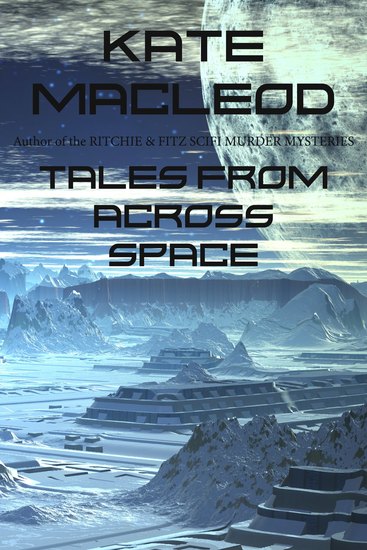
Tales from Across Space - cover

Tales from Across Space

Kate MacLeod

Publisher: Ratatoskr Press

  • 0
  • 0
  • 0

Summary

Tales from Across Space collects five stories from fantasy and science fiction writer Kate MacLeod:
 
The science fiction novelette “Required to Assist,” a mystery set on board a colony ship, where one woman alone is woken by the ship’s droids to solve a murder.
 
“Sword and Tattoo,” a fantasy short story where a stranger stumbles into a hidden town. He brings danger with him, but the people of the town just might be more dangerous still.
 
The science fiction short story “Being Neighborly”, a light-hearted tale of a human family homesteading on a world side by side with a very alien people.
 
“Tumbling Up”, a science fiction short story about a group of diplomats attempting to negotiate a peace with an aquatic alien species.
 
“Death Spiral”, a science fiction mystery where a security officer must solve a murder and keep a strange species of aliens calm at the same time.
Available since: 08/20/2023.
Print length: 94 pages.
Other books that might interest you

  • Top 10 Short Stories The - The 1900's - The Europeans - The ten best stories written from 1900-1909 by European authors - cover

    Top 10 Short Stories The - The...

    Joseph Conrad, Leonid...

    • 0
    • 0
    • 0
    Short stories have always been a sort of instant access into an author’s brain, their soul and heart.  A few pages can lift our lives into locations, people and experiences with a sweep of landscape, narration, feelings and emotions that is difficult to achieve elsewhere. 
     
    In this series we try to offer up tried and trusted ‘Top Tens’ across many different themes and authors. But any anthology will immediately throw up the questions – Why that story? Why that author?  
     
    The theme itself will form the boundaries for our stories which range from well-known classics, newly told, to stories that modern times have overlooked but perfectly exemplify the theme.  Throughout the volume our authors whether of instant recognition or new to you are all leviathans of literature. 
     
    Some you may disagree with but they will get you thinking; about our choices and about those you would have made.  If this volume takes you on a path to discover more of these miniature masterpieces then we have all gained something. 
     
    A new century dawns, but old suffocating ideas live on.  Society seems wary of change until it is forced upon it.  But Europe’s authors seem to have no fear.  They move in relentless pursuit with an energy that must at some near future point challenge everything.   The World begins it short march to catastrophe. 
     
    1 - The Top 10 - The 1900's - The Europeans - An Introduction 
    2 - The Informer by Joseph Conrad 
    3 - Silence by Leonid Nikolaevich Andreyev 
    4 - Tomato Sauce by Hanns Heinz Ewers 
    5 - Putois by Anatole France 
    6 - The Devil's Horse by Ion Luca Caragiale 
    7 - How Treason Came to Russia by Rainer Maria Rilke 
    8 - The Duel by Nikolai Teleshov 
    9 - Cuchulain of Muirthemne. The Only Son of Aoife by Lady Augusta Gregory 
    10 - A Dry Spell by Eimar H Kvaran 
    11 - The Salvation of a Forsythe - Part 1 by John Galsworthy 
    12 - The Salvation of a Forsythe - Part 2 by John Galsworthy
    Show book
  • Sailing the Seven Sustainable Seas - cover

    Sailing the Seven Sustainable Seas

    Martin Chambers

    • 0
    • 0
    • 0
    "What I like about sailing is that it is sustainable. You set the sails and the wind propels and you can go to the end of the world with little extra thought. You don't need too many clothes and certainly you are not a slave to fashion or the need to dress in the latest style. Some locally sourced food and off you go." 
    These entertaining stories of sailing life began when Martin and his wife Kerryn departed from Adelaide on thier run-down yacht. They were headed for Fremantle but they forgot to turn right at Kangeroo Island and arrived in Hobart. It was an easy navigational error to make. 
    Once in Hobart, in order to avoid an almost global pandemic they remained in Tasmania. After all, Tasmania is at the end of the world and even a virus wouldn't want to go there. It was a strategy as successful as their navigation, but here you will hear no sotries of lockdowns or vaccinations. Instead, seven stories about wildlife, onboard catering, waste and power managment. Stories inspired by the reality of sustainable sailing in the same way the desire to sail home to Fremantle resulted in a trip to Tasmania.
    Show book
  • Twenty-Six Men and a Girl - From their pens to your ears genius in every story - cover

    Twenty-Six Men and a Girl - From...

    Maxim Gorky

    • 0
    • 0
    • 0
    Alexei Maximovich Peshkov was born on 28th March 1868, in Nizhny Novgorod, Russia. 
    Better known as Maxim Gorky he was orphaned at 11 and ran away from home at 12.  At 19 he had already attempted suicide and thereafter travelled, by foot, across the Russian Empire for 5 years. 
    His first book ‘Essays & Stories’ in 1898 was a sensation and so began a long career as an author of short stories, novels and plays.  Gorky saw writing as a moral and political act that would help to change the unjust world around him.  He was an ardent early advocate of the emerging Marxist movement and publicly opposed the Tsarist regime leading several times to his arrest.  
    In 1904 he began his own theatre but the censor banned every play and Gorky was forced to abandon the project. 
    But Gorky was a financially successful author, editor, and playwright and gave monies to political parties as well as for civil rights and social reform.  The brutal shooting of workers, which set in motion the Revolution of 1905, pushed Gorky more decisively toward radical solutions.  
    In 1906 he went to the United States to raise funds for the Bolsheviks. Those experiences including a scandal over travelling with his lover and not his wife deepened his contempt for the ‘bourgeois soul.’ 
    Gorky now moved to Capri in Italy, both for health reasons and to escape the increasingly repressive times in Russia.  
    An amnesty for the 300th anniversary of the Romanov dynasty saw him return to Russia in 1914. His politics remained close to the Bolshevik cause.  But soon, after the 1918 revolution, his essays referred to Lenin as a tyrant for his senseless arrests and repression.  He was soon appealing to the outside world for food aid after the catastrophic crop failure. 
    In October 1921 Gorky returned to Italy, now in Fascist hands, and settled in Sorrento until 1932.  His health worsened with the onset of tuberculosis. 
    He wrote several successful books there but now decided to find an understanding with the communist regime. Stalin invited him home and his return was hailed as a major propaganda victory.  He was decorated with the Order of Lenin, and a province, a park, and various streets re-named in his honour. 
    But he had his faults too.  In 1933, Gorky co-edited a book on the White Sea-Baltic Canal and denied even a single prisoner died during its construction, but thousands had. As well, knowing that some Nazis were homosexual, a phrase was attributed to him that said ‘exterminate all homosexuals and fascism will vanish’.  Although he was himself was quoting another he was decidedly homophobic. 
    With the increase of Stalinist repression in 1935 Gorky was placed under unannounced house arrest. 
    Maxim Gorky died on the 18th June 1936 from pneumonia.  He was 68. 
    Stalin and Molotov were among those who carried Gorky's urn of ashes at his funeral.
    Show book
  • Horror Short Stories: Volume 1 - cover

    Horror Short Stories: Volume 1

    Willow Rose

    • 0
    • 0
    • 0
    Two frightening psychological thrillers. Better Watch Out: He sees you when you’re sleeping; he knows when you’re awake. Some kids are scared of the dark, others of monsters living under their beds. Some are even afraid of clowns. None of those things scare Sara. But she is terrified of one man who comes to her house every year in the middle of the night. Santa... Curl up with some frightening Christmas horror from the Queen of Scream, Willow Rose. Warning: You might not feel like putting out cookies for Santa ever again after listening to this short story. The Bird: Everyone's nightmare. When five-year-old Winnie finds a little bird that is hurt, she wants to take it in and take care of it. Her mother is reluctant. She is terrified of birds. As she rightfully should be... Two quick and scary listens, as only Willow Rose can deliver it. Get the audiobook today.
    Show book
  • 3 Stories - Without Character Names - A trio of classic tales perfect for a commute walk or quiet night in - cover

    3 Stories - Without Character...

    Edgar Allan Poe, Franz Kafka,...

    • 0
    • 0
    • 0
    There is something about the number 3.    
     
    The Ancient Greeks believed 3 was the perfect number, and in China 3 has always been a lucky number, and they know a thing or two.   
     
    Most religions also have 3 this and 3 that and, of course, in these more modern times, three’s a crowd may be too many, except when it’s a ménage à trois.  It seems good things usually come in threes. 
     
    Whatever history and culture says WE think 3, a hat-trick of stories, is a great number to explore themes and literary avenues that classic authors were so adept at creating. 
     
    From their pens to your your ears.   
     
    01 - 3 Stories - Stories Without Character Names 
    02 - In the Penal Colony by Franz Kafka 
    03 - The Lady, or the Tiger by Frank Stockton 
    04 - The Black Cat by Edgar Allan Poe
    Show book
  • Virginia Woolf - Six of the Best - Their legacy in 6 classic stories - cover

    Virginia Woolf - Six of the Best...

    Virginia Woolf

    • 0
    • 0
    • 0
    Six has always been a number we group things around – Six of the best, six of one half a dozen of another, six feet under, six pack, six degrees of separation and a sixth sense are but a few of the ways we use this number. 
     
    Such is its popularity that we thought it is also a very good way of challenging and investigating an author’s work to give width, brevity, humour and depth across six of their very best. 
     
    In this series we gather together authors whose short stories both rivet the attention and inspire the imagination to visit their gems in a series of six, to roam across an author’s legacy in a few short hours and gain a greater understanding of their writing and, of course, to be lavishly entertained by their ideas, their narrative and their way with words. 
     
    These stories can be surprising and sometimes at a tangent to what we expected, but each is fully formed and a marvellous adventure into the world and words of a literary master.
    Show book