Join us on a literary world trip!
Add this book to bookshelf
Grey
Write a new comment Default profile 50px
Grey
Subscribe to read the full book or read the first pages for free!
All characters reduced
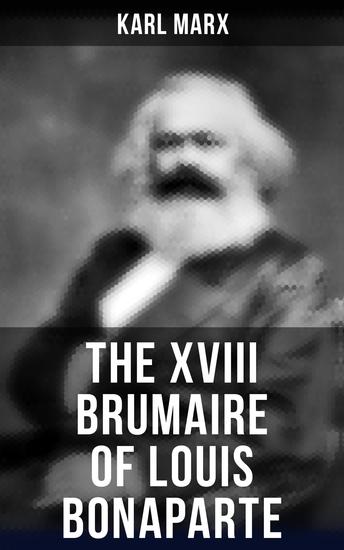
The XVIII Brumaire of Louis Bonaparte - cover

The XVIII Brumaire of Louis Bonaparte

Karl Marx

Publisher: Musaicum Books

  • 0
  • 1
  • 0

Summary

In Karl Marx's 'The XVIII Brumaire of Louis Bonaparte,' the author delves into the political upheaval of France in the mid-19th century, analyzing the rise of Louis Bonaparte to power and the complex social dynamics that shaped the era. Marx's writing is characterized by his incisive critique of capitalism and class struggle, making this work a seminal piece in Marxist literature. His keen observations on historical materialism and the revolutionary potential of the proletariat are evident throughout the book. Karl Marx, a prominent philosopher and economist, was deeply influenced by the social and economic conditions of his time, which led him to develop his theory of communism. His background in philosophy and political activism equipped him with the tools necessary to analyze and critique the political events unfolding in France. 'The XVIII Brumaire of Louis Bonaparte' is a product of Marx's intellectual rigor and revolutionary spirit. I highly recommend 'The XVIII Brumaire of Louis Bonaparte' to readers interested in 19th-century political history, Marxist theory, and the socio-economic forces that drive historical change. Marx's insightful analysis and sharp wit make this book a crucial read for anyone seeking a deeper understanding of class struggle and political power dynamics.
Available since: 12/17/2020.
Print length: 96 pages.

Other books that might interest you

  • The Eighteenth Century - A World History - cover

    The Eighteenth Century - A World...

    John O. Voll

    • 0
    • 0
    • 0
    The eighteenth century was a time of major global transitions. Movements of religious and intellectual revival challenged established ideas, European colonies emerged in the Western hemisphere, global trade expanded, and political revolutions and revolts in America, France, Russia, and Haiti started to reshape political life. At the beginning of the century, power and wealth were roughly balanced among the major regions of the world. By its end, this balance was upset by the emergence of European imperial nation-states and Western European industrial societies whose evolution was enabled by modern processes of industrialization, globalization, and empires. 


    John O. Voll highlights key events and individuals in that transformation, from Emperor Kangxi's meeting with Jesuits and Catherine the Great's imperial expansion of Russia, Jonathan Edwards's Great Awakening and Muhammid ibn Abd al-Wahhab's Islam reform movement to Mulla Abdul Ghafur's trade in cotton, Richard Arkwright's textile factories, and Isaac Newton's and Immanuel Kant's contributions to the Enlightenment and modern science. This book shows that the eighteenth century was a time of transition to modernity, a time when the impact of the first globalization was being felt around the world. Old ways of life disappeared as new ways of organizing human activities emerged.
    Show book
  • Alexander the Great - cover

    Alexander the Great

    Jacob Abbott

    • 0
    • 0
    • 0
    A complete biography of the ancient Macedonian king and one of history’s greatest military leaders.Alexander the Great, son of King Philip II of Macedonia, and his fourth wife, Olympias, seemed destined for success. He had Aristotle for a tutor until he was sixteen. He took interest in his father’s military efforts abroad, and worried there would be nothing left to conquer when he became king. When ambassadors from Persia arrived in Macedonia, they tried to entertain young Alexander with colorful stories of their home, but the future leader was more interested in their armies and war tactics. It should be no surprise that Alexander became one of ancient history’s greatest and most successful military leaders.In this biography, author Jacob Abbott recounts the life and times of Alexander the Great. He takes readers through the king’s early years, including his youth and education, as well as his relationship with his parents. The history continues with Alexander’s ascension to the throne at the age of twenty and details all the drama and military victories over the next ten years of the monarch’s reign as he expanded his empire from Macedonia and Egypt to northwest India. Unfortunately, Alexander’s demise soon followed, but not before he left his mark on the world. Nineteenth-century American author Jacob Abbott wrote many books over the course of his own life from juvenile fiction to history. He wrote numerous biographies on such monumental individuals as Alfred the Great, Queen Elizabeth I, Genghis Khan, Julius Caesar, and Peter the Great.
    Show book
  • The Principal 20 - Three Keys to Maximizing Impact - cover

    The Principal 20 - Three Keys to...

    Michael Fullan

    • 0
    • 0
    • 0
    In 2014 Michael Fullan set his sights on the daily needs of school leaders in his bestselling book The Principal. This updated edition shows how the principal's role continues to change and how we can embrace the transformation in short order. As crucial in-school influencers of student learning, principals have an opportunity and an obligation to maximize student achievement. But how? In The Principal 2.0, Fullan explains why the answer lies neither in micro-managing instruction nor in autonomous entrepreneurialism. He shows a new way forward that allows principals to expand their roles without overstepping and contribute to the development of the whole school. 


    Even in difficult times of crisis, there's room for principals to take action. In The Principal 2.0, Fullan explains how to loosen focus on accountability and instead concentrate on capacity-building; focus less on technology and more on pedagogy; abandon fragmented strategies; and forgo individualistic solutions in favor of collaborative effort. 


    Discover why The Principal is a bestseller in educational leadership and strike out into the future with this new edition, updated for the changing role of today's principals.
    Show book
  • SELF-REGULATION SKILLS - How To Control And Regulate The Learning Process - cover

    SELF-REGULATION SKILLS - How To...

    Brittany Forrester

    • 0
    • 0
    • 0
    Self-regulation can be defined in various ways. In the most basic sense, it involves controlling one's behavior, emotions, and thoughts to pursue long-term goals. More specifically, emotional self-regulation refers to managing disruptive emotions and impulses. In other words, to think before acting. It also reflects the ability to cheer yourself up after disappointments and work in a way consistent with your deepest values. 
    It's easy to see how a lack of self-regulation will cause problems in life. A child who yells or hits other children out of frustration will not be famous among peers and may face reprimands at school. An adult with poor self-regulation skills may lack self-confidence and self-esteem and have trouble handling stress and frustration. Often, this might be expressed in anger or anxiety. In more severe cases, it may be diagnosed as a mental disorder. 
    Self-regulation is also essential because it allows you to follow your deeply held values or social conscience and express yourself appropriately. If you value academic achievement, it will enable you to study instead of slack off before a test. 
    Many students do not possess the self-regulatory skills they need to become high academic performers.  
    Some students have found ways to regulate their learning and develop a system of control that shields them from motivational interference and conflict. Limiting distractions and using music to tune out distractions are students' most common self-regulatory strategies to manage motivational interference and conflict. Other students use athletics.
    Show book
  • How to Live a Happily Ever Afterlife - Stories of Trapped Souls and How Not to Become One - cover

    How to Live a Happily Ever...

    Echo Bodine

    • 0
    • 0
    • 0
    “What happens after we die? What is the Afterlife really like? From her own perspective, Echo shares intimate insights that she has garnered from Spirit about life after death. This book is compelling, thought-provoking, and comforting.”—Chip Coffey, costar, Kindred SpiritsA Psychic's Exploration of Ghosts and How to Prevent It from Happening to You"Echo Bodine is the most genuine psychic I have ever worked with..." —Dennis William Hauck, author of Haunted PlacesWell-known psychic and ghost hunter, Echo Bodine, started seeing spirits as a young girl and has been helping to set them free for decades. Most of these spirits have one thing in common—unfinished business from their lives that leaves them restless, unable to let go and move on. Some souls choose to remain closer to this dimension rather than move into the light when they die.Here, Bodine shares her experiences and compelling investigations that have led her to see the issues from a spirit's living time on Earth which have left them restless and unable to cross over. Each story is accompanied by an exercise that will help the reader avoid the fate of a trapped, angry, or unprepared soul.Some reasons spirits haven't gone through the light include:They don't know they're dead.They are afraid of what could be waiting for them on the other side.They don't believe in an afterlife so they’re stuck in limbo.They are possessive over a person or object.They are terrified of change.How To Live a Happily Ever Afterlife is an eye-opening look at spirits—at what compels and holds them—and what you can do to avoid the same fate. 
    Show book
  • Let There Be Light - Healing and Transformation through Divine Consciousness - cover

    Let There Be Light - Healing and...

    Anila Gada

    • 0
    • 0
    • 0
    Divine light is a metaphorical representation of spiritual illumination that has the power to dispel our inner darkness—the fear, ignorance, negativity, and suffering that hinder our growth. Just as light illuminates a room, divine light illuminates our consciousness, bringing clarity, understanding, and liberation. Recognizing the presence of darkness within ourselves is the first step toward inviting the divine light. It serves as a guide and catalyst for transformation, offering wisdom, compassion, and love. 
    In Let There Be Light: Healing and Transformation through Divine Consciousness, author and healer Anila Gada presents simple yet profound practices that can help us create a receptive space for the divine light to permeate our being. These include meditation, prayer, self-reflection, gratitude, and the cultivation of positive thoughts. By aligning ourselves with the light, we can embrace its transformative power, gain insight into our true nature, and deepen our connection with the divine all of which can help us navigate life’s challenges with grace and equanimity. 
    This book offers tools to embrace divine light, dispel inner darkness, and journey toward self-discovery, healing, and growth, unveiling our true essence.
    Show book