Begleiten Sie uns auf eine literarische Weltreise!
Buch zum Bücherregal hinzufügen
Grey
Einen neuen Kommentar schreiben Default profile 50px
Grey
Jetzt das ganze Buch im Abo oder die ersten Seiten gratis lesen!
All characters reduced
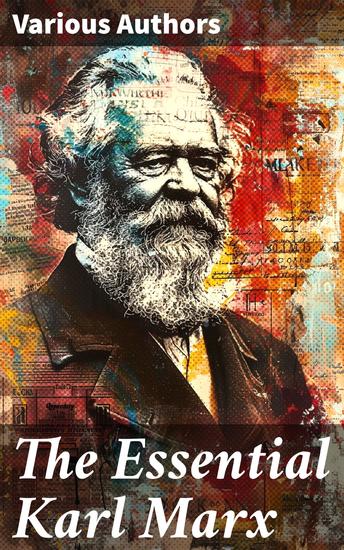
The Essential Karl Marx - Capital Communist Manifesto Wage Labor and Capital Critique of the Gotha Program Wages Price and Profit Theses on Feuerbach - cover

The Essential Karl Marx - Capital Communist Manifesto Wage Labor and Capital Critique of the Gotha Program Wages Price and Profit Theses on Feuerbach

Karl Marx, Florence Kelley, N.I. Stone

Übersetzer Friedrich Engels, Eleanor Marx Aveling, Daniel De Leon, Samuel Moore, Harriet E Lothrop

Verlag: Good Press

  • 0
  • 0
  • 0

Beschreibung

The Essential Karl Marx is a compelling anthology capturing the dynamic interplay of social theory and revolutionary ideology characteristic of Marx's most influential works. The collection spans a range of literary styles from incisive theoretical formulations and critiques of political economy to impassioned calls for social change. Sitting at the intersection of sociopolitical discourse and economic analysis, this anthology showcases pivotal pieces from each stage of Marx's intellectual journey, deftly curated to illuminate the enduring relevance and profound impact of his ideas on contemporary thought. Standout selections underscore the radical yet deeply analytical spirit that propels Marx's enduring legacy. Bringing together contributions from Karl Marx, Florence Kelley, and N.I. Stone, this volume offers readers access to a wealth of perspectives on Marxist thought and its application across various historical and cultural contexts. Florence Kelley's work as a social reformer and N.I. Stone's contributions to economic theory provide complementary insights, enriching the overarching themes of class struggle, labor rights, and economic justice. The diverse backgrounds of these contributors emphasize the global and cross-disciplinary reach of Marx's ideology, underscoring the anthology's alignment with pivotal movements such as labor reform and socialist theory. This collection stands as both a guide and exploration for readers eager to delve into Karl Marx's multifaceted legacy through the prism of diverse perspectives. It offers an unparalleled opportunity to engage with foundational texts and insightful reflections on their impact across different cultural milieus. The Essential Karl Marx should be embraced for its educational breadth, enlightening insights, and its unique ability to foster a robust dialogue between past and present critical thought. This anthology is indispensable for those seeking to understand the profound resonances of Marxism in contemporary society.
Verfügbar seit: 04.12.2023.
Drucklänge: 2607 Seiten.

Weitere Bücher, die Sie mögen werden

  • How To Collect Record Organize & Store All Your Creative Thoughts And Inspirations - You Will Never Lose A Great Idea Ever Again - cover

    How To Collect Record Organize &...

    Cindy Boyce

    • 0
    • 0
    • 0
    Ideas are priceless, they are golden nuggets of the mind and you are not always ready to capture them when the moment of inspiration strikes so over time I have used many different methods to capture every idea that I can and keep them for future use. I have compiled a collection of my best note taking tools so that you have the best chance of collecting all of your ideas as well, in a way that works for you. I have found them all to be useful depending on where I am at the time and what I'm using them for. You will find in this audiobook tools for recording spontaneous ideas and the best ways to store your ideas and inspiration. You will never lose a great idea ever again.
    Zum Buch
  • Partisan Song - A Holocaust Story of Resilience Resistance and Revenge - cover

    Partisan Song - A Holocaust...

    James A. Grymes

    • 0
    • 0
    • 0
    Prior to the Holocaust, Moshe Gildenman lived a simple life as a cultural leader in his hometown of Korets, Ukraine. When the Nazis murdered 2,200 Jews in his peaceful community, including his wife and daughter, Moshe responded not with prayer and grieving but with a cry for revenge. If Moshe was going to die, he was going to take as many Nazis with him as possible. Bearing only a revolver, five bullets, and a Yiddish songbook, Moshe escaped to the forest with his son, a nephew, and nine other Jews. Fighting under the alias Uncle Misha, the engineer devised a number of intricate missions for the small but fearless brigade that became known as Uncle Misha's Jewish Group.Operating in Ukraine under the leadership of their unlikely commander, this undaunted band of brothers and sisters is credited with carrying out more than 150 combat operations, blowing up bridges and other strategic targets. Even after the Nazis were driven out of Ukraine, Uncle Misha insisted on staying in the fight all the way to Berlin, until the last German was defeated. The enthralling and profoundly moving story of Uncle Misha's extraordinary paramilitary success resounds powerfully with the enduring camaraderie he forged around forest campfires and his unyielding dedication to avenging the murders of his loved ones, liberating his homeland, and keeping his people's legacy alive.
    Zum Buch
  • Death in Old Mexico - The 1789 Dongo Murders and How They Shaped the History of a Nation - cover

    Death in Old Mexico - The 1789...

    Nicole von Germeten

    • 0
    • 0
    • 0
    In a Mexico City mansion on October 23, 1789, Don Joaquín Dongo and ten of his employees were brutally murdered by three killers armed with machetes. Investigators worked tirelessly to find the perpetrators, who were publicly executed two weeks later. Labelled the "crime of the century," these events and their aftermath have intrigued writers of fiction and nonfiction for over two centuries. Using a vast range of sources, Nicole von Germeten recreates a paper trail of Enlightenment-era greed and savagery, and highlights how the violence of the Mexican judiciary echoed the acts of the murderers. The Spanish government conducted dozens of executions in Mexico City's central square in this era, revealing how European imperialism in the Americas influenced perceptions of violence and how it was tolerated, encouraged, or suppressed. An evocative history, Death in Old Mexico provides a compelling new perspective on late colonial Mexico City.
    Zum Buch
  • Hearing History Life in 1880s Los Angeles As Told By The Mayor's Daughter - cover

    Hearing History Life in 1880s...

    Belle Buford Thom Collins

    • 0
    • 0
    • 0
    The following is a 1964 recording of Belle Buford Thom Collins, born in 1878, speaking about her childhood in Los Angeles in the 1880s. Mrs. Collins' father, Cameron E. Thom, was the Mayor of Los Angeles between 1882 and 1884. 
     
    Belle Buford Thom Collins, born in 1878, speaking about her childhood in Los Angeles in the 1880s. Mrs. Collins' father, Cameron Erskine Thom (June 20, 1825 – February 2, 1915), born in Culpeper County, Virginia, was an attorney and Confederate officer, wounded at the Battle of Gettysburg, and, later, a California state senator, Los Angeles County district attorney, city attorney and 16th mayor of Los Angeles between 1882 and 1884. 
    Zum Buch
  • Chernobyl - Details of the Worst Nuclear Disaster in History - cover

    Chernobyl - Details of the Worst...

    Kelly Mass

    • 0
    • 0
    • 0
    On April 26, 1986, the world witnessed one of the gravest technological disasters in human history: the Chernobyl nuclear catastrophe. Occurring at the Chernobyl Nuclear Power Plant's No. 4 reactor in Pripyat, then part of the Ukrainian Soviet Socialist Republic, the event not only claimed lives but also left a legacy of environmental and human suffering that persists to this day. This calamity stands as the deadliest nuclear accident in history, both in terms of its immediate human cost and its staggering financial implications. It remains one of only two incidents—alongside the 2011 Fukushima nuclear disaster in Japan—classified as a Level 7 event, the highest rating on the International Nuclear Event Scale.  
    Responding to the crisis required a monumental effort, involving over 500,000 personnel for emergency operations and subsequent environmental cleanup. This massive endeavor cost approximately 18 billion Soviet rubles, a figure equivalent to $68 billion in 2019 when adjusted for inflation. The scale of the response underscores the unprecedented challenges posed by the catastrophe, as well as the Soviet Union's desperate attempts to mitigate its consequences.  
    The disaster itself unfolded during a scheduled safety test designed to assess the reactor's ability to maintain critical operations during a power outage. The test was carried out on an RBMK-type reactor, a design already known to have significant safety flaws. During the test, a sudden and unexpected drop in power output brought the reactor to near-zero levels. The operators, unaware of the reactor's increasing instability due to incomplete and misleading operating instructions, attempted to bring the power back up to the required level. However, these efforts placed the reactor in a precarious and highly unstable state. 
    Zum Buch
  • America’s Greatest Engineering Projects: The Construction History of the Transcontinental Railroad the Panama Canal and the Hoover Dam - cover

    America’s Greatest Engineering...

    Editors Charles River

    • 0
    • 0
    • 0
    The Transcontinental Railroad, laid across the United States during the 1860s, remains the very epitome of contradiction. On the one hand, it was a triumph of engineering skills over thousands of miles of rough terrain, but on the other hand, it drained the natural resources in those places nearly dry. It “civilized” the American West by making it easier for women and children to travel there, but it dispossessed Native American civilizations that had lived there for generations. It made the careers of many men and destroyed the lives from many others. It was bold and careless, ingenious and cruel, gentle and violent, and it enriched some and bankrupted others. In short, it was the best and worst of 19th century America in action. 
    Traveling around the tip of South America was fraught with danger, and European explorers and settlers had proposed building a canal in Panama or Nicaragua several centuries before the Panama Canal was actually built. Taking about 10 years to build, workers had to excavate millions of cubic yards of earth and fight off hordes of insects to make Roosevelt’s vision a reality. Roosevelt also had to tie up the U.S. Navy in a revolt in Colombia to ensure Panama could become independent and thus ensure America had control of the canal. 
    During the 1930s, at the height of the Great Depression, thousands of workers began work on the Hoover Dam, built in the Black Canyon, which had been cut by the powerful Colorado River. The Colorado River was responsible for the Grand Canyon, and by the 20th century, the idea of damming the river and creating an artificial lake was being explored for all of its potential, including hydroelectric power and irrigation. By the time the project was proposed in the 1920s, the contractors vowing to build it were facing the challenge of building the largest dam the world had ever known. As if that wasn’t enough, the landscape was completely unforgiving.
    Zum Buch