Join us on a literary world trip!
Add this book to bookshelf
Grey
Write a new comment Default profile 50px
Grey
Subscribe to read the full book or read the first pages for free!
All characters reduced
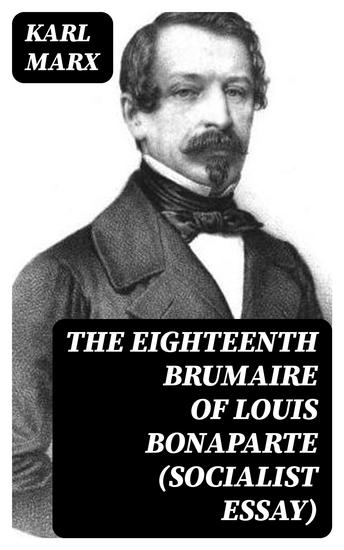
The Eighteenth Brumaire of Louis Bonaparte (Socialist Essay) - cover

The Eighteenth Brumaire of Louis Bonaparte (Socialist Essay)

Karl Marx

Publisher: DigiCat

  • 0
  • 0
  • 0

Summary

In "The Eighteenth Brumaire of Louis Bonaparte," Karl Marx offers a profound analysis of the political events surrounding the 1851 coup d'état in France, illuminating the dynamics of class struggle and the interplay of history and individual agency. Written in a journalistic style interlaced with incisive critique, this essay reflects the turbulence of 19th-century European politics, examining how historical circumstances affect the actions of individuals and the course of society. Marx's exploration of the paradox of a bourgeois democracy forcibly repressing socialist movements showcases his dialectical method and keen understanding of political economy. Karl Marx, a towering figure in social theory and political philosophy, was influenced by the tumultuous socio-political landscape of his time. His experiences as a journalist and his commitment to revolutionary socialism shaped his perspective, leading him to critique not just Louis Bonaparte's authoritarian regime but also the broader capitalist structures underpinning society. Through his writings, Marx sought to provide a framework for understanding the contradictions of capitalism and the implications for social change. This essential text is highly recommended for those interested in political theory, history, and the dynamics of revolutionary movements. Marx's sharp analyses resonate with current political discourses, making this a vital read for anyone seeking to understand the persistent conflicts between authority, democracy, and the struggle for social justice.
Available since: 11/13/2022.
Print length: 96 pages.
Other books that might interest you

  • The Shocking Truth about Legal Rights - cover

    The Shocking Truth about Legal...

    Zoey Fraisers

    • 0
    • 0
    • 0
    Legal rights are the foundation of the modern world, influencing every aspect of our lives. From the moment we are born, we are subject to a complex web of rights that protect our freedoms, safeguard our interests, and ensure our ability to live our lives in a fair and just society. But what exactly are legal rights, and how have they evolved over time? The shocking truth is that many people don’t fully understand the legal rights they are entitled to, nor do they realize how these rights impact them on a daily basis. In this book, we aim to uncover the truths behind legal rights, shedding light on their importance and how they shape the world we live in. 
      
    Legal rights are not a recent concept; they have been developed over centuries, evolving with society's changing needs and values. In early civilizations, rights were often limited and dictated by rulers, leaving little room for individual freedoms. It wasn’t until the rise of democratic societies that the idea of legal rights for all people began to take shape. The Magna Carta, signed in 1215, is one of the earliest examples of a legal document that set the foundation for individual freedoms and legal protections. However, it wasn’t until much later that such rights would become enshrined in the constitutions and laws of nations across the world. 
      
    The significance of legal rights today cannot be overstated. From voting rights to free speech, from the right to a fair trial to protection from discrimination, legal rights play a crucial role in ensuring equality and justice. Without these rights, individuals would have no means of holding authorities accountable or protecting themselves from abuse. In the digital age, the scope of legal rights continues to expand, with new laws aimed at safeguarding personal privacy, intellectual property, and access to technology.
    Show book
  • Political Monopolies in American Cities - The Rise and Fall of Bosses and Reformers - cover

    Political Monopolies in American...

    Jessica Trounstine

    • 0
    • 0
    • 0
    Around the same time that Richard J. Daley governed Chicago, greasing the wheels of his notorious political machine during a tenure that lasted from 1955 to his death in 1976, Anthony “Dutch” Hamann’s “reform” government centralized authority to similar effect in San Jose. In light of their equally exclusive governing arrangements—a similarity that seems to defy their reputations—Jessica Trounstine asks whether so-called bosses and reformers are more alike than we might have realized. Situating her in-depth studies of Chicago and San Jose in the broad context of data drawn from more than 240 cities over the course of a century, she finds that the answer—a resounding yes—illuminates the nature of political power. Both political machines and reform governments, she reveals, bias the system in favor of incumbents, effectively establishing monopolies that free governing coalitions from dependence on the support of their broader communities. Ironically, Trounstine goes on to show, the resulting loss of democratic responsiveness eventually mobilizes residents to vote monopolistic regimes out of office. Envisioning an alternative future for American cities, Trounstine concludes by suggesting solutions designed to free urban politics from this damaging cycle.
    Show book
  • Coming Together - cover

    Coming Together

    Sean McCutcheon

    • 0
    • 0
    • 0
    The book Coming Together provides hope and an action plan for us to work together and fix many of the problems in our country. 
    The U.S. used to provide affordable healthcare, and education. Our people supported workers' rights. We used to invest in our people. We are being told that we can't do those things, and gaslit into thinking that the crippling healthcare and educational debt being forced upon is our fault. 
    Too many times we have used fear to dehumanize people because of the color of their skin, or sexual preference. 
    Many of our politicians gain tremendous wealth and power by keeping us divided and hopeless. 
    We have fought hard to conquer these problems before, and we can do it again. We can work together towards a more honest and just society. We can repair the damage done to our society from the lies we have been told.
    Show book
  • Freedom of Speech - Navigating the Balance Between Expression and Responsibility - cover

    Freedom of Speech - Navigating...

    Marcus Kline

    • 0
    • 0
    • 0
    Freedom of speech is a cornerstone of democratic societies, integral to the exercise of individual autonomy and the pursuit of truth. At its core, it is the right to express ideas, opinions, and beliefs without fear of government reprisal or censorship. This principle is enshrined in numerous legal documents, most notably the First Amendment to the U.S. Constitution, which guarantees "the freedom of speech, or of the press," protecting the individual’s right to speak openly in the public sphere. 
      
    The origins of free speech can be traced back to philosophical and political thinkers of the Enlightenment era, who emphasized the importance of reason, individual rights, and personal liberty. Thinkers such as John Locke, Voltaire, and John Stuart Mill argued that the free exchange of ideas was essential for the flourishing of society, allowing for the progress of knowledge, the correction of errors, and the protection of political freedom. These ideas laid the groundwork for the modern understanding of free expression as a fundamental human right. 
      
    However, the right to free speech is not absolute. Throughout history, the boundaries of this freedom have been tested by a wide range of societal, political, and ethical concerns. From the regulation of speech in times of war or national security threats to the ongoing debates over hate speech, defamation, and misinformation, societies have struggled to find a balance between protecting free expression and safeguarding the common good. This tension continues to shape the debate surrounding free speech, particularly in the context of emerging technologies like social media, which have transformed the landscape of communication.
    Show book
  • Vladimir Lenin collection - The State And Revolution The Three Sources And Three Component Parts Of Marxism - cover

    Vladimir Lenin collection - The...

    Vladimir Lenin

    • 0
    • 0
    • 0
    The Three Sources and Three Component Parts of Marxism, by Lenin, is a concise article that examines the historical roots, essence, and content of Marxist teaching. Lenin wrote it on the 30th anniversary of the death of Karl Marx. 
    Soviet propaganda makers lifted a key quote from the article to use as a slogan for posters, inscriptions on monuments, or other propaganda purposes. The phrase was: "The might of Marx's teaching is in its truth."
    The book, The State and Revolution: The Marxist Theory of the State and the Tasks of the Proletariat in the Revolution, was written while preparing for the socialist revolution. At this time the role of the state was of prime importance to the Bolsheviks. Lenin used the text to justify the need for a dictatorship of the proletariat. He also provided definitions for imperialism, socialism, and communism.
    Show book
  • Foundations of Our Democracy: The Documents that Made America - The Declaration of Independence The US Constitution The Federalist Papers and The US Bill of Rights - cover

    Foundations of Our Democracy:...

    Various Authors

    • 0
    • 0
    • 0
    In 1776, the United States of America was born from a document that declared all men created equal and free to choose who they serve in this world. What followed was a difficult fight against a monarchy, a fight that ended with the creation of a powerful country built on the tenets of freedom and equality. These documents are some of the foundational writings from the earliest days of the country that have shaped the United States government for centuries:The Declaration of Independence – This was the formal decree that the 13 colonies wished to separate from the rule of England. This essay declares that the rulership of England had been unjust and did not give the people living in America proper representation in the government, and declared independence from the King of Great Britain.The Constitution – The Constitution of the United States was adopted as the supreme law of the country in 1789. This document, along with its amendments, is the instruction manual for running the United States’ democracy, from outlining the three branches of government to enacting a protocol for succession of power. The Federalist Papers – The Federalist Papers were a series of articles written by Alexander Hamilton, John Jay, and James Madison. The essays present the reasoning and logic behind each article of the Constitution, and were written to garner congressional support for its ratification. Today, they are used to assist in interpreting the intentions of the original supporters of the Constitution.The Bill of Rights – The Bill of Rights is the set of the first 10 amendments added to the Constitution. These amendments outline inalienable and natural rights for individuals, as well as stating that states have the power to create their own laws for matters not addressed in the Constitution.
    Show book