Join us on a literary world trip!
Add this book to bookshelf
Grey
Write a new comment Default profile 50px
Grey
Subscribe to read the full book or read the first pages for free!
All characters reduced
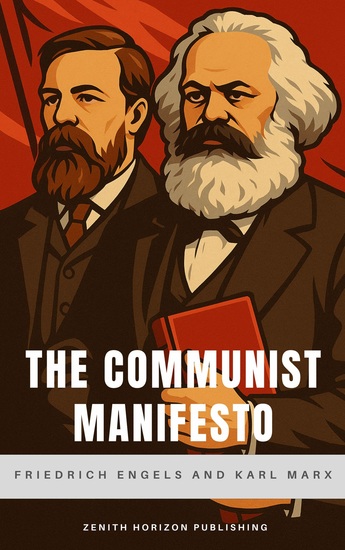
The Communist Manifesto - Karl Marx & Friedrich Engels' Revolutionary Call - cover

The Communist Manifesto - Karl Marx & Friedrich Engels' Revolutionary Call

Karl Marx, Friedrich Engels, Zenith Horizon Publishing

Publisher: Zenith Horizon Publishing

  • 0
  • 0
  • 0

Summary

"Workers of the world, unite!" — A bold declaration that changed history.

The Communist Manifesto, co-authored by Karl Marx and Friedrich Engels, is one of the most influential political documents ever written. Originally published in 1848, this concise yet powerful text outlines the principles of communism, critiques the inequalities of capitalism, and envisions a classless, collective future.

Whether you're a student of history, a political science enthusiast, or simply curious about the roots of socialist thought, this essential edition provides both context and clarity.

📕 This edition includes:

The complete, unabridged original text

Annotations to help modern readers understand key terms and ideas

Historical illustrations and Kindle-optimized formatting

📚 Perfect for classroom study, personal reflection, or political insight.

Understand the ideas that ignited revolutions.
Get your annotated edition today.
Available since: 06/13/2025.
Print length: 29 pages.

Other books that might interest you

  • DARE to Say No - Policing and the War on Drugs in Schools - cover

    DARE to Say No - Policing and...

    Max Felker-Kantor

    • 0
    • 0
    • 0
    With its signature "DARE to keep kids off drugs" slogan and iconic t-shirts, DARE (Drug Abuse Resistance Education) was the most popular drug education program of the 1980s and 1990s. But behind the cultural phenomenon is the story of how DARE and other antidrug education programs brought the War on Drugs into schools and ensured that the velvet glove of antidrug education would be backed by the iron fist of rigorous policing and harsh sentencing. 


    Max Felker-Kantor has assembled the first history of DARE, which began in Los Angeles in 1983 as a joint venture between the police department and the unified school district. By the mid-'90s, it was taught in seventy-five percent of school districts across the United States. DARE received near-universal praise from parents, educators, police officers, and politicians and left an indelible stamp on many millennial memories. But the program had more nefarious ends, and Felker-Kantor complicates simplistic narratives of the War on Drugs. He shows how policing entered US schools and framed drug use as the result of personal responsibility, moral failure, and poor behavior deserving of punishment rather than something deeply rooted in state retrenchment, the abandonment of social service provisions, and structures of social and economic inequality.
    Show book
  • Raising a Bilingual Child - A step-by-step guide for parents - cover

    Raising a Bilingual Child - A...

    Barbara Zurer Pearson

    • 0
    • 0
    • 0
    Raising a Bilingual Child is a guidebook for what to do and what to expect when you're parenting a bilingual-to-be. It can be used as a quick reference to help with a specific strategy, but also provides the bigger picture of the stages learners go through on their path to language and literacy in one, two, or more languages. The book includes many inspirational accounts from parents and childhood bilinguals. It dispels myths about bilingualism and explains how learning multiple languages at a young age can enhance your child's overall intellectual and emotional development. This version is abridged by the author to focus on the most practical advice.
    Show book
  • Native American Tribes: An Enthralling Guide to the Cherokee Chickasaw Choctaw Creek and Seminole - cover

    Native American Tribes: An...

    Billy Wellman

    • 0
    • 0
    • 0
    Do you know the story of the Native American tribes, from the earliest known histories to the first European contact to the modern day?  
    The “Five Civilized Tribes” tried to adapt to the American way of life, while others fought to keep their land. Which was more successful? This audiobook will attempt to tell their story, the story of those five tribes. It will not go back into the distant past, and it will not be able to cover modern issues within the Native American community. But it will tell the story of how a group of people dealt with a world that had suddenly and drastically changed—and continued to change—and how they dealt with these changes as Native Americans. 
    In this audiobook, you’ll learn about:The Five Civilized Tribes: Cherokee, Muscogee (Creek), Seminole, Choctaw, and ChickasawThe role of disease in the European colonization of AmericaGreat Native American fighters like Tecumseh, Crazy Horse, and Black HawkGreat Native American leaders like Pushmataha, Chief John Ross, and Blue JacketWhat role Andrew Jackson played in the Indian Removal ActThe reality of Native Americans who owned slavesThe real story behind the Trail of TearsGreat battles like Fallen Timbers, Tippecanoe, Little Bighorn, and St. Clair's DefeatMassacres at Sand Creek and Wounded Knee and the devastation at Prospect BluffHow the Native Americans used and were used by the Americans, British, and Spanish in the southeastern United StatesAnd so much more! 
     Scroll up and click the “add to cart” button to learn more about Native American tribes!
    Show book
  • Forgotten Souls - The Search for the Lost Tuskegee Airmen - cover

    Forgotten Souls - The Search for...

    Cheryl W. Thompson

    • 0
    • 0
    • 0
    NPR investigative journalist and the daughter of a Tuskegee Airman, Cheryl W. Thompson explores the stories of the 27 Tuskegee Airmen – the Black pilots who fought for America in WWII – who went missing in combat, the lives they lived, the reasons their planes went down, why the remains of all but two were never found, and the impact their disappearances had on their families and communities. 
     
    In 1945, World War II ended one of the deadliest conflicts in history. Geared for battle were nearly 1,000 trailblazing Black pilots trained at the Tuskegee Army Air Field, an unrepentantly segregated facility in Alabama. Hailing from the Iowa cornfields to the Texas Gulf Coast to the tobacco plantations of North Carolina, the Tuskegee Airmen already proved, under the toughest circumstances, to be among the most resilient and defiantly patriotic men of the Army Air Corps. 
     
    27 of them disappeared during the final critical missions in Europe. So, too, would the government’s efforts to find them or help to bring closure to the loved ones that the valiant 332nd Fighter Group left behind. 
     
    In Forgotten Souls, award-winning investigative journalist Cheryl W. Thompson delves into the true stories of the Black combat pilots who faced unimaginable racism—before, during and after the war—from a military that told them they were less than, even as their courage and aviation prowess saved scores of White brothers-in-arms from the enemy and possibly death. 
     
    As cruel as war itself could be, the friends, family, communities and fellow Tuskegee Airmen who mourned the lost pilots never imagined how unforgivable it could get. After 80 years, Forgotten Souls honors the impact they made, and the sacrifices they endured on America’s behalf.
    Show book
  • A Reading of the Inaugural Address of President Theodore Roosevelt - cover

    A Reading of the Inaugural...

    President Theodore Roosevelt

    • 0
    • 0
    • 0
    Theodore Roosevelt (October 27, 1858 - January 6, 1919) was the 26th president of the United States, serving from 1901 to 1909. Roosevelt was previously involved in New York politics, including serving as the state's 33rd governor for two years. He later served as the 25th vice president under President William McKinley for six months in 1901, assuming the presidency after McKinley's assassination. As president, Roosevelt emerged as a leader of the Republican Party and became a driving force for anti-trust and Progressive policies. The following is a reading of President Roosevelt's inaugural address delivered on March 04, 1905.
    Show book
  • Owning the Sun: Book Summary & Analysis - cover

    Owning the Sun: Book Summary &...

    Alexander Pike

    • 0
    • 0
    • 0
    This content is an independent and unofficial summary created for informational and educational purposes only. It is not affiliated with, authorized, approved, licensed, or endorsed by the original author or publisher. All rights to the original work belong to its respective copyright holders. This summary is not intended to substitute the original book, but to offer a concise overview and interpretation of its main ideas.


    What if the very medicine that could save your life was locked behind a patent?
     
    Owning the Sun is a powerful and urgent investigation into how the pharmaceutical industry turned lifesaving knowledge into private property—and the global consequences of that transformation. Tracing the rise of medical monopolies from postwar public research to pandemic-era profit wars, this audiobook exposes the systems, laws, and ideologies that prioritize wealth over wellness.
     
    With riveting storytelling and deep analysis, it unpacks how drugs developed with public funds became billion-dollar assets controlled by private corporations. From the AIDS crisis in Africa to the COVID-19 vaccine battles, from grassroots resistance to the call for a new commons, Owning the Sun challenges listeners to reconsider what we value—and who pays the price for progress.
     
    Essential listening for anyone concerned with healthcare, ethics, or justice in the modern world, this audiobook is a call to action: reclaim medicine for the many, not the few.
    Show book