¡Acompáñanos a viajar por el mundo de los libros!
Añadir este libro a la estantería
Grey
Escribe un nuevo comentario Default profile 50px
Grey
Suscríbete para leer el libro completo o lee las primeras páginas gratis.
All characters reduced
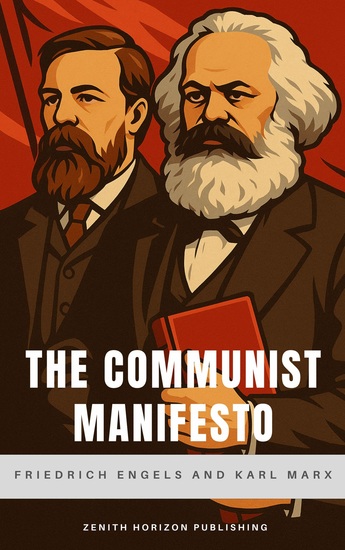
The Communist Manifesto - Karl Marx & Friedrich Engels' Revolutionary Call - cover

The Communist Manifesto - Karl Marx & Friedrich Engels' Revolutionary Call

Karl Marx, Friedrich Engels, Zenith Horizon Publishing

Editorial: Zenith Horizon Publishing

  • 0
  • 0
  • 0

Sinopsis

"Workers of the world, unite!" — A bold declaration that changed history.

The Communist Manifesto, co-authored by Karl Marx and Friedrich Engels, is one of the most influential political documents ever written. Originally published in 1848, this concise yet powerful text outlines the principles of communism, critiques the inequalities of capitalism, and envisions a classless, collective future.

Whether you're a student of history, a political science enthusiast, or simply curious about the roots of socialist thought, this essential edition provides both context and clarity.

📕 This edition includes:

The complete, unabridged original text

Annotations to help modern readers understand key terms and ideas

Historical illustrations and Kindle-optimized formatting

📚 Perfect for classroom study, personal reflection, or political insight.

Understand the ideas that ignited revolutions.
Get your annotated edition today.
Disponible desde: 13/06/2025.
Longitud de impresión: 29 páginas.

Otros libros que te pueden interesar

  • Extinction and the Human - Four American Encounters - cover

    Extinction and the Human - Four...

    Timothy Sweet

    • 0
    • 0
    • 0
    In Extinction and the Human Timothy Sweet ponders the realities of animal extinction and endangerment and the often divergent Native American and Euro-American narratives that surround them. He focuses especially on the force of human impact on megafauna—mammoths, whales, and the North American bison—beginning with the moments that these species' extinction or endangerment began to generate significant print archives: transcriptions of traditional Indigenous oral narratives, historical and scientific accounts, and literary narratives by Indigenous American and Euro-American authors. 


    Sweet investigates culturally distinct ways of understanding the extinction of the mammoths; the impact of the Euro-American whaling industry and the revitalization of Native American whaling traditions; and the bison's near-extermination at the hands of white market hunters and today's Euro-American and Native American efforts on behalf of the animal's preservation. He reflects on humans' relations with animals through models of divine preservation, competitive extermination, evolutionary determination, biophilia, and treaties with animals. Ultimately, he argues, it is the critical assessment of ideas of human exceptionalism that provides a necessary counterpoint both to apologies for human mastery over nature and deep ecology's attempts to erase the human.
    Ver libro
  • Growing Up Psychic - My Story of Not Just Surviving but Thriving and How Others Like Me Can Too - cover

    Growing Up Psychic - My Story of...

    Chip Coffey

    • 0
    • 0
    • 0
    No one knows more about psychic kids than Chip Coffey, and no expert on psychic kids is better known throughout the world. These kids are widely misunderstood, misjudged, and misdiagnosed. In Growing Up Psychic, Chip Coffey offers indispensable information for anyone who interacts with these extraordinary youngsters—parents, educators, medical professionals, mental health clinicians, members of the clergy, paranormal investigators—and adults who faced the challenges of growing up psychic. 


    In Growing Up Psychic, drawing on his firsthand experience and the true stories of kids he has worked with and helped, Chip Coffey shows you how to: 


    ● Determine if a child is really psychic—as opposed to simply imaginative or seeking attention 


    ● Identify the different kinds of psychic abilities kids (and adults) might have 


    ● Gain control over when and how psychic information is received 


    ● Safely connect with others in the psychic community 


    ● Deal with skeptics and disbelievers
    Ver libro
  • House of Two Pharaohs - Step into the world of gold gods and deadly ambition - cover

    House of Two Pharaohs - Step...

    Wilbur Smith

    • 0
    • 0
    • 0
    Global bestselling author of River God and The New Kingdom, Wilbur Smith, returns with the next epic book in his brand-new Ancient Egyptian series.FROM THE SHADOWS. A NEW EVIL WILL RISE. FACELESS. NAMELESS.Since his appointment as Nomarch of Memphis, by the God-Pharaoh Rameses, Piay has thrown himself into pulling the city back from the brink. The famous white city walls have been rebuilt, the once starving inhabitants fed and every day caravans have arrived from the desert wastes, filled with the many riches looted and hidden by the Hyksos. But when the body of a murdered scribe is found sealed inside the newly constructed city vault - the mark of Anubis, god of death, scrawled next to him in his own blood - panic sweeps the city. Only the wisest man in all Egypt can solve this mystery - Piay's mentor, the great sage Taita.Called from his place at the God-Pharaoh Rameses' side, Taita's arrival in Memphis calms the populace, but it isn't long before the mark of Anubis appears again, and again. Taita and Piay are drawn into a battle of wits against a criminal mastermind turned warlord, his aim - with the demise of the Hyksos - to see the kingdom of the Red Pretender restored and the forces of Rameses crushed.Will everything that Taita has fought for be torn asunder? Or will he and Piay finally reunite the two kingdoms? Only time will tell. And time is running out.
    Ver libro
  • Earth in Flames - How an Asteroid Killed the Dinosaurs and How We Can Avoid a Similar Fate From Nuclear Winter - cover

    Earth in Flames - How an...

    Alan Robock, Owen Brian Toon

    • 0
    • 0
    • 0
    Sixty-six million years ago an asteroid as large as Mt. Everest hit what is now the Yucatan Peninsula at a speed ten times faster than the fastest rifle bullet. Debris from the impact blew into space, re-entered the atmosphere as a swarm of shooting stars that burned the global forests and grasslands, leaving behind a thin global layer containing rock from the asteroid and from Mexico, and smoke from the fires. This layer marks one of the greatest extinctions in Earth history including not just dinosaurs, but also fish, plankton, ammonites, and plants making up about 75% of the known species. 


    A nuclear war with just a few hundred of the world's 12,000 nuclear weapons targeted on densely populated cities could plunge Earth into the same types of conditions that the dinosaurs experienced. Even a war between India and Pakistan could kill 1 to 3 billion people from starvation due to agricultural failure, while 6 billion people might starve following a war involving Russia, NATO, and the U.S. 


    The book describes how the dinosaurs died, and how their deaths parallel what might happen to people after a nuclear war. The book reflects on the odds of future asteroid impacts, how to stop them, and ends with what the listeners personally and together can do to prevent a nuclear war, so that humans don't end up like the dinosaurs.
    Ver libro
  • Prehistoric Warfare: The History of Early Human Conflicts - cover

    Prehistoric Warfare: The History...

    Editors Charles River

    • 0
    • 0
    • 0
    Raymond C. Kelly, an anthropologist and ethnologist who has written extensively on societal inequality and subsequent warfare suggests that among the hunter-gatherer groups of Homo erectus, the population density was low enough to avoid armed conflict in most cases. In the same vein, a perception has persisted that during this less populated time of Earth’s history, life among the Homo species was relatively peaceful. Archaeologists have supported this theory through early cave art, little of which ever depicts humans hunting or killing each other explicitly. Kelly theorized that the migration out of Africa by Homo erectus 1.8 million years ago was “a natural consequence of conflict avoidance.” He believes that this general period of “Paleolithic warlessness” was to persist until the appearance of Homo sapiens approximately 350,000 years ago, and that it began with the occurrence of “economic and social shifts associated with sedentism.” 
    However, depictions of humans pierced with arrows began to appear in the Aurignacian-Périgordian eras (30,000 years ago), and in the early Magdalenian era (17,000 years ago). A work of Mesolithic art (20,000 to 10,000 years ago) shows an explicit battle between groups of archers, and in Valencia, a group of three archers are seen surrounded by four of the similarly armed enemy in the Cova del Roure la Vella in Castellón. In the Ares del Maestrat in Alcañiz of Aragon, another work depicts warriors fleeing a group of eight archers, while a similar work at Val del Charco del Agua in Aragon shows seven archers with plumed headgear. Other examples show warriors in lines and columns with a “distinctly garbed leader at the front.”
    Ver libro
  • Your Brain's Not Broken Workbook - Strategies for Navigating Your Emotions and Life with ADHD - cover

    Your Brain's Not Broken Workbook...

    Tamara Rosier

    • 0
    • 0
    • 0
    In her popular book Your Brain's Not Broken, Dr. Tamara Rosier applied her years of coaching others to explain how ADHD affects every aspect of your life so that you could understand why you think, feel, and act the way you do. The result? A book chock-full of practical tools with the power to dramatically improve your life. 
     
    Now this interactive companion workbook helps you personalize all those tools to fit your particular challenges. With plenty of space to write out your ADHD story, guided prompts to help you work through problems, and visual summaries of key concepts, including the Solve-It Grid, this practical workbook is designed specifically to work with the way your amazing brain is wired. The minute you start using it, you are one step closer to losing the shame, loving your brain, and living better with ADHD.
    Ver libro