Rejoignez-nous pour un voyage dans le monde des livres!
Ajouter ce livre à l'électronique
Grey
Ecrivez un nouveau commentaire Default profile 50px
Grey
Abonnez-vous pour lire le livre complet ou lisez les premières pages gratuitement!
All characters reduced
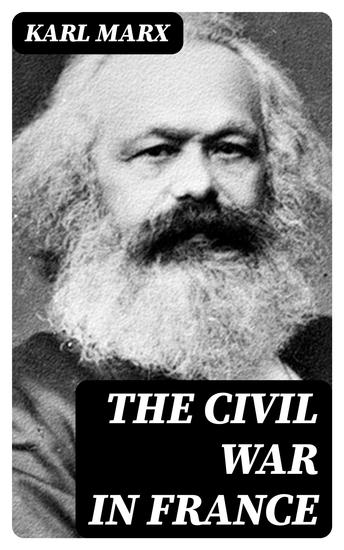
The Civil War in France - Enriched edition - cover

The Civil War in France - Enriched edition

Karl Marx

Traducteur Friedrich Engels

Maison d'édition: DigiCat

  • 0
  • 0
  • 0

Synopsis

In "The Civil War in France," Karl Marx delivers a profound analysis of the Paris Commune of 1871, presenting it as a pivotal moment in the struggle for working-class emancipation. Written in a passionate and incisive prose style, Marx utilizes a historical materialist framework to dissect the social, political, and economic conditions that gave rise to the Commune. He contextualizes the Commune not merely as a local uprising, but as a critical episode in the broader narrative of class struggle, illuminating the failures of the proletariat to maintain power amidst relentless bourgeois opposition. This work serves both as a historical document and a manifesto for socialist theory, shedding light on the implications of revolutionary action. Marx, a German philosopher, economist, and revolutionary socialist, drew on his deep intellectual roots within the Hegelian tradition and his observations of contemporary social movements to shape this work. His own experiences in the tumultuous political landscape of 19th-century Europe, coupled with his commitment to advocating for the working class, provide the foundation for his insightful critique of the Commune. Through his writings, he sought to educate and inspire further revolutionary consciousness among the oppressed. "The Civil War in France" is essential reading for those interested in understanding the foundational events of the modern left and the dynamics of revolutionary movements. It not only offers a historical perspective but also stimulates critical thinking about the potential for class struggle in contemporary society. This work is a must-read for anyone seeking to understand Marxist theory and its relevance in the ongoing pursuit of social justice.

In this enriched edition, we have carefully created added value for your reading experience:
- A succinct Introduction situates the work's timeless appeal and themes.
- The Synopsis outlines the central plot, highlighting key developments without spoiling critical twists.
- A detailed Historical Context immerses you in the era's events and influences that shaped the writing.
- An Author Biography reveals milestones in the author's life, illuminating the personal insights behind the text.
- A thorough Analysis dissects symbols, motifs, and character arcs to unearth underlying meanings.
- Reflection questions prompt you to engage personally with the work's messages, connecting them to modern life.
- Hand‐picked Memorable Quotes shine a spotlight on moments of literary brilliance.
- Interactive footnotes clarify unusual references, historical allusions, and archaic phrases for an effortless, more informed read.
Disponible depuis: 29/05/2022.
Longueur d'impression: 78 pages.

D'autres livres qui pourraient vous intéresser

  • Fixing America - An Engineer’s Solution to our Social Cultural and Political Problems - cover

    Fixing America - An Engineer’s...

    William M Taggart IV

    • 0
    • 0
    • 0
    Have you been wondering about the big issues dominating the news? Is climate change a massive threat or not? What is really going on with immigration? More importantly, how did American politics become so divided and hostile?  What if we approached American social, cultural and political problems from a purely rational perspective? What if we focus on functional systems instead of division? Careful analysis of readily available data can help us discover patterns and uncover the real issues. An engineering perspective allows us to focus on what needs to be fixed rather than ideological divisions.  
       Finally, one of America's top engineers has brought these topics and others together in a thought-provoking book. This book is rooted in history, facts, and logic, and it lays out solutions to America's problems. A book focused to get Americans talking to one another again, so we can rise to the occasion and solve today's problems together.  
        William Taggart has over thirty years as a professional engineer in industry. He has travelled the world, building some of industry’s biggest projects and solving some of their thorniest problems. Now, he has applied analytical skills developed in industry, coupled with his natural inquisitiveness and thirst for creative solutions, to the problems of modern-day American politics. Seeking answers to questions many of us have been asking, he has focused his keen mind on researching these, and other big issues. He invites everyone to think about what America really needs.
    Voir livre
  • The Shocking Truth about International Relations - cover

    The Shocking Truth about...

    Zoey Fraisers

    • 0
    • 0
    • 0
    International relations is a complex and ever-evolving field that shapes the global political landscape. The relationships between countries, organizations, and individuals influence everything from trade and diplomacy to security and human rights. Understanding the history, theories, and modern-day dynamics of international relations is essential for anyone seeking to grasp the intricacies of global affairs. The study of international relations has evolved from a niche academic discipline into a vital framework for analyzing global conflicts, cooperation, and power struggles. 
      
    The modern world has been profoundly shaped by the forces of globalization, which have made international relations more interconnected than ever before. Advances in communication, transportation, and technology have blurred the lines between domestic and international issues. Countries can no longer afford to operate in isolation; they must cooperate on matters of shared concern, such as climate change, terrorism, economic crises, and public health. However, the globalized world also comes with challenges. Increasingly, nations must navigate a complex web of relationships and competing interests, where power dynamics and the quest for dominance can create conflict. 
      
    Globalization has had a profound impact on international relations, but it has also revealed the limits of traditional diplomacy. In the past, diplomacy was primarily conducted between states, often in secret negotiations behind closed doors. Today, international diplomacy involves a wider range of actors, from multinational corporations and non-governmental organizations to grassroots movements and individual leaders. This shift has led to both opportunities and challenges for international cooperation, as diverse interests often clash in the pursuit of a global agenda.
    Voir livre
  • Strong Floor No Ceiling - Building a New Foundation for the American Dream - cover

    Strong Floor No Ceiling -...

    Oliver B. Libby

    • 0
    • 0
    • 0
    We’re not just divided—we’re adrift. Strong Floor, No Ceiling presents a bold, radically moderate blueprint to reconnect our fractured country and restore belief in opportunity, fairness, and shared progress.
    Voir livre
  • Observing Conflict Escalation in World Society - Ukraine's Maidan and Mali's Breakup - cover

    Observing Conflict Escalation in...

    Richard Bösch

    • 0
    • 0
    • 0
    How do conflicts escalate? This is one of the major questions in conflict research. To offer further answers, Richard Bösch follows a tripartite agenda: First, he develops a constructivist methodology for the study of conflict escalation embedded in a Luhmannian systems theoretical world society perspective. Bösch argues that conflicts can be observed as social systems and he looks at the process of conflict escalation by analysing communication. Second, this analysis offers two case studies: the Maidan protests in Ukraine 2013-2014 and Mali's crisis 2010-2012. Third, it gives insights on how systems theoretical research can be beneficial for Peace and Conflict Studies.
    Voir livre
  • Socialism Looks Forward - cover

    Socialism Looks Forward

    John Strachey

    • 0
    • 2
    • 0
    The author and politician analyzes the troubled state of Britain’s post–World War II political and economic systems, and proposes a solution.When World War II ended for Great Britain in 1945, MP John Strachey wondered what he and his country were going to do with the freedom they had fought for and won. The men who ran the country before the war had taken England so far down the road to disaster that it seemed almost impossible to save. To prevent history from repeating itself, changes needed to be made.In Socialism Looks Forward, Strachey shares his plan to lead Great Britain into a prosperous future in which its people are free from want. Examining both political and economic factors, he breaks down why the system in Britain was in such disrepair prior to World War II, with some of its citizens being even better off during the war. He then outlines his proposed solution—Socialism—explaining what it would be like and how Britain could make it happen. Originally published in 1945, Socialism Looks Forward provides insight into Great Britain’s political and economic history in the post–World War II era, as well as an introduction to Socialist thought.
    Voir livre
  • Republicanism Explained - The Principles of Republican Government and Its Variants - cover

    Republicanism Explained - The...

    Arlo Holders

    • 0
    • 0
    • 0
    Republicanism is a political ideology that emphasizes the importance of a government where power rests in the hands of elected representatives, rather than a monarch or dictator. The essence of republicanism lies in the commitment to a system that prioritizes liberty, the rule of law, and the well-being of the public. Republicanism has roots in the ancient political thought of Greece and Rome, particularly through the Roman Republic, which provided the foundational ideas of civic participation and the limitation of power. It was in the Renaissance and Enlightenment periods that these principles were revived and further refined, giving rise to modern republicanism as we know it today. 
    The core tenet of republicanism is that government should be based on consent of the governed. Unlike monarchies, where power is inherited or imposed, republicanism promotes a system in which rulers are elected by the people to serve their interests. This concept of popular sovereignty—government’s authority coming from the consent of the people—distinguishes republicanism from both monarchy and democracy. In republican systems, rulers are expected to act in the best interest of society, balancing the needs of the individual with those of the community, while also safeguarding the common good. 
    A key feature of republicanism is its emphasis on the separation of powers. Drawing from Montesquieu’s influence, republican thought advocates for dividing government authority into branches—executive, legislative, and judicial—in order to prevent any one entity from becoming too powerful. This system of checks and balances ensures that power is distributed and that no single branch or individual can dominate or misuse their authority. This is vital to maintaining the liberty of individuals within a republican system.
    Voir livre