Begleiten Sie uns auf eine literarische Weltreise!
Buch zum Bücherregal hinzufügen
Grey
Einen neuen Kommentar schreiben Default profile 50px
Grey
Jetzt das ganze Buch im Abo oder die ersten Seiten gratis lesen!
All characters reduced
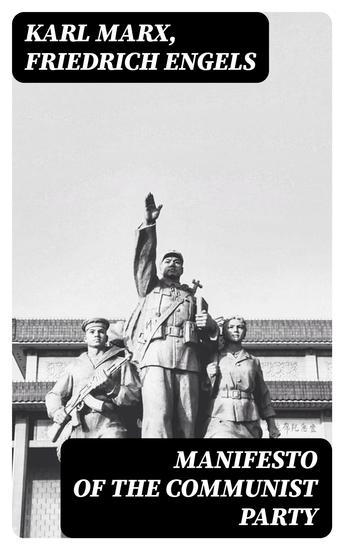
Manifesto of the Communist Party - Enriched edition - cover

Manifesto of the Communist Party - Enriched edition

Karl Marx, Friedrich Engels

Verlag: DigiCat

  • 0
  • 0
  • 0

Beschreibung

The "Manifesto of the Communist Party" stands as a seminal anthology of revolutionary thought, bringing together the incisive critiques of socio-economic structures and the call for radical transformation. This collection traverses the landscape of 19th-century political theory, capturing both the spirit of its age and timeless philosophical inquiries. The text weaves a tapestry of visions for a redefined social order, marked by profound explorations into class struggles. With its bold rhetoric and analytical profundity, the works within these pages underscore the mounting tensions and aspirations of an industrializing world, inviting readers into a dialogue that challenges existing power dynamics. The anthology is crafted through the collective genius of Karl Marx and Friedrich Engels, whose intellectual endeavors have laid the cornerstone of Marxist thought. Their partnership and shared interrogations of capitalist society stem from diverse academic and political engagements, uniting to critique and propose alternatives to the dominant socio-economic paradigms of their time. Their voices, steeped in the fervor of revolutionary fervor and deep historical insight, capture the essence of a movement that transcends borders, offering readers a penetrating examination of humanity's quest for equity and justice. Readers are invited to immerse themselves in this robust dissection of capitalist society, a foundational text for anyone seeking to understand the roots of Marxist ideology. "Manifesto of the Communist Party" serves not only as an urgent call to action but also as an intellectual journey through the ideological clashes of its era. This anthology promises a rich educational experience, fostering critical thought and engagement with the authors' enduring social critique, making it indispensable for students of history, politics, and economics alike.

In this enriched edition, we have carefully created added value for your reading experience:
- A succinct Introduction situates the work's timeless appeal and themes.
- The Synopsis outlines the central plot, highlighting key developments without spoiling critical twists.
- A detailed Historical Context immerses you in the era's events and influences that shaped the writing.
- An Author Biography reveals milestones in the author's life, illuminating the personal insights behind the text.
- A thorough Analysis dissects symbols, motifs, and character arcs to unearth underlying meanings.
- Reflection questions prompt you to engage personally with the work's messages, connecting them to modern life.
- Hand‐picked Memorable Quotes shine a spotlight on moments of literary brilliance.
- Interactive footnotes clarify unusual references, historical allusions, and archaic phrases for an effortless, more informed read.
Verfügbar seit: 28.05.2022.
Drucklänge: 39 Seiten.

Weitere Bücher, die Sie mögen werden

  • The Morals of Diet - The First Step - cover

    The Morals of Diet - The First Step

    Leo Tolstoy

    • 0
    • 0
    • 0
    Written in 1892, during the later years of his life, Leo Tolstoy’s The Morals of Diet reflects the profound spiritual transformation that reshaped his outlook after Anna Karenina and War and Peace. In the decades following his literary success, Tolstoy underwent a moral and religious awakening, renouncing wealth, privilege, and the comforts of aristocratic life. He sought a simpler, purer existence grounded in truth, humility, and nonviolence. This period gave rise to his moral essays — What I Believe, The Kingdom of God Is Within You, and The Morals of Diet (The First Step) — in which he strove to align daily actions with spiritual conscience. 
    The First Step emerges from this search for ethical coherence. Ostensibly an essay about vegetarianism, it is in fact a meditation on the nature of moral progress and the necessity of compassion. Tolstoy argues that abstaining from the killing of animals is the first, most tangible act of moral purification — “the first step” toward a life of genuine goodness. For him, cruelty, however subtle or socially accepted, degrades the human spirit. To refrain from violence, even in small forms, is to begin transforming one’s relationship to all living beings.
    Zum Buch
  • Best British Short Stories 2023 - cover

    Best British Short Stories 2023

    Nicholas Royle

    • 1
    • 2
    • 0
    'Best British Short Stories invites you to judge a book by its cover – or more accurately, by its title. This new series aims to reprint the best short stories published in the previous calendar year by British writers, whether based in the UK or elsewhere.'
    Zum Buch
  • Cain - From their pens to your ears genius in every story - cover

    Cain - From their pens to your...

    Alexander Kuprin

    • 0
    • 0
    • 0
    Alexander Kuprin was born in Narovchat, Penza in Russia on 7th September 1870. 
    At 3 his Father died and he and mother moved to Moscow. By 10 he was enrolled at the Second Moscow Military High School and there his interest in literature began. The Alexander Military Academy followed and two years later he was a sub-lieutenant and posted to an Infantry Regiment for a further four years. 
    Despite his duties he was a now a keen writer and published his first short story at this time. His military duties also garnered him experiences for his breakthrough work ‘The Duel’.  Leaving the military he left for Kiev to work for local newspapers.  He continued to publish both stories and novels and by 1901 he was in St Petersburg becoming part of a group that included Chekhov, Ivan Bunin, Maxim Gorky and Leonid Andreyev.  
    In the years that followed further controversial works and acclaim followed.  His comments on the regime meant he was also put under secret police surveillance.   
    As World War I erupted, Kuprin opened a military hospital but was then given command of an infantry company in Finland. He was soon discharged on grounds of ill health.  
    The October Revolution saw him praise Lenin, but he warned that the Bolsheviks threatened Russian culture and might cause further widespread suffering to the peasants.  As Civil War raged he took his family to Helsinki and then on to Paris. 
    Exile saw his talents decline further and his succumbing to alcoholism. He became lonely and withdrawn. The family's poverty increased his malaise.   
    In May 1937, the Kuprin’s returned to Moscow.  He now saw his work published but wrote almost nothing new.  In 1938 his health rapidly deteriorated.  Already suffering from a kidney problems and sclerosis, he had now developed cancer of the oesophagus.  
    Alexander Kuprin died on 25th August 1938.
    Zum Buch
  • Loving my lying dying cheating husband - cover

    Loving my lying dying cheating...

    Kerstin Pilz

    • 0
    • 0
    • 0
    A memoir of a whirlwind romance gone wrong. 
     
    Kerstin is childless by choice and married to her job when Gianni, a charming Italian, turns her life into a champagne-coloured fairy tale. 
     
    Soon after their runaway wedding, Gianni is diagnosed with cancer and Kerstin becomes his dedicated carer. But when she discovers that he has been cheating on her all through their relationship, she is faced with a difficult choice: walk away, or continue to care for the man who betrayed her. She turns first to wine and then to therapy, eventually ending up in a Buddhist monastery. There she realises that finding a new way of loving her lying, dying husband might offer a chance to grow from her pain rather than be crushed by it - and to avoid liver damage. 
     
    Written with wisdom, humour, and unfailing kindness, this is a life-affirming tale of one woman's search for better ways to love, grieve and forgive.
    Zum Buch
  • Summary of Elton John’s Love is the Cure - cover

    Summary of Elton John’s Love is...

    Falcon Press

    • 0
    • 0
    • 0
    Buy now to get the main key ideas from Elton John’s Love is the Cure 
      
    In Love Is the Cure (2012), pop superstar Elton John recounts his life in parallel with his AIDS activism, starting from the beginning of the epidemic in 1981. He tells about people who have fought against AIDS, those he has lost to the disease, and his foundation’s effort to bring an end to it. The keys are education, research, fund-raising, and above all, compassion.
    Zum Buch
  • Hellhounds of the Cosmos - cover

    Hellhounds of the Cosmos

    Clifford D. Simak

    • 0
    • 0
    • 0
    In Hellhounds of the Cosmos, Clifford D. Simak takes listeners on a thrilling journey through space and time. The story follows a group of explorers who encounter terrifying, mysterious creatures on a distant planet. As they navigate strange landscapes and face deadly threats, they uncover shocking secrets about the universe and their place within it. With Simak's signature blend of science fiction and philosophical musings, this gripping tale explores themes of humanity, survival, and the unknown. Perfect for fans of classic sci-fi, Hellhounds of the Cosmos is a captivating adventure that will keep you on the edge of your seat
    Zum Buch