Join us on a literary world trip!
Add this book to bookshelf
Grey
Write a new comment Default profile 50px
Grey
Subscribe to read the full book or read the first pages for free!
All characters reduced
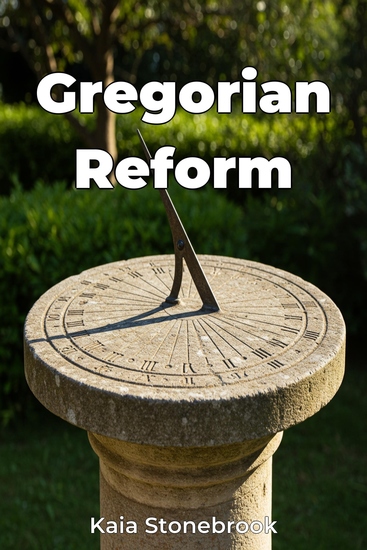
Gregorian Reform - cover

Gregorian Reform

Kaia Stonebrook

Translator A AI

Publisher: Publifye

  • 0
  • 0
  • 0

Summary

Gregorian Reform explores the dramatic shift from the Julian to the Gregorian calendar, a change that briefly erased eleven days in 1582 for many Europeans. This book investigates the scientific, social, and political factors behind this reform, highlighting how a seemingly technical adjustment triggered widespread resistance and gradual global adaptation.

 
For over 1600 years, the Julian calendar miscalculated the solar year, leading to a ten-day discrepancy affecting religious observances like Easter. The book examines the meticulous calculations made by Pope Gregory XIII's commission to devise a more accurate system. It details the vehement reactions to the new calendar, particularly from Protestant countries that viewed it as a "Papist plot," and traces its eventual worldwide adoption.

 
Using primary sources and astronomical data, this book offers a balanced perspective on a pivotal moment in timekeeping history. The book begins with historical context, progresses through the scientific basis and social reactions, and concludes with its global implementation. It is a valuable resource for those intrigued by history of science or the sociology of time.
Available since: 03/04/2025.
Print length: 65 pages.
Other books that might interest you

  • Hamilton at War - cover

    Hamilton at War

    Robert Child

    • 0
    • 0
    • 0
    As the story opens, young Alexander Hamilton marches with the Continentals at Fort Lee, New Jersey. He is frustrated by being relegated to the end of the line and missing out on the action. He desperately wants to make a name for himself. His fortunes soon change at the Raritan River when the vanguard of British infantry catches up to Washington's army. 
     
    Hamilton, and his cannons are the only defense line available to prevent the army from being destroyed. Successfully protecting the Continental army and allowing their escape with his rear-guard action, Hamilton catches the attention of George Washington. 
     
    The future President asks the twenty-year-old Hamilton to join his staff. Sent on one daring mission after another Hamilton s stature grows, creating great political mistrust among his rivals. When ambition overtakes Hamilton, he threatens to overthrow Congress, which he sees as corrupt. Challenging a Congressman to a duel who views Hamilton as treasonous immigrant his world nearly self-destructs. 
     
    With the end of the American Revolution looming and his visions of his own glory fading, Hamilton becomes determined to leave Washington s staff and return to the battlefield. Washington, the only man who can help him, does all in his power to deny him. One daring assignment remains, however, that will determine the outcome of the final battle and the entire war. It is at a place called Yorktown.
    Show book
  • The Illusionist - The True Story of the Man Who Fooled Hitler - cover

    The Illusionist - The True Story...

    Robert Hutton

    • 0
    • 0
    • 0
    Cairo, 1942: If you had asked a British officer who Colonel Clarke was, they would have been able to point him out. Always ready with a drink and a story, Clarke was a well-known figure in Cairo social circles and nightlife. If you then asked what he did, you would have less success. Those who knew didn't tell—and almost no one really knew at all. 


    Clarke thought of himself as developing a new kind of weapon. Its components? Rumor, stagecraft, a sense of fun. Its target? The mind of Erwin Rommel, Hitler's greatest general. Throughout history, military commanders have sought to mislead their opponents. Dudley Clarke set out to do it on a scale no one had imagined before. Even afterwards, almost no one understood the magnitude of his achievement. 


    Drawing on recently released documents and hugely expanding on the louche portrait of Clarke as seen in SAS: Rogue Warriors, journalist and historian Robert Hutton reveals the amazing story of Clarke's "A Force," the invention of the SAS and the Commandos, and the masterful hoodwinking of the Desert Fox at the battle of El Alamein. The Illusionist tells for the first time the dazzling tale of how, at a pivotal moment in the war, British eccentricity and imagination combined to thwart the Nazis and save innumerable lives—on both sides.
    Show book
  • Emerson's Essays Volume 1 - cover

    Emerson's Essays Volume 1

    Ralph Waldo Emerson

    • 0
    • 0
    • 0
    "Emerson's Essays" is a collection that showcases Ralph Waldo Emerson's profound influence on American thought and literature. With eloquence and a unique philosophical perspective, these essays delve into themes of self-reliance, individualism, and the beauty of nature. Emerson champions the inherent greatness of the individual and the importance of intuition in understanding the spiritual world. Through topics ranging from friendship to politics, he explores the interconnectedness of humanity and nature, urging readers to transcend the mundane and seek the extraordinary within. This seminal work is an enduring testament to Emerson's belief in the power of the individual spirit.
    Show book
  • How to Analyze People - The Definitive Guide to Speed Reading People on Sight Using Dark Psychology Techniques Body Language and Emotional Intelligence with Manipulation Secrets to Influence People - cover

    How to Analyze People - The...

    Scott Habits

    • 0
    • 0
    • 0
    Don’t Let People Fool You Into Doing Anything You Don’t Want To! Read This Definitive Guide To Speed Reading People On The Spot! 
    Human beings are a complicated species. 
    We keep secrets as much as we open up to people. This makes deceiving others very easy to carry out. When you’re on the receiving end of a deceptive person’s agenda, your safety and wellbeing might be put at risk… which is why you need to keep an open eye out for verbal and physical clues. 
    So, how can you better read people and avoid being cuckolded? 
    In this book, Scott Habits will teach you the art of reading people on the spot, using dark psychology techniques, body language, emotional intelligence, and manipulation secrets so you can see through a person’s deceptive attempts and influence them to do otherwise. 
    Here’s what you’ll get:How to master the art of analyzing peopleThe fundamentals of reading peopleEssential tools that give you an edge in analyzing behaviorUnderstanding people’s childhoodsHow to master the art of body languageHow to effectively analyze people through their wordsThe psychology of lying and how to tell if someone is lyingHow to interpret personality typesThe common mistakes made when analyzing people and how to avoid themAnd so much more! 
    In this day and age, one can never be too sure. Of course, we want to trust people and build relationships with them, but we also need to stay vigilant and avoid being taken for fools! 
    So what are you waiting for? Download this audiobook now to Speed Reading People On The Spot!
    Show book
  • French Invasion of Russia and the Battle of Leipzig The: The History and Legacy of the Defeats that Forced Napoleon into Exile at Elba - cover

    French Invasion of Russia and...

    Charles River Editors

    • 0
    • 0
    • 0
    Though Napoleon Bonaparte's unquenchable thirst for military adventurism eventually cost him both his throne and his freedom during the Napoleonic Wars of the late 18th and early 19th centuries, the French Emperor was not easily defeated even when most of Europe's nations united against him. Two military setbacks on a scale unprecedented in history until then were required before the high tide of Napoleon's success began to ebb towards the final denouement of the Hundred Days and the famous battle of Waterloo.  
    	Napoleon's Russian adventure gutted his veteran army, depriving him of the majority of his finest and most loyal soldiers. Those who remained formed the hard core of his new armies, but the Russian fiasco damaged their health and embittered their previously unquestioning loyalty. Napoleon raised vast new armies, but circumstances compelled him to fill the ranks with raw recruits, whose fighting skills did not equal their undoubted bravery and whose dedication to the Napoleonic cause was shaky, and in many cases due solely to coercion. The tough, experienced, faithful veteran found himself outnumbered by unwilling, sketchily trained amateurs. 
    These factors set the stage for the second setback, which essentially sealed the fate of Napoleon's empire. The four-day Battle of Leipzig in October 1813, romantically but accurately dubbed the "Battle of the Nations," proved the decisive encounter of the War of the Sixth Coalition and essentially determined the course the Napoleonic Wars took from that moment forward. 	The resultant collision was the single largest field action of the Napoleonic Wars, dwarfing Waterloo in size, complexity, and overall importance. The Battle of Leipzig was probably the combat which involved the highest concentration of men on a single extended battlefield on the planet up to that point in history, and would not be exceeded until the vast struggles of the First World War almost precisely a century later. 
    Show book
  • Life in the Neck Advent of Christmas - cover

    Life in the Neck Advent of...

    Diane Davies

    • 0
    • 0
    • 0
    Learn the meaning of advent in a simple gentle way on the porch of Fort Eli in the Neck among the forest animals. Two children celebrate the coming of Christmas with an advent wreath, lanterns for candles, Bible verses and a manager explaining the significance of each as they move forward bringing His light into the world.
    Show book