Junte-se a nós em uma viagem ao mundo dos livros!
Adicionar este livro à prateleira
Grey
Deixe um novo comentário Default profile 50px
Grey
Assine para ler o livro completo ou leia as primeiras páginas de graça!
All characters reduced
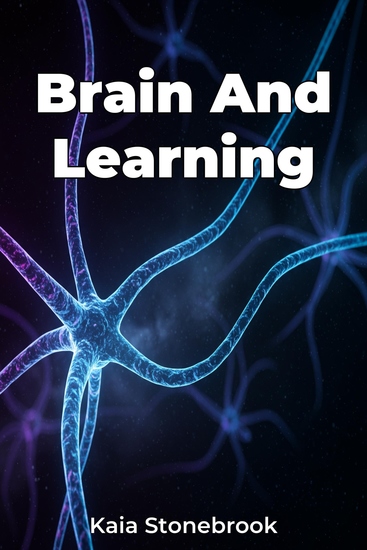
Brain And Learning - cover
LER

Brain And Learning

Kaia Stonebrook

Tradutor A AI

Editora: Publifye

  • 0
  • 0
  • 0

Sinopse

Brain and Learning explores the fascinating connection between neuroscience and education, revealing how our brains learn and retain information. It emphasizes that understanding the brain's mechanisms is key to optimizing educational strategies and improving learning outcomes. The book highlights neuroplasticity, the brain's ability to reorganize itself, and memory consolidation, the process of turning short-term memories into long-term ones, as crucial elements in learning. Did you know that emotions also play a significant role, often overlooked in traditional education?


This book progresses logically, starting with foundational neuroscience concepts before exploring various memory types and their neural bases. Major chapters delve into the impact of stress and sleep, the neuroscience of attention, and the functions of different brain regions. What makes this book unique is its translation of complex neuroscientific findings into practical strategies for educators and learners alike, offering a clear path toward personalized learning and memory improvement. It uses a wealth of research to analyze learning theories and offers insights for enhancing cognitive performance.
Disponível desde: 11/03/2025.
Comprimento de impressão: 77 páginas.

Outros livros que poderiam interessá-lo

  • Mastering Computer Vision with PyTorch 20 - Discover Design and Build Cutting-Edge High Performance Computer Vision Solutions with PyTorch 20 and Deep Learning Techniques - cover

    Mastering Computer Vision with...

    M. Arshad Siddiqui

    • 0
    • 0
    • 0
    Unleashing the Power of Computer Vision with PyTorch 2.0.
    Book DescriptionIn an era where Computer Vision has rapidly transformed industries like healthcare and autonomous systems, PyTorch 2.0 has become the leading framework for high-performance AI solutions. [Mastering Computer Vision with PyTorch 2.0] bridges the gap between theory and application, guiding readers through PyTorch essentials while equipping them to solve real-world challenges.
    Starting with PyTorch’s evolution and unique features, the book introduces foundational concepts like tensors, computational graphs, and neural networks. It progresses to advanced topics such as Convolutional Neural Networks (CNNs), transfer learning, and data augmentation. Hands-on chapters focus on building models, optimizing performance, and visualizing architectures. Specialized areas include efficient training with PyTorch Lightning, deploying models on edge devices, and making models production-ready.
    Explore cutting-edge applications, from object detection models like YOLO and Faster R-CNN to image classification architectures like ResNet and Inception. By the end, readers will be confident in implementing scalable AI solutions, staying ahead in this rapidly evolving field. Whether you're a student, AI enthusiast, or professional, this book empowers you to harness the power of PyTorch 2.0 for Computer Vision.
    Table of Contents1. Diving into PyTorch 2.02. PyTorch Basics3. Transitioning from PyTorch 1.x to PyTorch 2.04. Venturing into Artificial Neural Networks5. Diving Deep into Convolutional Neural Networks (CNNs)6. Data Augmentation and Preprocessing for Vision Tasks7. Exploring Transfer Learning with PyTorch8. Advanced Image Classification Models9. Object Detection Models10. Tips and Tricks to Improve Model Performance11. Efficient Training with PyTorch Lightning12. Model Deployment and Production-Ready Considerations       Index
    Ver livro
  • Plasma Physics - Exploring the Fourth State of Matter - cover

    Plasma Physics - Exploring the...

    Mark Hedges

    • 0
    • 0
    • 0
    Plasma, often referred to as the fourth state of matter, is a unique and dynamic state in which gas is ionized, allowing free electrons and ions to coexist. Unlike solids, liquids, and gases, plasma exhibits collective behavior due to long-range electromagnetic interactions among its charged particles. It is the most abundant form of matter in the universe, making up stars, the interstellar medium, and even artificial applications on Earth. 
    The concept of plasma dates back to the late 19th and early 20th centuries when scientists first began studying ionized gases. The term "plasma" was coined in 1928 by Irving Langmuir while researching electrical discharges in gases. Since then, plasma physics has evolved into a vast field, influencing multiple scientific and technological disciplines, including astrophysics, nuclear fusion, space exploration, and industrial applications. 
    One of the defining characteristics of plasma is its ability to conduct electricity and respond to magnetic fields. Unlike neutral gases, where collisions dominate particle interactions, plasmas are governed by electromagnetic forces, leading to complex behaviors such as waves, instabilities, and turbulence. This property allows plasmas to sustain structures like magnetospheres around planets and controlled fusion reactors designed for energy production.
    Ver livro
  • The Sacred Disease - cover

    The Sacred Disease

    Hippocrates

    • 0
    • 0
    • 0
    The Sacred Disease is a text written by Hippocrates that explores the topic of epilepsy. In this text, Hippocrates attempts to dispel the belief that epilepsy is a sacred disease caused by supernatural forces. Instead, he argues that epilepsy is a natural disease that should be treated like any other illness. This text is significant because it represents one of the earliest attempts to provide a rational explanation for a medical condition. Read in English, unabridged.
    Ver livro
  • Kickstart MySQL Fundamentals - Build Real-World Databases Query with Confidence and Optimize Data Using Advanced MySQL and SQL Skills - cover

    Kickstart MySQL Fundamentals -...

    Amit Diwan

    • 0
    • 0
    • 0
    Your Complete Guide to Mastering MySQL from Basics to Real Projects!
    Book Description
    From powering web applications and content management systems to enterprise-level data storage, understanding MySQL is a foundational skill for anyone entering software development, data analysis, or IT.
    Kickstart MySQL Fundamentals is your step-by-step guide to becoming confident in relational database concepts and SQL programming. The book begins with the basics, such as- how to install MySQL, set up databases, and run your first queries. As you progress, you will explore constraints, operators, and built-in functions that form the core of practical SQL development.
    Moving into advanced territory, you will master joins, indexing for performance, and secure user management. Each chapter is filled with real-world examples and use cases to help solidify your understanding. A final capstone project brings all the concepts together in a hands-on, practical challenge that mimics real-world database tasks.
    Thus, whether you are a student, an aspiring developer, or IT professional, this book offers the essential foundation to manage and query databases effectively.
    So, do not get left behind—data skills are no longer optional. Start mastering MySQL today, and take control of your data future!
    Table of Contents
    1. Introduction to MySQL
    2. Getting Started with MySQL
    3. Constraints in MySQL
    4. Operators in MySQL
    5. MySQL Built-in Functions
    6. MySQL Statements
    7. MySQL Joins
    8. MySQL Indexes
    9. MySQL Users
    10. MySQL Advanced
    11. MySQL Miscellaneous
    12. Capstone Project       
    
    Index
    Ver livro
  • The History of Computing - From the Abacus to Artificial Intelligence - cover

    The History of Computing - From...

    Craig Dames

    • 0
    • 0
    • 0
    The story of computing begins not with electricity or screens, but with simple tools and the human need to solve problems. Long before the modern computer, ancient civilizations were already creating devices to aid in counting, measuring, and performing basic arithmetic. These early innovations laid the groundwork for centuries of progress in computing. 
    One of the most enduring tools from this era is the abacus. Believed to have originated in Mesopotamia over 4,000 years ago, the abacus evolved in various cultures, including Chinese, Roman, and Japanese societies. It was a portable, efficient device that allowed users to perform addition, subtraction, multiplication, and division by sliding beads along rods or grooves. Although simple in design, the abacus was powerful for its time and is still used in some regions for teaching arithmetic and mental calculation skills. 
    In addition to the abacus, ancient number systems were critical to the development of computation. The Babylonians used a base-60 numeral system, which influenced the way we measure time and angles today. The Egyptians employed a system based on units of ten, using hieroglyphs to represent values. Meanwhile, the Romans had a cumbersome numeral system that made complex calculations challenging. It wasn't until the adoption of the Hindu-Arabic numeral system, with its concept of zero and place value, that true advances in mathematical computation became possible.
    Ver livro
  • Wait Five Minutes - Weatherlore in the Twenty-First Century - cover

    Wait Five Minutes - Weatherlore...

    Shelley Ingram, Willow G. Mullins

    • 0
    • 0
    • 0
    The weather governs our lives. It fills gaps in conversations, determines our dress, and influences our architecture. No matter how much our lives may have moved indoors, no matter how much we may rely on technology, we still monitor the weather. Wait Five Minutes: Weatherlore in the Twenty-First Century draws from folkloric, literary, and scientific theory to offer up new ways of thinking about this most ancient of phenomena. 


    Weatherlore is a concept that describes the folk beliefs and traditions about the weather that are passed down casually among groups of people. From detailing personal experiences at picnics and suburban lawns to critically analyzing storm stories, novels, and flood legends, contributors offer engaging multidisciplinary perspectives on weatherlore. 


    As we move further into the twenty-first century, an increasing awareness of climate change and its impacts on daily life calls for a folkloristic reckoning with the weather and a rising need to examine vernacular understandings of weather and climate. Weatherlore helps us understand and shape global political conversations about climate change and biopolitics at the same time that it influences individual, group, and regional lives and identities. We use weather, and thus its folklore, to make meaning of ourselves, our groups, and, quite literally, our world.
    Ver livro