Join us on a literary world trip!
Add this book to bookshelf
Grey
Write a new comment Default profile 50px
Grey
Subscribe to read the full book or read the first pages for free!
All characters reduced
The Prophet - cover

The Prophet

Kahlil Gibran

Publisher: David De Angelis

  • 0
  • 0
  • 0

Summary

Kahlil Gibran considered The Prophet his greatest achievement. He said: "I think I've never been without The Prophet since I first conceived it in Mount Lebanon. It seems to have been a part of me....I kept the manuscript four years before I delivered it over to my publisher, because I wanted to be sure, I wanted to be very sure, that every word of it was the very best I had to offer."
The Chicago Post said of The Prophet: "Cadenced and vibrant with feeling, the words of Kahlil Gibran bring to one's ears the majestic rhythm of Ecclesiastes....If there is a man or woman who can read this book without a quiet acceptance of a great man's philosophy and a singing in the heart as of music born within, that man or woman is indeed dead to life and truth." 
Available since: 10/16/2024.

Other books that might interest you

  • Brave New World Interviews & Purports The - Talks by Aldous Huxley - cover

    Brave New World Interviews &...

    Geoffrey Giuliano

    • 0
    • 0
    • 0
    "There is only one corner of the universe you can be certain of improving, and that's your own self." 
     
    "One of the great attractions of patriotism - it fulfills our worst wishes." 
     
    "The secret of genius is to carry the spirit of the child into old age, which means never losing your enthusiasm." Aldous Huxley 
     
    Aldous Huxley was an English writer and philosopher. He wrote nearly fifty books, both novels and non-fiction works—as well as wide-ranging essays, narratives, and poems. 
    Born into the prominent Huxley family, he graduated from Oxford, with an undergraduate degree in English literature. Early in his career, he published short stories and poetry and edited the literary magazine Oxford Poetry, before going on to publish travel writing, satire, and screenplays. Huxley spent the latter part of his life in the United States, living in Los Angeles from 1937 until his death. By the end of his life, Huxley was widely acknowledged as one of the foremost intellectuals of his time. He was nominated for the Nobel Prize in Literature nine times and was elected Companion of Literature by the Royal Society of Literature in 1962. 
     
    Includes a rare treasury of ultra-rare previously unheard conversations with the esteemed intellectual.
    Show book
  • The Genesis of the Doughnut Club - cover

    The Genesis of the Doughnut Club

    Lucy Maud Montgomery

    • 0
    • 0
    • 0
    Lucy Maud Montgomery (November 30, 1874 – April 24, 1942), published as L. M. Montgomery, was a Canadian author best known for a series of novels beginning in 1908 with Anne of Green Gables. The book was an immediate success. The title character, orphan Anne Shirley, made Montgomery famous in her lifetime and gave her an international following.
    The Genesis of the Doughnut Club: When John Henry died there seemed to be nothing for me to do but pack up and go back east. I didn't want to do it, but forty-five years of sojourning in this world have taught me that a body has to do a good many things she doesn't want to do, and that most of them turn out to be for the best in the long run.
    Show book
  • Les Misérables: Volume 4: The Idyll in the Rue Plumet and the Epic in the Rue St Denis - Book 2: Éponine (Unabridged) - cover

    Les Misérables: Volume 4: The...

    Victor Hugo

    • 0
    • 0
    • 0
    Victor-Marie Hugo (26 February 1802 - 22 May 1885) was a French poet, novelist, essayist, playwright, and dramatist of the Romantic movement. During a literary career that spanned more than sixty years, he wrote abundantly in an exceptional variety of genres: lyrics, satires, epics, philosophical poems, epigrams, novels, history, critical essays, political speeches, funeral orations, diaries, and letters public and private, as well as dramas in verse and prose.
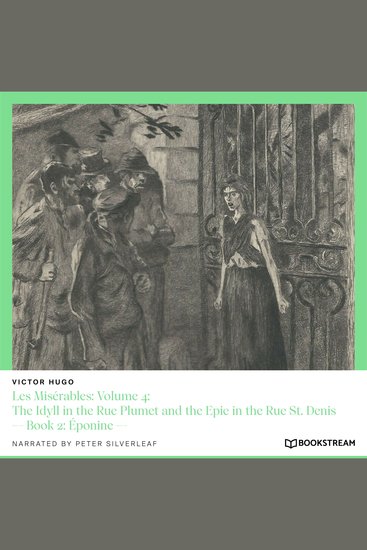
    BOOK 2: ÉPONINE: Marius had witnessed the unexpected termination of the ambush upon whose track he had set Javert; but Javert had no sooner quitted the building, bearing off his prisoners in three hackney-coaches, than Marius also glided out of the house. It was only nine o'clock in the evening.
    Show book
  • West-Running Brook - cover

    West-Running Brook

    Robert Frost

    • 0
    • 0
    • 0
    "West-Running Brook" is a collection of poetry by the renowned American poet Robert Frost, first published in 1928. The title poem serves as the centerpiece of the collection, with the overarching theme of the flow of time and the interconnectedness of past, present, and future. 
    In "West-Running Brook," Frost uses the metaphor of a brook that flows contrary to the usual direction, symbolizing the poet's own journey against the current of conventional wisdom and tradition. The brook becomes a powerful symbol of resilience and individuality, as well as a reflection of the poet's own introspection and exploration of the human experience. 
    Throughout the collection, Frost's signature style of writing in accessible yet profound language is evident. His poetry often explores themes of nature, rural life, and the complexities of human existence. With vivid imagery and keen observation, Frost invites readers to contemplate the beauty and mystery of the natural world, as well as the deeper truths and universal truths that lie beneath the surface. 
    Among the notable poems in the collection are "Spring Pools," which reflects on the cyclical nature of life and the passage of time; "The Silken Tent," a metaphor for the delicate balance between strength and flexibility in human relationships; and "Desert Places," which explores themes of isolation and existential despair amidst the vastness of the natural world. 
    "West-Running Brook" showcases Frost's mastery of form and language, as well as his ability to capture the complexities of the human condition with depth and nuance. Through its exploration of timeless themes and its lyrical beauty, the collection remains a testament to Frost's enduring legacy as one of America's most beloved poets.
    Show book
  • A Study in Scarlet - cover

    A Study in Scarlet

    Arthur Conan Doyle

    • 0
    • 0
    • 0
    Sherlock Holmes, a brilliant but eccentric detective, and his loyal companion Dr. Watson solve their first case together. A gruesome murder in London leads them on a trail involving a mysterious cult and a shocking revelation about the victim's past. The investigation unveils a complex web of secrets, deceit, and revenge stretching across continents, culminating in a dramatic confrontation with the killer. The story blends mystery, suspense, and a touch of the macabre, introducing the iconic duo and establishing their unique dynamic.
    Show book
  • A Slav Soul - From their pens to your ears genius in every story - cover

    A Slav Soul - From their pens to...

    Alexander Kuprin

    • 0
    • 0
    • 0
    Alexander Kuprin was born in Narovchat, Penza in Russia on 7th September 1870. 
    At 3 his Father died and he and mother moved to Moscow. By 10 he was enrolled at the Second Moscow Military High School and there his interest in literature began. The Alexander Military Academy followed and two years later he was a sub-lieutenant and posted to an Infantry Regiment for a further four years. 
    Despite his duties he was a now a keen writer and published his first short story at this time. His military duties also garnered him experiences for his breakthrough work ‘The Duel’.  Leaving the military he left for Kiev to work for local newspapers.  He continued to publish both stories and novels and by 1901 he was in St Petersburg becoming part of a group that included Chekhov, Ivan Bunin, Maxim Gorky and Leonid Andreyev.  
    In the years that followed further controversial works and acclaim followed.  His comments on the regime meant he was also put under secret police surveillance.   
    As World War I erupted, Kuprin opened a military hospital but was then given command of an infantry company in Finland. He was soon discharged on grounds of ill health.  
    The October Revolution saw him praise Lenin, but he warned that the Bolsheviks threatened Russian culture and might cause further widespread suffering to the peasants.  As Civil War raged he took his family to Helsinki and then on to Paris. 
    Exile saw his talents decline further and his succumbing to alcoholism. He became lonely and withdrawn. The family's poverty increased his malaise.   
    In May 1937, the Kuprin’s returned to Moscow.  He now saw his work published but wrote almost nothing new.  In 1938 his health rapidly deteriorated.  Already suffering from a kidney problems and sclerosis, he had now developed cancer of the oesophagus.  
    Alexander Kuprin died on 25th August 1938.
    Show book