Join us on a literary world trip!
Add this book to bookshelf
Grey
Write a new comment Default profile 50px
Grey
Subscribe to read the full book or read the first pages for free!
All characters reduced
Tinkercad User Manual 2026 - Step by Step Guide to Mastering 3D Design Coding Unlocking Core Features Building Real Projects and Simulate Electronics - cover

Tinkercad User Manual 2026 - Step by Step Guide to Mastering 3D Design Coding Unlocking Core Features Building Real Projects and Simulate Electronics

Justine Howells

Publisher: BookRix

  • 0
  • 0
  • 0

Summary

Like many beginners, I opened the workspace full of excitement only to feel overwhelmed minutes later. Shapes everywhere. Tools I didn’t understand. Tutorials that assumed I already knew what I was doing. I wanted to create real projects, but instead I kept asking myself, “Why is this so hard?”Tinkercad User Manual 2026 was written to guide you step by step from your very first click to confidently building, coding, and simulating complete projects. This isn’t a rushed overview or a confusing reference guide. It’s a practical, beginner-friendly manual designed to help you actually use Tinkercad the right way.What You’ll Learn Inside This GuideHow to navigate the Tinkercad interface without confusion or overwhelmThe exact process for creating accurate, clean 3D designs from scratchHow to use Codeblocks to automate designs and think creativelyStep-by-step methods for building and simulating electronic circuitsHow to turn simple ideas into real, functional projectsCommon beginner mistakes and how to avoid them completelyThis book was written for you.Every concept is broken down in clear language, with logical progression and real-world context. You don’t need prior experience in 3D design, coding, or electronics just a willingness to follow the steps and build as you learn.CLICK THE BUY BUTTON TO GRAB A COPY NOW!!! 
Available since: 02/11/2026.
Other books that might interest you

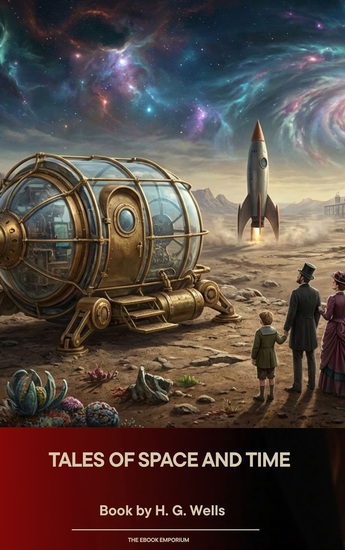
  • Tales of Space and Time - cover

    Tales of Space and Time

    H. G. Wells

    • 0
    • 0
    • 0
    "Between the stars and the stone, lies the story of us."
    
    In this seminal collection, H.G. Wells—the "Father of Science Fiction"—takes readers on a journey across the spectrum of existence. From the primitive struggles of our ancestors in "A Story of the Stone Age" to the dystopian urban sprawl of "A Story of the Days to Come," Wells explores how environment and technology shape the human spirit. Featuring the chilling cosmic disaster of "The Star" and the mysterious Martian surveillance in "The Crystal Egg," these five stories serve as a profound meditation on humanity's fragile place in a vast, indifferent universe.
    
    The Origins of Mystery: In "The Crystal Egg," Wells returns to the themes of The War of the Worlds, suggesting that even as we go about our daily lives, we are being watched from across the void. In "The Star," he delivers one of the most powerful descriptions of a global cataclysm ever written, showing how a passing celestial body could rewrite the geography of Earth and the humility of man.
    
    The Future of the Machine: In the novella-length "A Story of the Days to Come," Wells predicts a world of moving sidewalks, synthesized food, and a rigid social hierarchy where the wealthy live in the sun and the poor toil in the subterranean depths. This vision of a "megacity" served as the direct inspiration for later masterpieces like Fritz Lang's Metropolis.
    
    A Struggle for Survival: Wells reminds us that whether we are fighting a cave lion with a flint axe or battling a corporate monopoly in the year 2100, the core of the human experience remains the same: the drive to survive, to love, and to transcend our limitations.
    
    Travel across the eons. Purchase "Tales of Space and Time" today and witness the evolution of a genius.
    Show book
  • A Stroke of Grace - A Guide to Understanding and Living with an Acquired Brain Injury - cover

    A Stroke of Grace - A Guide to...

    Julianne Heagy

    • 0
    • 0
    • 0
    Julianne Heagy experienced a stroke on May 21, 2019. 
    Following her stroke, she felt unsupported by the systems in place to care for post-stroke victims. She knew there were resources available but with an inability to hold a thought or comprehend written words, Julianne became frustrated with her search for information. Aside from her family doctor, she seemed to be alone in her struggle to find information about therapies, services, and policies. 
    As Julianne began to heal, she could recall some of what she needed to know and committed to taking notes and sharing her findings with others on the same acquired brain injury path. This book is a roadmap of what Julianne learned on her journey. 
    It is Julianne’s firm belief that everything in our lives happens for us and not to us. She wrote this book now because she found improvement in her health, peace, and joy and wanted to use her experience to help others. 
    The author’s goal is to educate, empower and encourage others with an acquired brain injury. This book provides the information, easily and simply, for those struggling to ask the questions and find the resources.
    Show book
  • Climate Hope - Stories of Action in an Age of Global Crisis - cover

    Climate Hope - Stories of Action...

    David Geselbracht

    • 0
    • 0
    • 0
    Climate change is a problem so enormous and complex—with threats so frightening in their implications—that many of us fend off confusion and hopelessness by simply turning away. Meanwhile, with delayed action, missed targets, and increasingly dire reports at the international level, a notion that the crisis is intractable continues to spread. And the proposed solutions can be just as daunting. They often involve jargon about gigatons of carbon and kilowatt-hours of electricity. In a deeply polarized political environment, any sense of the common purpose required to make these work seems to dissolve into denial or paralysis. With all this fear and conflict, the question must be asked: How do we find the tools and the hope we need to tackle such a wickedly difficult issue? 


    In Climate Hope, journalist David Geselbracht blends in-depth research, expert interviews, and on-the-ground reporting in multiple countries, revealing remarkable efforts to identify the causes and impacts of climate change—and devise crucial ways to address them. The scale of the challenge is clear in the range of fields he covers, from glaciology and climate science to law and diplomacy. But in drawing these approaches together, he shares stories of hope, awe, and wonder that encourage us to confront this long-term, world-warping phenomenon with a renewed sense of purpose and possibility.
    Show book
  • Easy Guide to Attachment Disorders in Adults - Understanding adult attachment styles and relationships and attachment trauma and healing - cover

    Easy Guide to Attachment...

    Vanessa Alvarez

    • 0
    • 0
    • 0
    If you're like many adults today, you've experienced some kind of loss of a loved one. Whether it was a parent, spouse, sibling, friend, or child, losing someone close hurts. 
    People who develop attachment disorders have trouble regulating emotions and forming healthy relationships. They think negatively about themselves and find it hard to trust others. They often withdraw from social situations because they fear rejection. Some develop fears of intimacy and relationships. Others struggle with anger management issues. Still, others have difficulties controlling impulses and acting responsibly. 
    But, an attachment disorder doesn't mean you'll never recover. Many people overcome these challenges through therapy and support groups. 
    The book describes how attachment disorders affect adults, what they look like, and how to recognize them. It discusses the different types of attachment disorders, such as secure, avoidant, ambivalent/resistant, disorganized, and unresolved, and describes how they are diagnosed and treated. The authors discuss common comorbidities associated with ADs, including anxiety disorder, mood disorder, substance use disorder, eating disorders, personality disorders, and trauma exposure. 
    The Vanessa Alvarez explains why people develop these disorders, and he provides advice on how to help someone who suffers from one. She also includes suggestions for parents, teachers, and therapists.
    Show book
  • The Story of Space - From Spirit Realms to Spacetime and Beyond - cover

    The Story of Space - From Spirit...

    Ylia Callan

    • 0
    • 0
    • 0
    This audiobook is narrated by an AI Voice. The Story of Space – From Spirit Realms to Spacetime and Beyond takes listeners on an extraordinary journey through humanity’s evolving relationship with the cosmos. From the earliest myths of sacred skies and heavenly realms, to the philosophical concept of the aether, to the scientific revolutions of relativity and quantum theory, this audiobook traces the ever-shifting ways we have understood the nature of space itself. 
     
    Blending history, philosophy, science, and culture, this sweeping narrative reveals how each era has projected its deepest ideas, fears, and aspirations onto the vast expanse above us. Explore how space has been imagined not only by scientists and philosophers, but also by poets, artists, and dreamers - across cultures, languages, and spiritual traditions. 
     
    From the timeless myths of creation to Einstein’s curved spacetime, from the quantum void to the imaginative frontiers of science fiction, The Story of Space uncovers the many dimensions - physical, cultural, psychological, and spiritual - of this endless mystery. 
     
    If you’ve ever looked up at the night sky and wondered what it truly means, this audiobook offers a guide to the evolving tapestry of ideas that have shaped our vision of the universe.
    Show book
  • Hearing Happiness - Deafness Cures in History - cover

    Hearing Happiness - Deafness...

    Jaipreet Virdi

    • 0
    • 0
    • 0
    Weaving together lyrical history and personal memoir, Virdi powerfully examines society’s—and her own—perception of life as a deaf person in America. 
     
    At the age of four, Jaipreet Virdi’s world went silent. A severe case of meningitis left her alive but deaf, suddenly treated differently by everyone. Her deafness downplayed by society and doctors, she struggled to “pass” as hearing for most of her life. Countless cures, treatments, and technologies led to dead ends. Never quite deaf enough for the Deaf community or quite hearing enough for the “normal” majority, Virdi was stuck in aural limbo for years. It wasn’t until her thirties, exasperated by problems with new digital hearing aids, that she began to actively assert her deafness and reexamine society’s—and her own—perception of life as a deaf person in America. 
      
    Through lyrical history and personal memoir, Hearing Happiness raises pivotal questions about deafness in American society and the endless quest for a cure. Taking us from the 1860s up to the present, Virdi combs archives and museums in order to understand the long history of curious cures: ear trumpets, violet ray apparatuses, vibrating massagers, electrotherapy machines, airplane diving, bloodletting, skull hammering, and many more. Hundreds of procedures and products have promised grand miracles but always failed to deliver a universal cure—a harmful legacy that is still present in contemporary biomedicine. 
     
    Weaving Virdi’s own experiences together with her exploration into the fascinating history of deafness cures, Hearing Happiness is a powerful story that America needs to hear.
    Show book