Join us on a literary world trip!
Add this book to bookshelf
Grey
Write a new comment Default profile 50px
Grey
Subscribe to read the full book or read the first pages for free!
All characters reduced
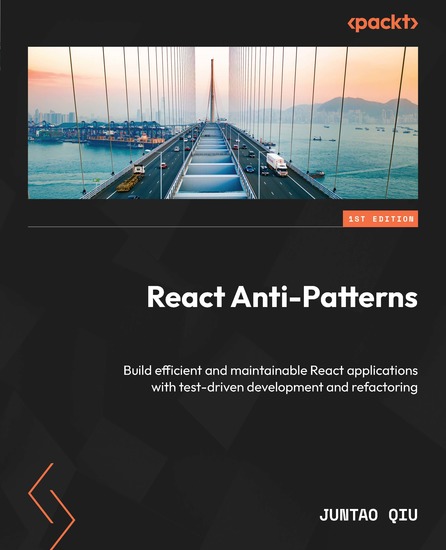
React Anti-Patterns - Build efficient and maintainable React applications with test-driven development and refactoring - cover

React Anti-Patterns - Build efficient and maintainable React applications with test-driven development and refactoring

Juntao Qiu

Publisher: Packt Publishing

  • 0
  • 0
  • 0

Summary

Take your React development skills to the next level by examining common anti-patterns with expert insights and practical solutions, to refine your codebases into sophisticated and scalable creations. Through this easy-to-follow guide, React Anti-Patterns serves as a roadmap to elevating the efficiency and maintainability of your React projects.You’ll begin by familiarizing yourself with the essential aspects of React before exploring strategies for structuring React applications and creating well-organized, modular, and easy-to-maintain codebases. From identifying and addressing common anti-patterns using refactoring techniques to harnessing the power of test-driven development (TDD), you’ll learn about the tools and techniques necessary to create reliable and robust tests. As you advance, you’ll get to grips with business logic and design patterns that offer solutions to prevalent challenges faced in React development. The book also offers insights into using composition patterns, such as code splitting and multiple entry points, to enhance the flexibility and modularity of your React applications, guiding you through end-to-end project implementation.By the end of this React book, you’ll be able to overcome common challenges and pitfalls to transform your React projects into elegant, efficient, and maintainable codebases.
Available since: 01/05/2024.
Print length: 324 pages.
Other books that might interest you

  • Carbon Technocracy - Energy Regimes in Modern East Asia - cover

    Carbon Technocracy - Energy...

    Victor Seow

    • 0
    • 0
    • 0
    A forceful reckoning with the relationship between energy and power through the history of what was once East Asia’s largest coal mine. 
     
    The coal-mining town of Fushun in China’s Northeast is home to a monstrous open pit. First excavated in the early twentieth century, this pit grew like a widening maw over the ensuing decades, as various Chinese and Japanese states endeavored to unearth Fushun’s purportedly “inexhaustible” carbon resources. Today, the depleted mine that remains is a wondrous and terrifying monument to fantasies of a fossil-fueled future and the technologies mobilized in attempts to turn those developmentalist dreams into reality. 
     
    In Carbon Technocracy, Victor Seow uses the remarkable story of the Fushun colliery to chart how the fossil fuel economy emerged in tandem with the rise of the modern technocratic state. Taking coal as an essential feedstock of national wealth and power, Chinese and Japanese bureaucrats, engineers, and industrialists deployed new technologies like open-pit mining and hydraulic stowage in pursuit of intensive energy extraction. But as much as these mine operators idealized the might of fossil fuel–driven machines, their extractive efforts nevertheless relied heavily on the human labor that those devices were expected to displace. Under the carbon energy regime, countless workers here and elsewhere would be subjected to invasive techniques of labor control, ever-escalating output targets, and the dangers of an increasingly exploited earth. 
     
    Although Fushun is no longer the coal capital it once was, the pattern of aggressive fossil-fueled development that led to its ascent endures. As we confront a planetary crisis precipitated by our extravagant consumption of carbon, it holds urgent lessons. This is a groundbreaking exploration of how the mutual production of energy and power came to define industrial modernity and the wider world that carbon made.
    Show book
  • Relativity and Cosmology - Space Time and the Universe (3 in 1) - cover

    Relativity and Cosmology - Space...

    Mark Hedges

    • 0
    • 0
    • 0
    This bundle contains three titles.  
    - General Relativity  
    - Special Relativity  
    - Relativity and Cosmology  
    The vastness of the universe and the mysteries of space and time have fascinated humanity for centuries. The theories of relativity, both special and general, have revolutionized our understanding of the cosmos, offering insights into the nature of gravity, space-time curvature, and the behavior of objects at speeds near that of light.  
    Together with cosmology, the study of the universe’s origins, structure, and eventual fate, these fields provide a unified framework for understanding the physical laws that govern everything from the smallest particles to the largest galaxies. This collection delves into the principles that shape our universe, uncovering the deep connections between relativity and cosmology.
    Show book
  • Six Easy Pieces - Essentials of Physics Explained by Its Most Brilliant Teacher - cover

    Six Easy Pieces - Essentials of...

    Richard P. Feynman

    • 0
    • 0
    • 0
    Learn how to think like a physicist from a Nobel laureate and "one of the greatest minds of the twentieth century" (New York Review of Books) with these six classic and beloved lessons It was Richard Feynman's outrageous and scintillating method of teaching that earned him legendary status among students and professors of physics. From 1961 to 1963, Feynman delivered a series of lectures at the California Institute of Technology that revolutionized the teaching of physics around the world. Six Easy Pieces, taken from these famous Lectures on Physics, represent the most accessible material from the series. In these classic lessons, Feynman introduces the general reader to the following topics: atoms, basic physics, energy, gravitation, quantum mechanics, and the relationship of physics to other topics. With his dazzling and inimitable wit, Feynman presents each discussion with a minimum of jargon. Filled with wonderful examples and clever illustrations, Six Easy Pieces is the ideal introduction to the fundamentals of physics by one of the most admired and accessible physicists of modern times. "If one book was all that could be passed on to the next generation of scientists it would undoubtedly have to be Six Easy Pieces."- John Gribbin, New Scientist
    Show book
  • Quick Guide for Creating Selling and Buying Non-Fungible Tokens (NFTs) - cover

    Quick Guide for Creating Selling...

    Dr. Hidaia Mahmood Alassouli

    • 0
    • 0
    • 0
    An NFT (non-fungible "non-interchangeable") token) simply represents ownership of an asset. Before choosing an NFT marketplace, you'll first want to decide the kind of digital asset you're interested in buying, selling, or creating. Just about anything digital -- the written word, videos, video games, art, collectors' items, etc. -- can be tokenized on a blockchain. Another consideration is the type of tokens supported on a marketplace.
    NFT marketplaces are your path to start investing in digital assets, collectibles, and art, but there are lots of options out there. Be sure to choose one that suits your buying and storage needs based on the type of NFT you're after and the crypto you're interested in using for transactions.
    This is a new industry and is highly speculative. The value of digital art and collectibles works much the same as physical art and collectibles: Value is subjective and determined by factors such as uniqueness and the reputation of the artist who made it.
    I know what you're thinking, why would anyone pay hundreds of thousands of dollars for a photo or video when they can only upload it? But it's just like real art, the copy of the photo is not the original! NFT is different because you get ownership of that piece of art when you buy it, otherwise you might be violating some copyright laws.
    
    Opensea.io is the most common online marketplace for non-fungible tokens.
    The report includes the following parts:
    1.What is NFT??
    2. Can't just upload the digital assets instead of buying them on NFT???
    3. Some NFT marketplaces.
    4. Using Opensea.io to sell and buy NFT assets.
    5. Creating and minting NFT assets in OpenSea.io.
    6. How to create and sell NFT on Binance NFT Marketplace.
    7. How to create and sell NFT on Gate.io NFT Marketplace.
    8. How to create and sell NFT on FTX.US NFT Marketplace.
    9. Example on selling NFT assets on OpeanSea.io.
    10. References.
     
    Show book
  • Connecting Care - Unlocking the Potential of Electronic Health Records to Unite Patients and Providers - cover

    Connecting Care - Unlocking the...

    Ken Hoffman, Gilbert Pant

    • 0
    • 0
    • 0
    Discover the missed opportunities and untapped potential of electronic health records (EHRs) with Connecting Care. Utilizing both technological and clinical perspectives, Ken Hoffman and Gilbert Pant delve into the evolution of EHRs, offering a candid look at their successes and shortcomings. This book presents a compelling case for how EHRs can enhance clinical decision-making, improve patient experiences, and streamline administrative processes.
    Show book
  • Oology - The Egg and Its Secrets: A Study in Bird Reproduction - cover

    Oology - The Egg and Its...

    Mike Crawford

    • 0
    • 0
    • 0
    The egg is one of nature’s most remarkable biological innovations, serving as the foundation of avian reproduction. Long before birds existed, the ability to lay eggs developed as a survival strategy in early reptiles, eventually giving rise to the diverse eggs seen in birds today. The evolution of eggs is a story of adaptation, refinement, and resilience, shaping the reproductive success of countless species. 
    Egg-laying, or oviparity, predates birds by hundreds of millions of years. The first amniotic eggs emerged among ancient reptiles during the Carboniferous period, around 300 million years ago. These eggs were a major evolutionary breakthrough, allowing vertebrates to reproduce on land without relying on water, unlike amphibians. The development of a protective shell and internal membranes provided a self-contained environment, shielding the embryo from desiccation while supplying it with the necessary nutrients and gases for development. Over time, the egg’s structure became more specialized, leading to the hardened, calcified shells seen in modern birds. 
    As dinosaurs evolved into birds, their eggs underwent significant transformations to meet the demands of flight and avian lifestyles. Fossil evidence suggests that theropod dinosaurs, the ancestors of birds, laid eggs with increasingly sophisticated structures. Their eggshells contained microscopic pores that regulated gas exchange, similar to those of birds today. Some species even exhibited brooding behaviors, indicating that parental care played a role in egg survival long before the emergence of modern avians. These adaptations contributed to the success of birds, enabling them to occupy a wide range of ecological niches.
    Show book