Join us on a literary world trip!
Add this book to bookshelf
Grey
Write a new comment Default profile 50px
Grey
Subscribe to read the full book or read the first pages for free!
All characters reduced
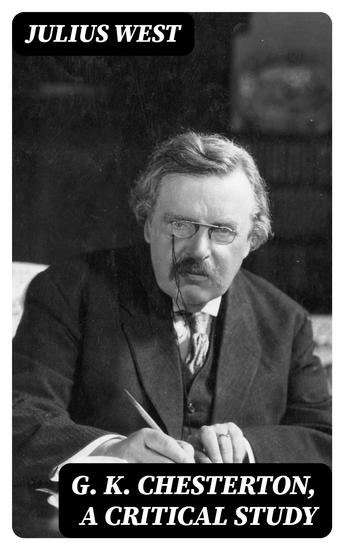
G K Chesterton A Critical Study - cover

G K Chesterton A Critical Study

Julius West

Publisher: DigiCat

  • 0
  • 0
  • 0

Summary

In "G. K. Chesterton, A Critical Study," Julius West offers a meticulous examination of one of the 20th century's most influential literary figures. West delves into Chesterton's multifaceted works, encompassing his novels, essays, and poetry, employing a blend of literary criticism and biographical exploration. The book is characterized by its analytical depth and eloquent prose, situating Chesterton's contributions within the broader context of early modernist thought and the Socratic form of discourse, which Chesterton famously championed. This critical study not only honors Chesterton's wit and paradoxical style but also tackles the intricacies of his philosophical underpinnings and theological viewpoints, thereby illuminating his impact on contemporary literature and culture. Julius West, a scholar with a profound interest in early 20th-century literature, draws from his extensive background in literary criticism and theology to craft this insightful analysis. His passion for Chesterton's work is evident, fueled by a desire to convey the importance of Chesterton's ideas in an age often bereft of the rich dialogues that define human existence. West's own experiences in literary scholarship lend significant weight to his interpretations and critiques. This book is highly recommended for anyone seeking to navigate the labyrinth of Chesterton's thought and articulate style. Whether a seasoned scholar, a graduate student of literature, or simply a curious reader, West's study functions as both an introductory guide and a profound exploration of Chesterton's enduring legacy, making it an indispensable addition to the libraries of those fascinated by literary criticism and theological inquiry.
Available since: 08/10/2022.
Print length: 106 pages.


Other books that might interest you

  • A Classic Interview with Music Icon Buddy Holly - cover

    A Classic Interview with Music...

    Buddy Holly

    • 0
    • 0
    • 0
    Charles Hardin Holley (September 7, 1936 - February 3, 1959), known as Buddy Holly, was an American singer, songwriter, and musician who was a central and pioneering figure of mid-1950s rock and roll. He was born to a musical family in Lubbock, Texas, during the Great Depression, and learned to play guitar and sing alongside his two siblings. In 1956 Holly created the band, The Crickets, with drummer Jerry Allison, bassist Joe B. Mauldin, and, from 1956 to 1958, rhythm guitarist Niki Sullivan. On February 3, 1959, Holly, Ritchie Valens, and "The Big Bopper" J. P. Richardson were all killed in a plane crash near Clear Lake, Iowa, together with pilot Roger Peterson. The event became known as "The Day the Music Died" after singer-songwriter Don McLean referred to it as such in his 1971 song "American Pie." The following audio includes several brief interviews Holly made in the late 1950s.
    Show book
  • Allied Invasions of France in 1944 The: The History and Legacy of the Campaigns that Began the Liberation of Western Europe from the Nazis - cover

    Allied Invasions of France in...

    Editors Charles River

    • 0
    • 0
    • 0
    By the end of D-Day, the Allies had managed to successfully land 170,000 men, including over 75,000 on the British and Canadian beaches, 57,000 on the American beaches, and over 24,000 airborne troops. Thanks to Allied deception, the German army had failed to react to prevent the Allies from making the most of their landings. Just one division, the Hitlerjugend, would arrive the following day. Despite a fearsome and bloody day, the majority of the Allied forces had held their nerve, and most importantly, achieved their objectives. This ensured Operation Overlord was ultimately successful, and victory in Europe would be achieved within less than a year. 	Churchill was not overstating the achievements of the invasion when he described the plan “the greatest thing we have ever attempted”. The greatest armada the world had ever seen had landed 170,000 soldiers on the heavily defended beaches of Normandy in just 24 hours. More remarkable was the fact that the operation was a success on every major level. Deception, tactical surprise and overwhelming force had contributed to the establishment of an adequate beachhead. Confusion and dissent had stopped the Germans massing for any great counterattack. The Atlantic Wall which Hitler had placed so much faith in had been breached, and the race to Paris was on. The landings in Normandy and the campaign that followed were successful, but that very success brought its own problems.  
    	While D-Day is one of the most famous events of the war, it is widely overlooked that about two months after the landings in Normandy, there was a second Allied landing in France. On August 15, 1944, a combined US-French force landed in southern France on the beaches of the Côte d'Azur as part of Operation Dragoon. In just over four weeks of fighting, the Allied landing led to the liberation of most of southern France and to one of the most audacious and successful Allied operations of World War II. 
    Show book
  • The Arab Spring - Escalations and Peace Efforts in a Longstanding Struggle - cover

    The Arab Spring - Escalations...

    Fredrich Hazelton

    • 0
    • 0
    • 0
    The Arab Springs stands as one of the most transformative events of the 21st century, reshaping the political and social landscapes of the Middle East and North Africa. Triggered in December 2010 by the self-immolation of Mohamed Bouazizi in Tunisia, the movement quickly spread across the region, igniting a wave of protests, uprisings, and revolutions. These events brought to the forefront the widespread grievances of millions—grievances rooted in authoritarian governance, economic stagnation, and social inequalities that had long plagued the Arab world.  
      
    At its core, the Arab Springs was a collective demand for dignity, freedom, and justice. It represented a breaking point for societies that had endured decades of political repression and corruption. While each country experienced the uprisings differently, common threads emerged: youthful populations yearning for change, the powerful role of social media in organizing protests, and a shared sense of solidarity among citizens who saw an opportunity to challenge entrenched regimes.  
      
    The revolutions also revealed deep-seated structural issues within the region. Economic hardship, unemployment, and a lack of political freedoms were not new problems, but the Arab Springs forced governments and the international community to confront these issues in an unprecedented way. Moreover, the movement challenged the perception of Arab societies as passive or unchangeable, showcasing the determination and resilience of ordinary people striving for their rights. 
    Show book
  • Mark Twain: A short biography - 5 Minutes: Short on time - long on info! - cover

    Mark Twain: A short biography -...

    5 Minutes, 5 Minute Biographies,...

    • 0
    • 0
    • 0
    Mark Twain, humorist and bestselling author: Life and works in a short biography! Everything you need to know, brief and concise. Infotainment, education and entertainment at its best!
    Show book
  • The History of England Volume 2 - King Henry III to King Richard III - cover

    The History of England Volume 2...

    David Hume

    • 0
    • 0
    • 0
    The second volume of David Hume’s classic survey of English history covers nearly 300 years (1200-1485) from the long reign of Henry III to the dramatic end of Richard III on Bosworth Field – he was the last Plantagenet, and the last king of England to die in battle. 
    In these last centuries of the medieval period, which culminated in the 30 years of the Wars of the Roses, England was ruled by 11 monarchs of varying personalities and abilities. These included the powerful figures of Edward I (reigning 1272-1307) whose authority stabilised the monarchy after his conflicted father; and Edward III (reigning 1327-1377) who similarly asserted his authority on the land following the weak rule of his father, Edward II.  
    After the disastrous reign of Richard II came the steady hand of Henry IV, (reigning 1399-1413), and the short but charismatic time of Henry V (reigning 1413-1422) with the highlight of Agincourt. This was followed by the 40-year reign of Henry VI (1422-1461/1470-71), a very different figure (characterised by Hume as ‘a weak prince, how gentle soever and innocent’). It led the way inexorably to the Wars of the Roses. 
    In telling this all-action tale, Hume delves deeply into contemporary records and presents a considered, even sympathetic view, showing that many factors, not just personalities, resulted in dramatic consequences for the nation. 
    In concluding each reign, he gives a character assessment of each individual who sat on the throne – at a time when strong rule was expected but not always delivered. Throughout, dissension was continually driven by conflicting pressures of political, familial, and commercial rivalries coloured and shaped by uncontrollable ambition.   
    Harnessing a wealth of detail, yet strong on judgement and opinion, Hume tells the story of this period with pace and the rich literary style, features which make The History of England in its entirety admired by historians even in the 21st century.
    Show book
  • Carmen's Legacy - cover

    Carmen's Legacy

    John Maher

    • 0
    • 0
    • 0
    Carmen's Legacy tells the story of a family's journey of tragedy and hope. At Age forty-two, John Maher was involved in a fatal car crash in which he was severely injured and, the eighteen-year-old driver of the other vehicle was killed. Thankfully, John was not at fault. His injuries were so severe that doctors informed him he would never work again. Married with four daughters in either secondary school or university, this was a tremendous blow to this young family.However, there was more tragedy to come for the Maher family. Just 30-months after John's horrific car crash, the youngest of their four beautiful daughters, 18-year-old Carmen, was killed in a car crash when she fell asleep at the wheel of her car and hit a tree.In an even crueller twist, her eldest sister Michelle was the third car on the crash scene when on her way to work.Carmen's Legacy has many lessons, and possibly the most powerful is how the love and support of family can overcome even the most devastating and tragic event.Two years after Carmen's death when four 18-year-old students were killed in a car crash in Bendigo, John decided to educate young drivers about the dangers on our roads. He developed Carmen's Road Safety presentation and presented it at secondary schools. Telling Carmen's story to years 10, 11, and 12 students hoping they would never do to their family what Carmen has done to his.Carmen's Legacy will take you on a journey of triumph over tragedy. It will also empower you to be a safer road user and help you understand who you are.The Maher family didn't know that on November 18, 1995, they would lose their beautiful Carmen forever and they would never be able to cuddle her again.We would love to give Carmen just one more cuddle.
    Show book