Join us on a literary world trip!
Add this book to bookshelf
Grey
Write a new comment Default profile 50px
Grey
Subscribe to read the full book or read the first pages for free!
All characters reduced
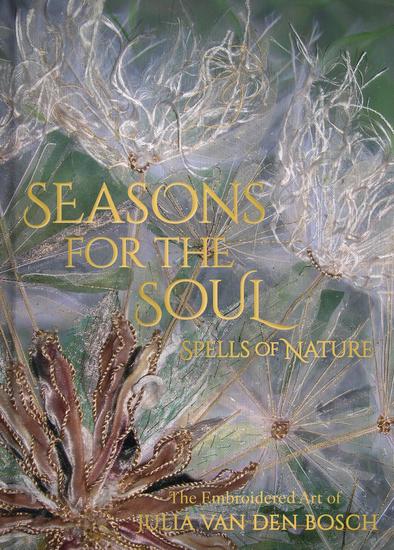
Seasons for the Soul - Spells of Nature - The Embroidered Art of Julia van den Bosch - cover

Seasons for the Soul - Spells of Nature - The Embroidered Art of Julia van den Bosch

Julia van den Bosch

Publisher: Unicorn

  • 0
  • 0
  • 0

Summary

The beauty and magic of nature seen through the eye of a needle.
Colours of flowers and shapes of plants; bleached grass and golden cornfields at harvest time; spiders webs on the structures of decayed seedheads; a metallic green chafer beetle landing on a deep crimson rose; a shooting star. Beguiling discoveries that are part of the world full of secrets, minute details and the sumptuous colours and textures of nature that lend themselves to their translation into rich embroidery.
This embroidered path of the seasons uses hand embroidery in its traditional role of storytelling to share nature's gifts. Each stitch holds the emotion of the moment and keeps a record.
The book tells the story of the companionship and healing offered by the seasons during the enforced isolation of the pandemic, and how it enabled the artist to find beauty in solitude.
Available since: 06/14/2024.
Print length: 128 pages.

Other books that might interest you

  • Kirby - King of Comics - cover

    Kirby - King of Comics

    Mark Evanier

    • 0
    • 1
    • 0
    Filled with stunning artwork, this biography of comics pioneer Jack Kirby by an artist who worked closely with him is “a treasure” (The Cleveland Plain Dealer). 
     
    “As a teenager, future television and comics writer [Mark] Evanier became an assistant to Jack Kirby, one of the foremost artists in the history of American comics. Kirby played a major role in shaping the superhero genre, not only through his innovative, dynamic artwork but through collaborating with Stan Lee to create classic Marvel characters like the Fantastic Four, the Hulk and the X-Men. Evanier has now written this magnificently illustrated biography of his mentor. Rather than employing the academic prose that one might expect from an art book, Evanier, a talented raconteur, tells Kirby’s life story in an informal, entertaining manner . . . he brings Kirby’s personality vividly alive: a child of the Great Depression, a creative visionary who struggled most of his life to support his family. The book recounts how Kirby was insufficiently appreciated by clueless corporate executives and close-minded comics professionals. But the stunning artwork in this book, taken from private collections, makes the case for Kirby’s genius. A landmark work, this is essential reading for comics fans and those who want to better understand the history of the comics medium—or those who just want to enjoy Kirby’s incredible artwork.” —Publishers Weekly 
     
    Includes an introduction by Neil Gaiman
    Show book
  • The Word of Dog - What Our Canine Companions Can Teach Us About Living a Good Life - cover

    The Word of Dog - What Our...

    Mark Rowlands

    • 0
    • 0
    • 0
    A heartwarming philosophical meditation on how to live a fulfilling life—inspired by the inherent happiness of dogs. 


    If you have spent any part of your life with a dog, you may have found certain questions popping, unbidden, into your mind: Is my dog living a fulfilled life? Is my dog a good dog? Does my dog love me? Addressing these questions compels you to confront not just your dog's life but yours as well—to think about what fulfillment, and meaning, in life really is. 


    In The Word of Dog, philosopher Mark Rowlands explores these questions and suggests that in dogs we can see hints—faint, shrouded, but discernible—of what a better way of living might look like. Perhaps none of us can be happy in the way a dog can, but The Word of Dog shows us we could do a lot better than we're doing simply by listening to the unspoken wisdom our dogs reveal to us every day of their happy, uncomplicated lives.
    Show book
  • Man vs Machine - An Experiment in Fiction - cover

    Man vs Machine - An Experiment...

    Chris Godber

    • 0
    • 0
    • 0
    "A man is nothing but a man, But before I let your steam drill beat me down, I’d die with a hammer in my hand..." - Ballad of John Henry* 
    According to the ballad that made him famous, John Henry did battle with a steam-powered drill, beat the machine, and died. 
    MACHINE 
    In the cyberpunk world of 2080, MamaMood, Byte, and Binary Blaze join forces to uncover the truth about the enigmatic group known as The Luminaries. Their quest takes them through a dystopian Neonova, filled with cybercrime and megacorporate control, as they navigate a treacherous digital landscape. 
    MAN 
    Part cyberpunk fiction novel part computer science experiement, Man vs Machine is author Chris Godber's experiment with writing fiction in colloboration with ChatGPT. Godber's aim is simple - see if he can write a semi-cohesive Cyberpunk thriller in tandem with AI and detemine if he gains anything from the experience.
    Show book
  • Janet Roth: Extremely Analytical - cover

    Janet Roth: Extremely Analytical

    Janet Roth

    • 0
    • 0
    • 0
    Janet Roth bares all in a blistering stand-up special about marriage, Millennial dating and living in LA. And she won't spare you the details.
    Show book
  • The Qin Dynasty - Unifying China - cover

    The Qin Dynasty - Unifying China

    Jun Liu

    • 0
    • 0
    • 0
    The Qin state emerged as one of the most formidable powers during the Warring States Period, a time of intense conflict and political fragmentation in ancient China. Situated in the western frontier, Qin was once considered a relatively backward state compared to its eastern rivals. However, through strategic reforms, military innovations, and a firm commitment to Legalist principles, Qin transformed itself into the dominant force that would eventually unify China. 
    One of the key factors in Qin’s rise was the implementation of Legalist policies under the statesman Shang Yang. In the fourth century BCE, Shang Yang introduced a series of reforms that fundamentally reshaped Qin society. These policies emphasized strict laws, centralized authority, and merit-based advancements. Land ownership was restructured to allow farmers more direct control over their land, encouraging agricultural productivity and economic growth. At the same time, a rigid legal code was enforced, ensuring discipline among the population while diminishing the power of aristocratic families. By weakening the influence of hereditary nobles and promoting individuals based on their abilities, Shang Yang’s reforms created a more efficient and loyal administrative system that strengthened Qin’s central government. 
    The military advancements of Qin also played a crucial role in its ascendance. Unlike other states that relied heavily on noble warriors, Qin adopted a professional army system that allowed for greater discipline and efficiency. The state implemented mass conscription, ensuring a steady supply of soldiers trained under strict military codes. Advanced weaponry, including iron swords and crossbows, gave Qin troops a significant advantage on the battlefield. Additionally, the construction of an extensive road network allowed for rapid troop movements, enabling Qin forces to respond quickly to threats and expand their territorial control.
    Show book
  • The Evolution of Urban Planning - Historical and Contemporary Perspectives - cover

    The Evolution of Urban Planning...

    Lyric Vale

    • 0
    • 0
    • 0
    Urban planning is the process by which cities, towns, and other urban spaces are designed, organized, and managed. It is a field that encompasses various aspects of human life, from infrastructure to social dynamics, and aims to create environments that promote the well-being of residents and the sustainability of the urban ecosystem. The importance of urban planning lies in its ability to shape the physical, social, and economic structure of a community. It influences the way people interact with their environment and with each other, determining the accessibility of resources, the flow of traffic, and the availability of green spaces, among other factors. 
    The evolution of urban planning can be traced back to ancient civilizations, where early cities were often designed around central hubs of commerce, religion, or governance. In these early stages, urban planning was driven by necessity, focusing primarily on basic functions like defense, water management, and trade. Over time, as cities grew and became more complex, the need for more organized and systematic approaches to urban development emerged. This shift was marked by the introduction of formal planning principles that considered not only the practical aspects of urban life but also the aesthetic, cultural, and social needs of the inhabitants. 
    In the modern era, urban planning became an established profession, with experts tasked with the responsibility of designing and managing urban spaces to meet the growing demands of an increasingly urbanized population. The industrial revolution, for example, brought about massive shifts in population density and the structure of cities. It prompted the creation of zoning laws, housing regulations, and other planning policies that addressed new challenges such as pollution, overcrowding, and public health. These developments laid the groundwork for the more sophisticated planning techniques used in contemporary cities.
    Show book