Join us on a literary world trip!
Add this book to bookshelf
Grey
Write a new comment Default profile 50px
Grey
Subscribe to read the full book or read the first pages for free!
All characters reduced
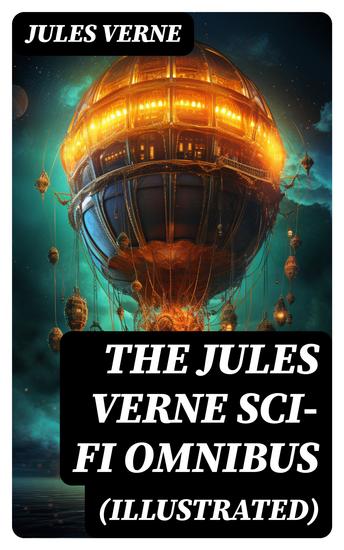
The Jules Verne Sci-Fi Omnibus (Illustrated) - cover

The Jules Verne Sci-Fi Omnibus (Illustrated)

Jules Verne

Translator Frederick Amadeus Malleson, Lewis Page Mercier, Eleanor E. King, Ellen E. Frewer, Agnes D. Kingston

Publisher: DigiCat

  • 0
  • 0
  • 0

Summary

The "Jules Verne Sci-Fi Omnibus (Illustrated)" presents a curated selection of Verne's seminal works, seamlessly capturing the spirit of adventure and innovation that defines early science fiction. The omnibus showcases Verne's masterful storytelling, imbued with meticulous detail and imaginative foresight. Each illustrated tale, including classics like "Twenty Thousand Leagues Under the Seas" and "Journey to the Center of the Earth," reflects the zeitgeist of the 19th century, as it grapples with themes of exploration, technological progress, and the human spirit's unyielding quest for knowledge. Verne's narrative style is characterized by a grandiose vision and a scientific seriousness, setting the groundwork for future science fiction writers and influencing the genre's evolution. Jules Verne, often heralded as the father of science fiction, was born in 1828 in Nantes, France. His keen interest in science, engineering, and exploration, showcased in his extensive travels and his familial background in law, fueled his imagination, leading him to craft extraordinary tales that pushed the boundaries of what was possible in his time. Verne's unique fusion of technical accuracy with fantasy not only entertained readers but also inspired generations to look toward the stars and beneath the seas. This omnibus is an essential read for both literary scholars and casual readers alike, offering a rich tapestry of imaginative literature that continues to resonate. The vibrant illustrations enrich the text, enhancing the reader's experience and making this collection a timeless addition to any library. For anyone seeking to understand the roots of modern science fiction or yearning for thrilling escapades, Verne's work remains an unparalleled treasure.
Available since: 12/10/2023.
Print length: 2694 pages.

Other books that might interest you

  • Twenty-Six Men and a Girl - From their pens to your ears genius in every story - cover

    Twenty-Six Men and a Girl - From...

    Maxim Gorky

    • 0
    • 0
    • 0
    Alexei Maximovich Peshkov was born on 28th March 1868, in Nizhny Novgorod, Russia. 
    Better known as Maxim Gorky he was orphaned at 11 and ran away from home at 12.  At 19 he had already attempted suicide and thereafter travelled, by foot, across the Russian Empire for 5 years. 
    His first book ‘Essays & Stories’ in 1898 was a sensation and so began a long career as an author of short stories, novels and plays.  Gorky saw writing as a moral and political act that would help to change the unjust world around him.  He was an ardent early advocate of the emerging Marxist movement and publicly opposed the Tsarist regime leading several times to his arrest.  
    In 1904 he began his own theatre but the censor banned every play and Gorky was forced to abandon the project. 
    But Gorky was a financially successful author, editor, and playwright and gave monies to political parties as well as for civil rights and social reform.  The brutal shooting of workers, which set in motion the Revolution of 1905, pushed Gorky more decisively toward radical solutions.  
    In 1906 he went to the United States to raise funds for the Bolsheviks. Those experiences including a scandal over travelling with his lover and not his wife deepened his contempt for the ‘bourgeois soul.’ 
    Gorky now moved to Capri in Italy, both for health reasons and to escape the increasingly repressive times in Russia.  
    An amnesty for the 300th anniversary of the Romanov dynasty saw him return to Russia in 1914. His politics remained close to the Bolshevik cause.  But soon, after the 1918 revolution, his essays referred to Lenin as a tyrant for his senseless arrests and repression.  He was soon appealing to the outside world for food aid after the catastrophic crop failure. 
    In October 1921 Gorky returned to Italy, now in Fascist hands, and settled in Sorrento until 1932.  His health worsened with the onset of tuberculosis. 
    He wrote several successful books there but now decided to find an understanding with the communist regime. Stalin invited him home and his return was hailed as a major propaganda victory.  He was decorated with the Order of Lenin, and a province, a park, and various streets re-named in his honour. 
    But he had his faults too.  In 1933, Gorky co-edited a book on the White Sea-Baltic Canal and denied even a single prisoner died during its construction, but thousands had. As well, knowing that some Nazis were homosexual, a phrase was attributed to him that said ‘exterminate all homosexuals and fascism will vanish’.  Although he was himself was quoting another he was decidedly homophobic. 
    With the increase of Stalinist repression in 1935 Gorky was placed under unannounced house arrest. 
    Maxim Gorky died on the 18th June 1936 from pneumonia.  He was 68. 
    Stalin and Molotov were among those who carried Gorky's urn of ashes at his funeral.
    Show book
  • The Sea-Wolf - cover

    The Sea-Wolf

    Jack London

    • 0
    • 0
    • 0
    "Humphrey Van Weyden is a smart, domesticated man. He enjoys reading and critiquing literature in his free time. So when he finds himself a survivor of a ferryboat accident and at the complete mercy of a tyrannical schooner captain, his life is turned upside down. Exploring themes of ambition, courage, and survival, this 1904 classic adventure novel features an antagonist based on a sailor Jack London once knew."
    Show book
  • The Piazza Tales - cover

    The Piazza Tales

    Herman Melville

    • 0
    • 0
    • 0
    "The Piazza Tales" by Herman Melville is a collection of short stories exploring the complexities of human experience. From the eerie "Bartleby, the Scrivener" to the adventurous "Benito Cereno," the tales traverse a range of themes. They delve into the enigmatic Bartleby's passive resistance, the dark secrets aboard a slave ship in "Benito Cereno," and the haunting quest for the White Whale in "The Encantadas." Through Melville's evocative prose, the collection offers a profound exploration of human nature, morality, and the mysteries that shape our lives.
    Show book
  • Stephen Leacock - A Short Story Collection - Widely renowned Canadian writer and humourist - cover

    Stephen Leacock - A Short Story...

    Anonymous

    • 0
    • 0
    • 0
    Stephen P H Butler Leacock FRSC was born on 30th December 1869 in Swanmore, near Southampton, England, the third of eleven children. 
    The family emigrated to Canada in 1876, settling on a 100-acre farm in Sutton, Ontario.  There he was home-schooled until, funded by his grandfather, he was enrolled into the elite Upper Canada College in Toronto.  Academically he was very strong and thence proceeded on to the University of Toronto to study languages and literature.  After completing two years of study in only one, he was obliged to leave because his alcoholic father had abandoned the family and finances could not stretch to cover his education.  Leacock now enrolled in a 3 month course to become a qualified high school teacher and thereby gain a regular income.  For the next decade he worked at Upper Canada College.  
    His passion was economics and political theory and in 1899 he became a postgraduate student at the University of Chicago and earned his PhD.  In 1906, he wrote ‘Elements of Political Science’, quickly adopted as a standard academic textbook for the next two decades and his most profitable book.   
    Although he had already published several humorous pieces it was only in 1910 that these works were collected and published and turned him into a commercially successful writer.  Volume after volume now appeared almost annually and it was often said that more people had heard of him than of Canada. 
    Politically he was a social conservative.  He opposed women’s right to vote and was a champion of Empire but also an advocate of social welfare legislation and wealth redistribution, but often caused friction with his racist views. 
    Stephen Leacock died on 28th March 1944 of throat cancer in Toronto, Canada.  He was 74.
    Show book
  • Top 10 Short Stories The - The 1860's - The Men - The top ten short stories written in the 1860s by male authors - cover

    Top 10 Short Stories The - The...

    Fyodor Dostoyevsky, Charles...

    • 0
    • 0
    • 0
    Short stories have always been a sort of instant access into an author’s brain, their soul and heart.  A few pages can lift our lives into locations, people and experiences with a sweep of landscape, narration, feelings and emotions that is difficult to achieve elsewhere. 
     
    In this series we try to offer up tried and trusted ‘Top Tens’ across many different themes and authors. But any anthology will immediately throw up the questions – Why that story? Why that author?  
     
    The theme itself will form the boundaries for our stories which range from well-known classics, newly told, to stories that modern times have overlooked but perfectly exemplify the theme.  Throughout the volume our authors whether of instant recognition or new to you are all leviathans of literature. 
     
    Some you may disagree with but they will get you thinking; about our choices and about those you would have made.  If this volume takes you on a path to discover more of these miniature masterpieces then we have all gained something. 
     
    This mid-century decade reveals a journey traversing continents and genres as authors explore and revel in the telling of tumultuous times of social upheaval as nations are divided by Civil War or expand with the brute force of Imperial Dreams.  Our writers are here to document and narrate more about this fascinating decade. 
     
    01 - The Top 10 - The 1860's - The Men - An Introduction 
    02 - The Crocodile. An Extraordinary Incident - Part 1 by Fyodor Dostoyevsky 
    03 - The Crocodile. An Extraordinary Incident - Part 2 by Fyodor Dostoyevsky 
    04 - The Signalman by Charles Dickens 
    05 - The Generous Gambler by Charles Baudelaire 
    06 - The Romance of Certain Old Clothes by Henry James 
    07 - Malachi's Cove by Anthony Trollope 
    08 - The Outcasts of Poker Flat by Bret Harte 
    05 - The Astounding Adventure of Wheeler J Calamity, Related by Himslef by W S Gilbert 
    10 - The Spectre Bridegroom by William Hunt 
    11 - The 9.30 Up-Train by Sabine Baring-Gould 
    12 - The Man Without a Country by Edward Everett Hale
    Show book
  • Germinal - cover

    Germinal

    Émile Zola

    • 0
    • 0
    • 0
    'There is a germ of revolt in every injustice.'
    
    Part of Zola's ambitious twenty-volume series Les Rougon-Macquart, Germinal is one of the most notable novels written in the French tradition and is often considered Zola's masterpiece.
    
    First serialised in the periodical Gil Blas in 1884, Germinal is a profoundly gripping novel that explores the harsh realities of industrial life in nineteenth century France. When Étienne Lantier arrives in the town of Montsou in search for work, he is confronted by the brutal conditions endured by the coal miners: gruelling shifts, meagre wages and backbreaking labour. As Étienne immerses himself in the community, he takes it upon himself to become a voice for the labourers and a leader in their fight for justice. As tensions rise and a minor's strike begins to brew, Zola candidly depicts a devastating spiral into violence and despair. Through vivid characters and uncompromising realism, Zola movingly captures the human cost of capitalism with a blossoming hope for revolution. This audiobook edition is beautifully narrated by David Rintoul.
    Émile Zola (1840 – 1902) was a French novelist, playwright and journalist. He was also a keen adopter of naturalism, famed for his realistic depictions of characters and their environments. Nominated for the first and second Nobel Prizes in Literature in 1901 and 1902, Zola's work is still widely read and respected today.
    Show book