Join us on a literary world trip!
Add this book to bookshelf
Grey
Write a new comment Default profile 50px
Grey
Subscribe to read the full book or read the first pages for free!
All characters reduced
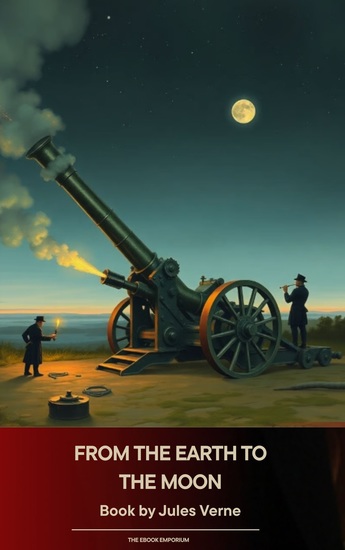
From the Earth to the Moon - cover

From the Earth to the Moon

Jules Verne

Publisher: The Ebook Emporium

  • 0
  • 0
  • 0

Summary

"The American character is one of action. They have decided to go; therefore, they will go."

The war is over, but the ambition of the Baltimore Gun Club is just beginning. In a world of steam and iron, President Impey Barbicane has issued a challenge that sounds like madness: fire a manned projectile at the Moon. This isn't a fantasy; it is a meticulously calculated industrial assault on the heavens. From the massive excavation of the Florida launch site to the chemical innovations required for life support, follow three men as they prepare to become the first human beings to leave the Earth's atmosphere.

The Mission Parameters:

The Weapon: The Columbiad, a 900-foot-deep "super-cannon" cast directly into the earth.

The Vessel: A hollow, conical aluminum shell—a revolutionary choice of material that predicted modern aerospace engineering.

The Crew: A trio of clashing personalities—Barbicane, Nicholl, and Ardan—trapped in a small, padded cabin for a journey through the silent vacuum of space.

The Physics: Experience the terrifying "recoil" of the launch and the first literary description of the weightlessness of space.

Jules Verne didn't just write a story; he wrote a prophecy. He correctly identified the need for a launch site near the equator, the use of rockets for course correction, and the approximate travel time to our lunar neighbor. It is the ultimate "tinker's" adventure, where the primary weapons are slide rules, gunpowder, and unbreakable human spirit.

The countdown has begun, and the world is watching the Florida coast. Will the Columbiad reach its target, or will it be lost to the void?

Order your copy of "From the Earth to the Moon" now and witness the birth of the Space Age.
Available since: 01/13/2026.
Print length: 188 pages.

Other books that might interest you

  • Ending Up - cover

    Ending Up

    Kingsley Amis

    • 0
    • 0
    • 0
    A group of disgruntled septuagenarians prepare for their final days in this dark and “very funny” English novel about death and the inevitability of growing old (The Observer). 
    Everyone wants a comfortable place to die, and Kingsley Amis’s characters have found it in Tuppeny-happeny Cottage, where assorted septuagenarians have come together to see one another out the door of life. There’s grotesque Adela, whose sole passion is her cheapness; her brother Brigadier Bernard Bastable, always strategizing a new retreat to the bathroom before sallying forth to play some especially nasty practical joke; Shorty, the servant, who years ago had a fling with the brigadier in the barracks and now organizes his day around a trail of hidden bottles; George Zeyer, the distinguished professor of history, bedridden and helpless to articulate his still-coherent thoughts; and Marigold, who slowly but surely is forgetting it all. 
    And now it is Christmas. Children and grandchildren are coming to visit their ailing elders. They don’t know what lies in store before the story ends. None of us do. 
    Ending Up is a grimly hilarious dance of death, full of bickering, bitching, backstabbing, drinking (of course), and idiocy of all sorts. It is an audiobook about dying people and about a dying England, clinging to its memories of greatness as it succumbs to terminal decay.
    Show book
  • Frankenstein Alive - cover

    Frankenstein Alive

    Mary Shelley

    • 0
    • 0
    • 0
    Mary Shelley ) was an English novelist who wrote the Gothic novel Frankenstein; or, The Modern Prometheus in 1818, which is considered an early example of science fiction. She also edited and promoted the works of her husband, the Romantic poet, and philosopher Percy Bysshe Shelley. Her father was the political philosopher William Godwin and her mother the philosopher and feminist activist Mary Wollstonecraft. 
     
    Shelley's mother died less than a month after giving birth to her. She was raised by her father, who provided her with a rich if informal education, encouraging her to adhere to his own anarchist political theories. When she was four, her father married a neighbor, Mary Jane Clairmont, with whom Shelley came to have a troubled relationship. 
     
    In 1814, Shelley began a romance with one of her father's political followers, Percy Bysshe Shelley, who was already married. Together with her stepsister, Claire Clairmont, she and Percy left for France and traveled through Europe. Upon their return to England, Shelley was pregnant with Percy's child. Over the next two years, she and Percy faced ostracism, constant debt, and the death of their prematurely born daughter. They married in late 1816, after the suicide of Percy Shelley's first wife, Harriet. 
     
    In 1816, the couple and her stepsister famously spent a summer with Lord Byron and John William Polidori near Geneva, Switzerland, where Shelley conceived the idea for her novel Frankenstein. The Shelleys left Britain in 1818 for Italy, where their second and third children died before Shelley gave birth to her last and only surviving child, Percy Florence Shelley. In 1822, her husband drowned when his sailing boat sank during a storm near Viareggio. A year later, Shelley returned to England and from then on devoted herself to the upbringing of her son and a career as a professional author.
    Show book
  • Midsummer Night's Dream A - William Shakespeare - cover

    Midsummer Night's Dream A -...

    William Shakespeare

    • 0
    • 0
    • 0
    The play is set in Athens and consists of several subplots that revolve around the marriage of Theseus and Hippolyta. One subplot involves a conflict among four Athenian lovers. 
    Show book
  • Twilight Alley - From their pens to your ears genius in every story - cover

    Twilight Alley - From their pens...

    Stefan Zweig

    • 0
    • 0
    • 0
    Stefan Zweig was born on the 28th November 1881 in Vienna, then part of the Austro-Hungarian Empire, and into a wealthy Jewish family with interests in banking and textiles. 
    He studied philosophy at the University of Vienna and achieved his degree in 1904. 
    Zweig first published in 1900 and two decades later was a popular and highly regarded author in many parts of the world, although not in England.    
    During the Great War he served in the Archives of the Ministry of War and supported Austria's war effort through his writings in the ‘Neue Freie Presse’.  Whilst his work praised his Country’s progress and, on occasions, its excesses and massacres, he later claimed, in his memoir, that he was a pacifist. 
    In 1912 he began an affair with the married, and mother or two, Friderike Maria von Winternitz, but it was only in 1920 that circumstances allowed them to marry.  She took care of much of his business interests and supported him artistically.  In this decade too many of his most famous works including the short stories; ‘Amok’, and ‘Letter from an Unknown Woman’ (filmed in 1948 by Max Ophüls), novels; ‘Confusion of Feelings’ and biographies including that on Marie Antoinette (filmed by MGM in 1938) were published. 
    He was also the librettist with Richard Strauss of two operas and a keen collector of autographed musical manuscripts.  His collection of over two hundred pieces was later donated to the British Library.  
    In 1934, Zweig, as a Jew, and finding life very difficult under his anti-Semitic government and the neighbouring Nazi’s persuaded him to leave Austria for England.   
    In 1940 Zweig, now divorced and married to his second wife, and former secretary, Lotte Altmann, left London and via New York moved to Petrópolis, a German-colonized town 50 miles north of Rio de Janeiro in Brazil.  Although he continued to write he became, along with his wife, increasingly depressed about the situation in Europe and the future for humanity,  
    His memoir ‘The World of Yesterday’ was completed on the 22nd February 1942. 
    The following day the Zweig’s were found in their house dead of a barbiturate overdose, holding each other’s hand.  He was 60.
    Show book
  • The Eye of the Camera - From their pens to your ears genius in every story - cover

    The Eye of the Camera - From...

    Fred M. White

    • 0
    • 0
    • 0
    Richard Bernard Heldmann was born on 12th October 1857, in St Johns Wood, North London.  
    By his early 20’s Heldmann began publishing fiction for the myriad magazine publications that had sprung up and were eager for good well-written content.  
    In October 1882, Heldmann was promoted to co-editor of Union Jack, a popular magazine, but his association with the publication ended suddenly in June 1883.  It appears Heldman was prone to issuing forged cheques to finance his lifestyle.  In April 1884 he was sentenced to 18 months hard labour. 
    In order to be well away from the scandal and the damage that this had caused to his reputation Heldmann adopted a pseudonym on his release from jail.  Shortly thereafter the name ‘Richard Marsh’ began to appear in the literary periodicals.  The use of his mother’s maiden name as part of it seems both a release and a lifeline. 
    A stroke of very good fortune arrived with his novel ‘The Beetle’ published in 1897.  This would turn out to be his greatest commercial success and added some much-needed gravitas to his literary reputation.   
    Marsh was a prolific writer and wrote almost 80 volumes of fiction as well as many short stories, across many genres from horror and crime to romance and humour.   His unusual characters, plotting devices and other literary developments have identified his legacy as one of the best British writers of his time.   
    Richard Marsh died from heart disease in Haywards Heath in Sussex on 9th August 1915.  He was 57.
    Show book
  • The Man of the Crowd - cover

    The Man of the Crowd

    Edgar Allan Poe

    • 0
    • 0
    • 0
    More classic horror narrations on Jonathan's YouTube channel: https://www.youtube.com/@JonathanDunneHorrorAudiobooks 
    Title: The Man of the Crowd 
    Author: Edgar Allan Poe 
    Narrator: Jonathan Dunne 
    Original Publication: 1840 
    Public Domain: Yes 
    Series: Timeless Terrors 
    Number: 98 
    Description: 
    The Man of the Crowd is a haunting exploration of urban isolation, obsession, and the inscrutable depths of the human soul. The story follows an unnamed narrator convalescing in a London coffeehouse, who becomes fixated on a mysterious old man glimpsed through the window. Compelled by an inexplicable fascination, he follows the stranger through the teeming streets of the city—through markets, alleys, theaters, and slums—only to discover that the man cannot endure solitude and seems condemned to wander endlessly among the masses. 
    Unlike tales driven by overt horror, The Man of the Crowd derives its unease from psychological pursuit and existential mystery. Poe masterfully portrays the modern city as both spectacle and labyrinth—a place where anonymity conceals hidden truths and where proximity does not equal connection. The old man remains unreadable, a living cipher who embodies what the narrator calls “the type and the genius of deep crime,” yet whose secret is never revealed. 
    Narrated by Amazon-bestselling horror author Jonathan Dunne, this performance captures Poe’s atmosphere of restless movement and mounting obsession, drawing listeners into a nocturnal journey through shadowed streets and crowded thoroughfares. The Man of the Crowd endures as a foundational work of psychological fiction—where the greatest mystery lies not in what is seen, but in what can never be fully known.
    Show book