Join us on a literary world trip!
Add this book to bookshelf
Grey
Write a new comment Default profile 50px
Grey
Subscribe to read the full book or read the first pages for free!
All characters reduced
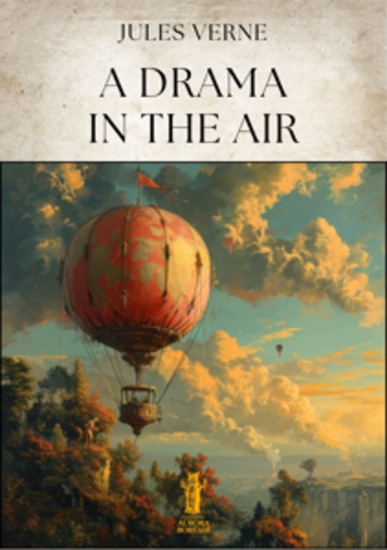
A Drama in the Air - cover

A Drama in the Air

Jules Verne

Publisher: Edizioni Aurora Boreale

  • 0
  • 0
  • 0

Summary

Jules Gabriel Verne (1828-1905) was a French novelist, poet, playwright and initiate.His collaboration with the publisher Pierre-Jules Hetzel led to the creation of the Voyages Extraordinaires, a series of bestselling adventure novels including Journey to the Center of the Earth (1864), Twenty Thousand Leagues Under the Seas (1870), and Around the World in Eighty Days (1872). His novels, always well-researched according to the scientific knowledge then available, are generally set in the second half of the 19th century, taking into account the technological advances of the time.He has been the second most-translated author in the world since 1979, ranking below Agatha Christie and above William Shakespeare. He has sometimes been called the "Father of Science Fiction", a title that has also been given to Herbert George Wells and Hugo Gernsback.A Drama in the Air (Un drame dans les airs), the adventure story by Jules Verne which we propose to our readers today, was first published in August 1851 under the title La science en famille. Un voyage en ballon (Science for families. A Voyage in a Balloon) in the literary magazine Musée des familles with five illustrations by Alexandre de Bar. In 1874, with six illustrations by Émile-Antoine Bayard, it was included in Doctor Ox, the only collection of Jules Verne's short stories published during Verne's lifetime. An English translation by Anne T. Wilbur, published in May 1852 in Sartain's Union Magazine of Literature, marked the first time a work by Jules Verne was translated into the English language.Just as the narrator starts the ascent of his balloon, a stranger jumps into its car. The unexpected passenger's only intent is to take the balloon as high as it will go, even at the cost of his and pilot's life. The intruder takes advantage of the long journey to recount the history of incidents related to the epic of lighter-than-air travel.This story foreshadows Verne's first novel, Five Weeks in a Balloon.
Available since: 03/24/2025.
Other books that might interest you

  • The Jungle - cover

    The Jungle

    Upton Sinclair

    • 0
    • 0
    • 0
    The Jungle by Upton Sinclair follows Jurgis Rudkus, a Lithuanian immigrant who arrives in Chicago seeking the American Dream. Instead, he faces brutal working conditions in the meatpacking industry, exploitation, poverty, and corruption. As he struggles to support his family, he becomes disillusioned with the system that exploits immigrant labor. Sinclair’s novel exposes the dark side of industrial capitalism, ultimately sparking public outcry and reforms in food safety laws.
    Show book
  • Selected Short Stories - by F Scott Fitzgerald - cover

    Selected Short Stories - by F...

    F Scott itzgerald

    • 0
    • 0
    • 0
    Selected Short Stories is a collection of some of F. Scott Fitzgerald's most memorable and thought-provoking works. Published in 1931, the collection includes several of his best-known stories, such as "The Diamond as Big as the Ritz," "Bernice Bobs Her Hair," and "The Curious Case of Benjamin Button." These stories explore themes of social class, love, loss, and the search for meaning in a rapidly changing world. Fitzgerald's writing style is characterized by its elegance, wit, and poetic language, making his stories both engaging and thought-provoking. 
     
    One of the recurring themes in Fitzgerald's stories is the tension between the individual and society. In many of his stories, the characters are struggling to find their place in a society that values wealth, status, and conformity. This is particularly evident in "Bernice Bobs Her Hair," in which the protagonist, Bernice, must decide whether to conform to the expectations of her wealthy cousin or to follow her own desires. Similarly, in "The Curious Case of Benjamin Button," the protagonist must come to terms with his unusual condition, which sets him apart from the rest of society. 
     
    Another important theme in Fitzgerald's stories is the fleeting nature of happiness and the inevitability of change. Many of his characters are searching for love, success, or fulfillment, but find that these things are elusive and ultimately fleeting. This is particularly evident in "The Diamond as Big as the Ritz," in which the protagonist discovers a hidden mountain of diamonds, only to realize that his wealth is meaningless in the face of the vastness of the universe. Fitzgerald's stories remind us that life is both beautiful and fragile and that the pursuit of happiness can be both exhilarating and heartbreaking. 
    Overall, Selected Short Stories is a testament to Fitzgerald's talent as a writer and his ability to capture the spirit of his time.
    Show book
  • Man in the Case - cover

    Man in the Case

    Anton Chekhov

    • 0
    • 1
    • 0
    As two friends are sharing stories together, the story of the man in the box comes up. The man in the box, Byelikov, was an eccentric professor that often made his coworkers feel uneasy. One day, Byelikov finds himself enamored with the sister of a new teacher at the school, Kovalenko. The prospect of a relationship between Byelikov and the sister, Varinka, excited his colleagues as they thought it might help to make him more normal and approachable. However, when someone takes it upon himself to draw a humorous caricature of the couple, things fall apart. When Byelikov's concern over the picture is not taken seriously, he retreats further into himself and the reader discovers what makes him the man in the box.   
      Anton Chekhov (1860-1904) was a Russian writer and playwright, considered by many to be one of the best writers of short stories in the history of literature. Chekhov was also a successful physician, but writing was his true passion. He was quoted as saying "Medicine is my lawful wife and literature is my mistress."
    Show book
  • The Leo Tolstoy Collection - War And Peace Anna Karenina A Confession - cover

    The Leo Tolstoy Collection - War...

    Leo Tolstoy

    • 0
    • 0
    • 0
    Leo Tolstoy was a Russian writer and philosopher who is widely regarded as one of the greatest novelists of all time. His most famous works include War and Peace and Anna Karenina, both of which are considered masterpieces of literature. Tolstoy's writing was known for its realism, attention to detail, and profound psychological insights into human behavior. In addition to his literary accomplishments, Tolstoy was also a prominent social and political thinker. He was deeply influenced by his Christian faith and believed in the importance of nonviolence and pacifism. He also advocated for social and economic equality, rejecting the inequalities of the aristocratic society he was born into. Later in life, Tolstoy became increasingly interested in spiritual matters, rejecting organized religion and instead seeking a more personal, direct connection with God. His writings on spirituality and morality continue to inspire readers and thinkers to this day.
    Show book
  • Odyssey of the North An - cover

    Odyssey of the North An

    Jack London

    • 0
    • 0
    • 0
    Things are not what they seem. A grizzled traveler arrives in a bluster. He doesn't make sense when he speaks. But once he warms up from the brink of death, his story and his heartbreak unfolds. 
    Enjoy this classic from Jack London, narrated by Audible best seller Evan Schmitt. 
    Story originally published in 1900. Production copyright 2023 by Riveting Publishing
    Show book
  • The Garden Lodge - cover

    The Garden Lodge

    Willa Cather

    • 0
    • 0
    • 0
    "The Garden Lodge" is a short story by Willa Cather, first published in 1905. It tells the story of a woman asked by her husband if she would agree to tear down their garden lodge and build a new summer house there instead. She grows nostalgic as she remembers spending fond times there with tenor Raymond d'Esquerre when he was visiting. Although a moderate and no-nonsense woman, the singer rekindled her passion for music during his stay. She had to let go of it after her lazy brother killed himself and her father was crippled with debts. She then proceeds to go to the garden lodge and plays a piece of opera that she played with the tenor the previous summer. However, after a night's sleep she comes around and tells her husband she agrees the lodge should go.
    Show book