Join us on a literary world trip!
Add this book to bookshelf
Grey
Write a new comment Default profile 50px
Grey
Subscribe to read the full book or read the first pages for free!
All characters reduced
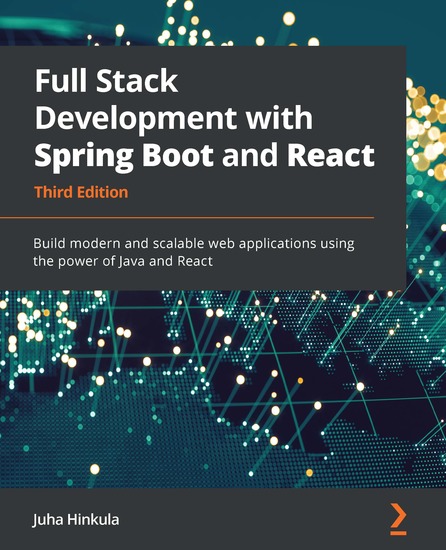
Full Stack Development with Spring Boot and React - Build modern and scalable web applications using the power of Java and React - cover

Full Stack Development with Spring Boot and React - Build modern and scalable web applications using the power of Java and React

Juha Hinkula

Publisher: Packt Publishing

  • 0
  • 0
  • 0

Summary

Getting started with full stack development can be daunting. Even developers who are familiar with the best tools, such as Spring Boot and React, can struggle to nail the basics, let alone master the more advanced elements. If you’re one of these developers, this comprehensive guide covers everything you need!
This updated edition of the Full Stack Development with Spring Boot 2 and React book will take you from novice to proficient in this expansive domain. Taking a practical approach, this book will first walk you through the latest Spring Boot features for creating a robust backend, covering everything from setting up the environment and dependency injection to security and testing.
Once this has been covered, you’ll advance to React frontend programming. If you’ve ever wondered about custom Hooks, third-party components, and MUI, this book will demystify all that and much more. You’ll explore everything that goes into developing, testing, securing, and deploying your applications using all the latest tools from Spring Boot, React, and other cutting-edge technologies.
By the end of this book, you'll not only have learned the theory of building modern full stack applications but also have developed valuable skills that add value in any setting.
Available since: 04/28/2022.
Print length: 378 pages.

Other books that might interest you

  • Human-Centered Leadership in Healthcare - cover

    Human-Centered Leadership in...

    Susan Campis, Lucy Leclerc, Kay...

    • 0
    • 0
    • 0
    Human-Centered Leadership in Healthcare is a new leadership model based on the theory of complex systems. 


    It addresses the requirement for healthcare organizations to develop environments that produce market leading outcomes which demonstrate value for patients. Since healthcare is a human-centric industry, it requires care for the leaders, the staff, and the patients. The Human-Centered Leadership model embraces the leader's focus on self-care and mindfulness while simultaneously focusing outward on others. The leader, at the center, adopts the attributes of the Awakener, the Connector, and the Upholder which result in practices leading to sustained quality outcomes, patient, and staff satisfaction, and a healthy work environment. These practices and outcomes can be described as cultures of excellence, trust, and caring. The Human-Centered Leader in Healthcare understands that "It starts with you but it's not about you". Kay Kennedy, Lucy Leclerc, and Susan P. Campis's goal for Human-Centered Leadership in Healthcare is to develop the people who lead the people who care for the people.
    Show book
  • The Spice Ports - Mapping the Origins of the Global Sea Trade - cover

    The Spice Ports - Mapping the...

    Nicholas Nugent

    • 0
    • 0
    • 0
    We may think of "globalism" as a recent development but its origins date back to the fifteenth century and beyond, when seafarers pioneered routes across the oceans with the objectives of exploration, trade, and profit. These voyages only became possible after certain technical innovations—improvements in ship design, compasses, and mapping—enabled navigation across unprecedented distances. The mariners' embarkation points were the vibrant ports of the West—Venice, Amsterdam, Lisbon—and their destinations the exotic ports of the East—Malacca, Goa, Bombay—where they tracked down the elusive spices, so much in demand by Western palates. 


    This development of maritime communication brought benefits apart from culinary delights: the spread of ideas on art, literature, and science. But it was not necessarily beneficial for everyone concerned: colonial ambitions were often disastrous for local populations, who were frequently exploited as slave plantation labor. 


    This wide-ranging account of a fascinating period of global history uses original maps and contemporary artists' views to tell the story of how each port developed individually while also encouraging us to consider contrasting points of view of the benefits and the damages of the maritime spice trade.
    Show book
  • The Feynman Lectures on Physics - A Comprehensive Introduction to the Principles of Physics - cover

    The Feynman Lectures on Physics...

    Mark Hedges

    • 0
    • 0
    • 0
    Physics is the study of the fundamental principles that govern the universe. It seeks to understand how the natural world works, from the smallest particles to the largest galaxies. At its core, physics is about exploring the behavior of matter and energy and how they interact. By uncovering these basic laws of nature, physicists have been able to make incredible advances in technology and our understanding of the universe, transforming how we live and think. 
    The nature and scope of physics are vast. It is divided into several branches, each focusing on different aspects of the physical world. Classical mechanics, electromagnetism, thermodynamics, and quantum mechanics are just a few examples of the areas of physics that explore different phenomena. Classical mechanics deals with the motion of objects and the forces acting upon them, while electromagnetism studies the behavior of electric and magnetic fields. Thermodynamics focuses on heat and energy transfer, and quantum mechanics explores the behavior of matter and energy at the smallest scales. 
    At its foundation, physics relies on a few core principles, such as the conservation of energy, the principle of least action, and Newton's laws of motion. These principles are fundamental to understanding how objects move, interact, and behave. The law of conservation of energy, for example, states that energy cannot be created or destroyed but only transformed from one form to another. Newton’s laws of motion provide the framework for understanding how forces affect the movement of objects. These laws have been used for centuries to explain everything from the motion of falling apples to the launch of rockets into space.
    Show book
  • The Last of Its Kind - The Search for the Great Auk and the Discovery of Extinction - cover

    The Last of Its Kind - The...

    Gisli Palsson

    • 0
    • 0
    • 0
    The great auk is one of the most tragic and documented examples of extinction. A flightless bird that bred primarily on the remote islands of the North Atlantic, the last of its kind were killed in Iceland in 1844. Gísli Pálsson draws on firsthand accounts from the Icelanders who hunted the last great auks to bring to life a bygone age of Victorian scientific exploration while offering vital insights into the extinction of species. 


    Pálsson vividly recounts how British ornithologists John Wolley and Alfred Newton set out for Iceland to collect specimens only to discover that the great auks were already gone. At the time, the Victorian world viewed extinction as an impossibility or trivialized it as a natural phenomenon. Pálsson chronicles how Wolley and Newton documented the fate of the last birds through interviews with the men who killed them, and how the naturalists' Icelandic journey opened their eyes to the disappearance of species as a subject of scientific concern—and as something that could be caused by humans. 


    Blending a richly evocative narrative with rare, unpublished material as well as insights from ornithology, anthropology, and Pálsson's own North Atlantic travels, The Last of Its Kind reveals how the saga of the great auk opens a window onto the human causes of mass extinction.
    Show book
  • ARTIFICIAL INTELLIGENCE FOR BUSINESS - Transforming Industries and Driving Growth with AI Strategies (2023 Guide for Beginners) - cover

    ARTIFICIAL INTELLIGENCE FOR...

    TARA MILLS

    • 0
    • 0
    • 0
    "Artificial Intelligence for Business: Transforming Industries and Driving Growth with AI Strategies" is your indispensable guide to harnessing the power of artificial intelligence to gain a competitive edge, optimize operations, and make informed decisions in the business world. 
    Inside this insightful guide, you'll explore:AI Fundamentals for Business: A clear and concise introduction to artificial intelligence, machine learning, and deep learning, tailored for business professionals.AI Use Cases: Real-world examples of how AI is revolutionizing industries, from automating customer service to enhancing supply chain management.Data-Driven Insights: How AI leverages data analytics to uncover valuable insights, enabling data-driven decision-making.AI Adoption Strategies: Practical guidance on implementing AI solutions within your organization, from strategy development to execution.Ethical Considerations: A discussion of the ethical and privacy implications of AI in business, along with responsible AI practices.AI-Ready Culture: Strategies for fostering a culture of innovation, collaboration, and AI literacy within your company.AI Tools and Technologies: An overview of the essential AI tools, platforms, and technologies that can benefit your business.Case Studies: In-depth case studies of businesses that have successfully integrated AI into their operations and achieved remarkable results. 
    Harness the potential of artificial intelligence to stay competitive, make informed decisions, and create lasting value in today's rapidly evolving business environment. Embrace AI with confidence and position your business for a future of innovation and success. 
     
    Show book
  • Digital Horizons - Where Technology Ends and Humanity Begins - cover

    Digital Horizons - Where...

    DemystifyTech

    • 0
    • 0
    • 0
    Digital Horizons: Where Technology Ends and Humanity Begins 
    Step into a mind-bending journey through tomorrow's technological landscape with "Digital Horizons," a groundbreaking five-part audio series that explores the profound ways emerging technologies are reshaping what it means to be human. Unlike conventional tech podcasts, this series weaves together cutting-edge research, expert insights, and compelling narratives to paint a vivid picture of our possible futures. 
    Each episode blends narrative storytelling with expert interviews, soundscaping, and immersive audio elements to create a rich, multifaceted exploration of our technological future. Whether you're a tech enthusiast, a concerned citizen, or simply curious about where humanity is heading, "Digital Horizons" offers an enlightening and thought-provoking journey into tomorrow's world. 
    Featuring insights from leading researchers, Silicon Valley pioneers, policy makers, and philosophers, this series goes beyond the headlines to ask fundamental questions about technology's role in human evolution. What happens when technology becomes inseparable from human consciousness? How do we preserve human agency in an algorithmic world? Where does authentic experience end and synthetic reality begin? 
    Join us for this extraordinary exploration of humanity's digital horizon, where every episode challenges your assumptions and expands your understanding of what's possible—and what's at stake—in our technological future.
    Show book