Join us on a literary world trip!
Add this book to bookshelf
Grey
Write a new comment Default profile 50px
Grey
Subscribe to read the full book or read the first pages for free!
All characters reduced
The Multicultural Mindset - Driving Business Growth in a Borderless Era - cover

The Multicultural Mindset - Driving Business Growth in a Borderless Era

Joycelyn David

Publisher: Advantage Media Group

  • 0
  • 0
  • 0

Summary

Joycelyn David, CEO of AV Communications and one of the 100 most influential Filipina women in the world, shares the essential blueprint for business leaders thriving in today's borderless marketplace. With over 20 years of expertise in multicultural marketing, David demonstrates how mastering your Multicultural Quotient (MQ)—the measurable essence of cultural intelligence—transforms good leaders into exceptional global changemakers.
Available since: 05/20/2025.
Print length: 194 pages.

Other books that might interest you

  • Sprachenräume der Schweiz - Band 1: Sprachen - cover

    Sprachenräume der Schweiz - Band...

    Johannes Kabatek, Barbara...

    • 0
    • 0
    • 0
    Das vorliegende Handbuch bietet eine umfassende Darstellung der Vielfalt der in der Schweiz bis in jüngste Zeit mündlich und schriftlich verwendeten Sprachen und Dialekte und der räumlichen und sozialen Bedingtheit ihres Auftretens. Es bezieht sich nicht ausschliesslich auf die Schweiz als viersprachiges Land, sondern geht neue Wege, indem es darüber hinaus das Englische sowie Sprachen berücksichtigt, deren heutige Präsenz in der Schweiz auf Migration beruht. Auch historische Sprachen und Dialekte, die in der Schweiz und im liechtensteinischen Sprachraum gesprochen werden, sowie die drei Schweizer Gebärdensprachen werden behandelt. Mit Ausblicken über die Schweiz hinaus bietet das Handbuch eine erweiterte Perspektive auf die Räume, die die Sprachen der Schweiz einnehmen. So wird das traditionelle Verständnis von Vielsprachigkeit um neue Aspekte und aktuelle Entwicklungen ergänzt.
    Show book
  • Becoming Batman - The Possibility of a Superhero - cover

    Becoming Batman - The...

    E. Paul Zehr, James Kakalios

    • 0
    • 0
    • 0
    Possessing no supernatural powers, Batman is the most realistic of all the superheroes. His feats are achieved through rigorous training and mental discipline, and with the aid of fantastic gadgets. Drawing on his training as a neuroscientist, kinesiologist, and martial artist, E. Paul Zehr explores the question: Could a mortal ever become Batman? 


    Zehr discusses the physical training necessary to maintain bad-guy-fighting readiness while relating the science underlying this process, from strength conditioning to the cognitive changes a person would endure in undertaking such a regimen. In probing what a real-life Batman could achieve, Zehr considers the level of punishment a consummately fit and trained person could handle, how hard and fast such a person could punch and kick, and the number of adversaries that individual could dispatch. He also tells us what it would be like to fight while wearing a batsuit and the amount of food we'd need to consume each day to maintain vigilance as Gotham City's guardian. 


    A fun foray of escapism grounded in sound science, Becoming Batman provides the background for attaining the realizable—though extreme—level of human performance that would allow you to be a superhero.
    Show book
  • CBT + DBT + ACT - 7 Books: Cognitive Behavioral Therapy Dialectical Behavior Therapy Acceptance and Commitment Therapy Includes: PTSD Vagus Nerve Polyvagal Theory EMDR and Somatic Psychotherapy - cover

    CBT + DBT + ACT - 7 Books:...

    Emily Torres

    • 0
    • 0
    • 0
    Unlock the transformative power of mental health therapies with our comprehensive audiobook collection: CBT + DBT + ACT – 7 Audiobooks. This expertly curated set offers in-depth insights into three of the most effective therapeutic modalities used today: Cognitive Behavioral Therapy (CBT), Dialectical Behavior Therapy (DBT), and Acceptance and Commitment Therapy (ACT). 
    Dive deep into the foundations and techniques of each approach, gaining practical tools to help manage a variety of mental health concerns. In addition, this collection expands your understanding with essential topics such as PTSD, the Vagus Nerve, Polyvagal Theory, EMDR (Eye Movement Desensitization and Reprocessing), and Somatic Psychotherapy. 
    Perfect for mental health professionals, students, and anyone seeking to enhance their therapeutic toolkit, this audiobook series provides a thorough, accessible, and engaging resource. Whether you're looking to deepen your practice or begin your journey into these transformative therapies, this collection offers both foundational knowledge and advanced concepts to support personal and professional growth.
    Show book
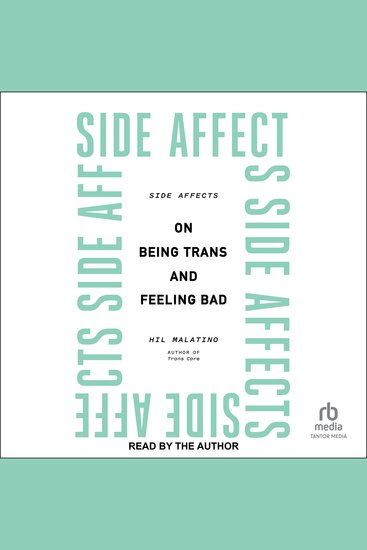
  • Side Affects - On Being Trans and Feeling Bad - cover

    Side Affects - On Being Trans...

    Hil Malatino

    • 0
    • 0
    • 0
    Some days—or weeks, or months, or even years—being trans feels bad. Yet as Hil Malatino points out, there is little space for trans people to think through, let alone speak of, these bad feelings. Negative emotions are suspect because they unsettle narratives of acceptance or reinforce virulently phobic framings of trans as inauthentic and threatening. 


    In Side Affects, Malatino opens a new conversation about trans experience that acknowledges the reality of feeling fatigue, envy, burnout, numbness, and rage amid the ongoing onslaught of casual and structural transphobia in order to map the intricate emotional terrain of trans survival. Trans structures of feeling are frequently coded as negative on both sides of transition. Before transition, narratives are framed in terms of childhood trauma and being in the "wrong body." Post transition, trans individuals—especially trans people of color—are subject to unrelenting transantagonism. 


    By moving these unloved feelings to the center of trans experience, Side Affects proposes an affective trans commons that exists outside political debates about inclusion. Acknowledging such powerful and elided feelings as anger and exhaustion, Malatino contends, is critical to motivating justice-oriented advocacy and organizing—and recalibrating new possibilities for survival and well-being.
    Show book
  • Stalingrad - cover

    Stalingrad

    Kelly Mass

    • 0
    • 0
    • 0
    Stalingrad has changed names. It's now called Volgograd and is still one of the largest cities in Russia. But we can't ignore the fact that for a significant time in history, it was called Stalingrad, named after the tyrant and leader of the Soviet Union in the Second World War, Joseph Stalin. Let's explore the history of this city during the Second World War, and why the battles fought there were so horrendous and pivotal in history.At the time of the Battle of Stalingrad In Southern Russia, Germany and its allies combated the Soviet Union for control of Stalingrad (now Volgograd). It is just one of the bloodiest engagements in the history of warfare, with an approximated 2 million general losses. It's marked by intense close-quarters battle and direct attacks on people in air campaign. The German High Command was pushed to eliminate substantial army forces from other theaters of war after their defeat at Stalingrad.The Stalingrad battle has been represented in the movies “Stalingrad” and “Enemy at the Gates.” It has become a level in video games like the “Call of Duty” series. Its casualties were many. Its circumstances brutal and took a very long time. Let’s take a look at what took place, why it was such a heroic turning point for the Russians against Hitler’s Nazi armies, and what happened after the Germans were pushed back.
    Show book
  • Thanks for Your Service - The Causes and Consequences of Public Confidence in the US Military - cover

    Thanks for Your Service - The...

    Peter D. Feaver

    • 0
    • 0
    • 0
    A definitive study on the decades-long run of high public confidence in the military and why it may rest on some shaky foundations. 


    What explains the high levels of public confidence in the US military and does high confidence matter? In Thanks for Your Service, the eminent civil-military relations scholar Peter D. Feaver addresses this question and focuses on what it means for the military. Proprietary survey data show that confidence is partly based on public beliefs about the military's high competence, adherence to high professional ethics, and a determination to stand apart from the bitter divisions of partisan politics. However, as Feaver argues, confidence is also shaped by a partisan gap and by social desirability bias, the idea that some individuals express confidence in the military because they believe that is the socially approved attitude to hold. Not only does Feaver help us understand how and why the public has confidence in the military, but he also exposes problems that policymakers need to be aware of. Specifically, this book traces how confidence in the institution shapes public attitudes on the use of force and may not always reinforce best practices in democratic civil-military relations.
    Show book