Join us on a literary world trip!
Add this book to bookshelf
Grey
Write a new comment Default profile 50px
Grey
Subscribe to read the full book or read the first pages for free!
All characters reduced
A Very Krampus Christmas - cover

A Very Krampus Christmas

Joslyn Chase

Publisher: Paraquel Press

  • 0
  • 0
  • 0

Summary

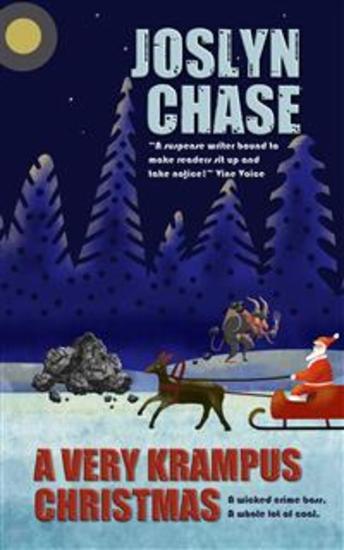
This holiday season, be good or be ready—Krampus is coming to town!
In the Bavarian-styled town of Leavenworth, Washington, Tal Bannerman goes undercover to bust a crime boss and his ring of scammers.
When Plan A blows up, Tal and his partner face exposure during the Christmas revelry, forcing them into a risky heist.
Can they pull it off and deliver the goods?
Mission Impossible meets Get Smart. Jump on board this delightful sleighride adventure for a fun and suspenseful holiday treat!
Available since: 06/12/2023.

Other books that might interest you

  • Everything Abridged - cover

    Everything Abridged

    Dennard Dayle

    • 0
    • 0
    • 0
    Best Books of 2022 - The New Yorker“Slyly defiant and blazingly imaginative, like the best modernist literature, Everything Abridged is a powerful celebration of flaw and failure. It’s a book that revels in the timelessness of obsolescence and the freedom of powerlessness. Dayle’s a genre-shattering writer, whose wit and intellect never cease to entertain. This refreshingly original and powerfully funny collection is a debut to remember.” —Paul Beatty, New York Times bestselling author of The Sellout  For readers of David Wong, Paul Beatty, and George Saunders, an electrifying and wholly original collection of satirical stories that create a bitingly funny portrait of American racism, capitalism, and politicsFramed as a reference work of humorous “entries” that offer trenchant social commentary, Everything Abridged presages a dark vision of the near future but tells jokes in the face of it: An intelligence agency operative uncovers a conspiracy to generate conspiracies and realizes his participation in the scheme. A Caribbean monarch meets four decades of American presidents and adjusts his country’s foreign policy accordingly. Experiment participants are asked to bring back a gun as quickly as possible. A copywriter on a space colony advertises a weapon with the potential to destroy his home during an intergalactic war.These and other linked stories, many of which feature a speculative bent—about being Black in America, law enforcement practices in an android society, Olympic speed walking, consumerism, nuclear war, and more—are interspersed with hilarious, one-line definitions for words ranging from abolition to zygote, creating a sharply humorous portrait of American inequality. With his singular wit, sharp prose, and shrewd observations, Dennard Dayle captures the struggles his characters face to keep hold of their sanity in a society collapsing into chaos and absurdity.
    Show book
  • The Case for the Baptism of the Mantelonian Queen - cover

    The Case for the Baptism of the...

    Mike DeFrench

    • 0
    • 0
    • 0
    A priest in the far future makes his case a Cardinal of the Catholic Church for the baptism of an alien species.
    Show book
  • The Adventures Of Sherlock Holmes - cover

    The Adventures Of Sherlock Holmes

    Arthur Conan Doyle

    • 0
    • 0
    • 0
    "The Adventures of Sherlock Holmes" is a collection of short stories featuring the iconic detective Sherlock Holmes and his friend Dr. John Watson. First published in 1892, the book includes some of Sherlock Holmes's most famous cases, such as "A Scandal in Bohemia," "The Adventure of the Blue Carbuncle," and "The Adventure of the Speckled Band." These stories showcase Holmes's unparalleled powers of observation and deduction as he solves various mysteries, from thefts and kidnappings to more complex and unusual crimes.
    Show book
  • Gooseberries - From their pens to your ears genius in every story - cover

    Gooseberries - From their pens...

    Anton Chekhov

    • 0
    • 0
    • 0
    Anton Pavlovich Chekhov was born on 29th January 1860 in Taganrog, on the south coast of Russia.  
    His family life was difficult; his father was strict and over-bearing but his mother was a passionate story-teller, a subject Chekhov warmed to. As he later said; ‘our talents we got from our father, but our soul from our mother’.  
    At school Chekhov was distinctly average. At 16 his father mis-managed his finances and was declared bankrupt. His family fled to Moscow. Chekhov remained and eked out a living by various means, including writing and selling short sketches to newspapers, to finish his schooling. That completed and with a scholarship to Moscow University obtained he rejoined his family. 
    He was able to help support them by selling satirical sketches and vignettes of Russian lifestyles and gradually obtained further commissions. In 1884, he qualified as a physician and, although it earned him little, he often treated the poor for free, he was fond of saying ‘Medicine is my lawful wife, and literature is my mistress.’ 
    His own health was now an issue as he began to cough up blood, a symptom of tuberculosis.  Despite this his writing success enabled him to move the family into more comfortable accommodation.  
    Chekhov wrote over 500 short stories which included many, many classics including ‘The Kiss’ and ‘The Lady with a Dog’.  His collection ‘At Dusk’ won him the coveted Pushkin Prize when was only 26.  
    He was also a major playwright beginning with the huge success of ‘Ivanov’ in 1887.   
    In 1892 Chekhov bought a country estate north of Moscow. Here his medical skills and money helped the peasants tackle outbreaks of cholera and bouts of famine. He also built three schools, a fire station and a clinic.  It left him with less time for writing but the interactions with real people gained him detailed knowledge about the peasantry and their living conditions for his stories.  
    His most famous work, ‘The Seagull’ was received disastrously at its premiere in St Petersburg. It was later restaged in Moscow to highlight its psychological aspects and was a huge success. It led to ‘Uncle Vanya’, ‘The Three Sisters’ and ‘The Cherry Orchard’.  
    Chekhov suffered a major lung hemorrhage in 1897 while visiting Moscow. A formal diagnosis confirmed tuberculosis and the doctors ordered changes to his lifestyle.  
    Despite a dread of weddings the elusive literary bachelor quietly married the actress Olga Knipper, whom he had met at rehearsals for ‘The Seagull’, on 25th May 1901. 
    By May 1904 with his tuberculosis worsening and death imminent he set off for the German town of Badenweiler writing cheerful, witty letters to his family and assuring them his health was improving.  
    On 15th July 1904 Anton Chekhov died at Badenweiler.  He was 44.
    Show book
  • I Wish I Were A Dog - cover

    I Wish I Were A Dog

    Desmond MacCarthy

    • 0
    • 0
    • 0
    In this tender Edwardian tale of childhood, loss, and imagination, I Wish I Were a Dog follows young Dicky Brook—a sensitive boy who struggles to meet the expectations of his strict father and brilliant siblings. Living in a home shaped by grief and duty, Dicky finds solace only in the unconditional love of Jasper, the family spaniel. 
    When a particularly difficult day leaves Dicky feeling worthless and misunderstood, he begins to daydream of a simpler life—one where he could be a dog, free from judgment and failure. As his imagination takes over, Dicky journeys into a surreal, emotional world where dreams and reality blur. 
    Rich with emotional nuance and written with gentle irony, this poignant short story explores the deep inner world of a child longing for comfort, understanding, and identity. Narrated with warmth and grace by Martine Baruch, I Wish I Were a Dog is a heartfelt, introspective classic for listeners of all ages.
    Show book
  • Forgotten Authors The - Women - Volume 1 - Alice Askew to Ethel Dell - cover

    Forgotten Authors The - Women -...

    Louisa Baldwin, Aphra Behn,...

    • 0
    • 0
    • 0
    Throughout the long centuries of human history is the want, and the need, to share information, to exchange ideas and for that knowledge and experience, for curiosity and learning, to be the basis of a civil society. 
    In literature the ambition is much narrower.  In order to be known, to be popular, you had to be published.  And for that people had to know you existed and your ideas worth reading.  Obviously for most of humanity’s time people couldn’t read and texts couldn’t be published in any great number. 
    In the 15th Century Gutenberg’s printing press began the revolution to address the second and by the 19th century had gathered pace with startling speed and mass distribution.  Education for the many was brought in to help people understand more of their world and, with new skills, how to have a better place within it.  Now, if the powers that owned the presses and means of distribution agreed an audience would now be able to avail themselves of your ideas, your printed words.  
    All too often the talents of women have been scorned, mocked and laughed at.  In reality that was more usually by those who’s own talents were hardly fit to even grace their shadows.   
    But society in general still connived and set women to one side in almost everything that men considered their rightful territory.  And literature was one such territory.  Remarkably resilient as well as talented these women strove to be published, to show themselves as equals.  The results more often than not proved that they were.   
    Sadly, in the thirst for the new, the recent and the past fell from sight, relegated to dark corners and dusty shelves.    
    But the printed word is rarely without someone, somewhere busying themselves through piles of papers and books rediscovering what a good story is, whatever its age. 
    In this volume we offer up a small selection of talents whose time has now come again.
    Show book