Join us on a literary world trip!
Add this book to bookshelf
Grey
Write a new comment Default profile 50px
Grey
Subscribe to read the full book or read the first pages for free!
All characters reduced
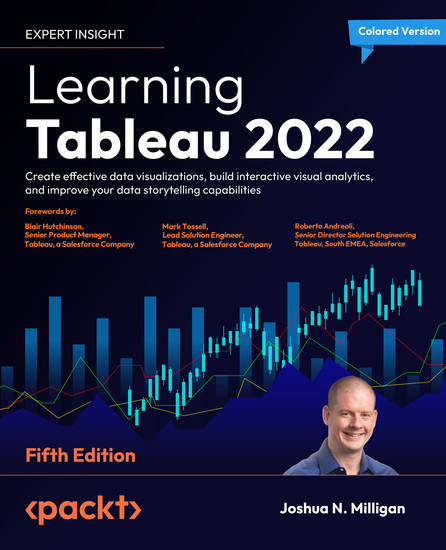
Learning Tableau 2022 - Create effective data visualizations build interactive visual analytics and improve your data storytelling capabilities - cover

Learning Tableau 2022 - Create effective data visualizations build interactive visual analytics and improve your data storytelling capabilities

Joshua N. Milligan

Publisher: Packt Publishing

  • 0
  • 0
  • 0

Summary

Learning Tableau 2022 helps you get started with Tableau and data visualization, but it does more than just cover the basic principles. It helps you understand how to analyze and communicate data visually, and articulate data stories using advanced features.This new edition is updated with Tableau’s latest features, such as dashboard extensions, Explain Data, and integration with CRM Analytics (Einstein Analytics), which will help you harness the full potential of artificial intelligence (AI) and predictive modeling in Tableau.After an exploration of the core principles, this book will teach you how to use table and level of detail calculations to extend and alter default visualizations, build interactive dashboards, and master the art of telling stories with data.You’ll learn about visual statistical analytics and create different types of static and animated visualizations and dashboards for rich user experiences. We then move on to interlinking different data sources with Tableau’s Data Model capabilities, along with maps and geospatial visualization. You will further use Tableau Prep Builder’s ability to efficiently clean and structure data.By the end of this book, you will be proficient in implementing the powerful features of Tableau 2022 to improve the business intelligence insights you can extract from your data.
Available since: 08/26/2022.
Print length: 568 pages.

Other books that might interest you

  • Mythic Plants - Potions and Poisons from the Gardens of the Gods - cover

    Mythic Plants - Potions and...

    Ellen Zachos

    • 0
    • 0
    • 0
    In this beautifully illustrated book that's Song of Achilles meets Secret Life of Trees, readers will discover the plants cultivated by the Greek Gods–many of which can still be experimented with today–for a myriad of uses.  In Greek mythology, plants were used for tools, intoxication, warfare, food, medicine, magic, and rituals. When Prometheus stole fire from the Olympian gods and gave it to mankind, he hid it in a stalk of giant fennel. Ancient Greeks waiting to question the oracles were given cannabis as part of their cleansing rituals. A quince fruit started the Trojan war. The goddess Demeter was so distraught when Hades kidnapped her daughter that she caused winter to blanket the earth, killing all plants. Mythic Plants focuses on how the ancient Greeks used plants in their lives and loves and conquests—some of which we can still use. Includes tips throughout for bringing these ancient plants into your garden.  
    Show book
  • Moving Between Worlds - A Guide to Embodied Living and Communicating - cover

    Moving Between Worlds - A Guide...

    Andrea Olsen

    • 0
    • 0
    • 0
    Communication is a fundamental human activity, and as much as 90% of all communication is non-verbal. Yet awareness of embodied intelligence in communication is rare. This book is the fourth in a series by interdisciplinary educator Andrea Olsen focused on embodiment. Through the exercises and readings in this book, we can deepen our relationship to ourselves and others and improve our communication skills, moving between worlds: inner and outer; self and other; self and Earth. Each of the thirty-one chapters combines factual information, personal anecdotes, and somatic excursions, inviting the reader to explore multiple learning styles and lenses for finding balance in a more-than-human world. This guidebook is a valuable resource for anyone seeking practical tools for living and communicating with more ease and clarity.
    Show book
  • Beyond Evolution - How New Discoveries in the Science of Life Point to God - cover

    Beyond Evolution - How New...

    Dr. Sy Garte

    • 0
    • 0
    • 0
    Is it possible that one of the biggest obstacles to harmonizing science and faith can finally be overcome? Respected biologist and former atheist Sy Garte says the answer is yes. A flash point for much of the science vs. faith divide has been Darwinian evolution. Sharing the same mistaken belief that science contradicts the Bible, especially the Genesis account of creation, many scientists and many Christians have concluded that the worlds of science and religion are at odds. But according to biologist Sy Garte, PhD, evolution is irrelevant to the harmony of faith and science. And revolutionary new developments in biology are providing stronger evidence than ever before of a purposeful creator God. In his new book, Dr. Garte combines the latest research with a biblical worldview as he explains:  how scientific progress has been hindered by the reluctance of many biologists to follow the evidence wherever it leads because of their fear of opening the door to theism  why misunderstandings about both the Bible and science have caused many people to unnecessarily abandon Christianity  why evolution by natural selection isn’t as important to science as many people think―and why it matters  how new evidence of purpose, agency and decision-making at the cellular level points to a creator God  how a reductionist, purely materialistic view of life ignores new advances in science  In Beyond Evolution, Sy Garte challenges both scientists and people of faith to follow the evidence wherever it leads―and argues powerfully for why that evidence warrants a belief in God.
    Show book
  • Hypnotherapy for chocolate addiction - quit binge eating - A guided meditation - DST Hypno with Stu Newman - cover

    Hypnotherapy for chocolate...

    Stuart Newman

    • 0
    • 0
    • 0
    If you have a chocolate addiction and are looking to quit binge eating, hypnotherapy with Stu Newman of DST Hypno may be the perfect solution for you.  
    With years of experience helping people overcome addictions, Stu is an expert in his field and can provide the guidance needed to break free from your unhealthy habits.  
    Through hypnosis techniques such as visualization, guided imagery and positive affirmations, he will help reprogram your mind so that it no longer craves unhealthy foods like chocolate.  
    Additionally, he will also work with you on developing healthy lifestyle habits that can ensure long-term success in overcoming your addiction once and for all.  
    So if you're ready to take control over food cravings once more then don't hesitate - try out hypnotherapy today!
    Show book
  • Man Cattle and Veld - cover

    Man Cattle and Veld

    Johann Zietsman

    • 0
    • 0
    • 0
    THE book for Profitable Ranching. A Real Ranching Revolution. Cattle Breeding. Grazing Management. 
    Much like nature, this book is both simple and complex. The author has taken great care to create both a simple technical guide as well as a philosophic declaration about complex human and environmental nuances, all in one volume. 
    Those persons who see and shape the future often say that the future is already here, it just isn't evenly distributed. I am confident that, several years from now many will look back upon this book, as well as the rest of Johann Zietsman's works, as foundational to the restoration of—and relationships between—man, cattle, and veld. 
    Zietsman puts forth a much-needed critique of man and his actions over the past century as well as personal stories as contra-example to the narratives we that have dominated the ranching world. 
    Achieving the ranch goal of maximum sustainable profit per hectare depends on breeding and feeding cattle (and all grazing species) as the grazers that they are. Efforts should be directed at raising cattle that are more efficient converters of forage, not on trying to make forage-reliant species into grain-efficient machines. Forces of nature created the animals we have, and their genetic potential will be brought out through non-selective grazing and proper supplementation. 
    Non-selective, time-controlled grazing, in which 80 to 95 percent of the mass of all grasses and forbs are utilized, thus pruning plants back to their crowns, is the process by which grasslands are improved in both plant vigor and species composition. I cannot overemphasize the importance of this last point—plant species diversity is promoted by time-controlled severe grazing events, whereas selective, take half leave half grazing is much more limited in improving species diversity, even leading to species narrowing in some circumstances.
    Show book
  • In the Herbarium - The Hidden World of Collecting and Preserving Plants - cover

    In the Herbarium - The Hidden...

    Maura C. Flannery

    • 0
    • 0
    • 0
    Collections of preserved plant specimens, known as herbaria, have existed for nearly five centuries. These pressed and labeled plants have been essential resources for scientists, allowing them to describe and differentiate species and to document and research plant changes and biodiversity over time—including changes related to climate. 


    Maura C. Flannery tells the history of herbaria, from the earliest collections belonging to such advocates of the technique as sixteenth-century botanist Luca Ghini, to the collections of poets, politicians, and painters, and to the digitization of these precious specimens today. She charts the growth of herbaria during the Age of Exploration, the development of classification systems to organize the collections, and herbaria's indispensable role in the tracking of climate change and molecular evolution. Herbaria also have historical, aesthetic, cultural, and ethnobotanical value—these preserved plants can be linked to the Indigenous peoples who used them, the collectors who sought them out, and the scientists who studied them. 


    This book testifies to the central role of herbaria in the history of plant study and to their continued value, not only to biologists but to entirely new users as well: gardeners, artists, students, and citizen-scientists.
    Show book