Join us on a literary world trip!
Add this book to bookshelf
Grey
Write a new comment Default profile 50px
Grey
Subscribe to read the full book or read the first pages for free!
All characters reduced
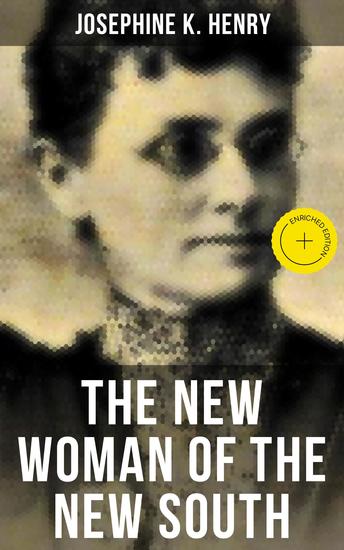
THE NEW WOMAN OF THE NEW SOUTH - Enriched edition A feminist literature classic - cover

THE NEW WOMAN OF THE NEW SOUTH - Enriched edition A feminist literature classic

Josephine K. Henry

Publisher: Musaicum Books

  • 0
  • 0
  • 0

Summary

In 'The New Woman of the New South' by Josephine K. Henry, the author delves into the changing social dynamics of the post-Civil War South, focusing on the emergence of a new type of woman who defies traditional gender roles. Henry's writing style is both insightful and engaging, offering a deep analysis of the societal expectations placed on women during this tumultuous period. Through a feminist lens, she explores how these women navigated challenges and sought independence in a patriarchal society. This book is a significant contribution to Southern literature, offering a fresh perspective on the role of women in the South post-Reconstruction. Josephine K. Henry, a pioneering feminist and social reformer, draws upon her own experiences and observations to write 'The New Woman of the New South.' Her advocacy for women's rights and progressive ideas shine through in her writing, making her a respected voice in the fight for gender equality. I highly recommend 'The New Woman of the New South' to readers interested in Southern history, women's studies, and the evolution of gender roles. Henry's nuanced analysis and passionate prose make this book a must-read for anyone seeking a deeper understanding of the complexities of Southern society.

In this enriched edition, we have carefully created added value for your reading experience:
- Hand‐picked Memorable Quotes shine a spotlight on moments of literary brilliance.
- Interactive footnotes clarify unusual references, historical allusions, and archaic phrases for an effortless, more informed read.
Available since: 12/06/2017.
Print length: 33 pages.

Other books that might interest you

  • Ratels on the Lomba - The Story of Charlie Squadron - cover

    Ratels on the Lomba - The Story...

    Leopold Scholtz

    • 0
    • 0
    • 0
    “We destroyed a whole enemy brigade (47 Brigade) on the Lomba. History will prove it to be one of the most glorious and successful actions that South African forces ever took part in.” – General Jannie Geldenhuys, as quoted in Cuito Cuanavale 
     
    On 3 October 1987 Charlie Squadron – the iron fist of 61 Mechanised Battalion Group – led the way in a decisive battle on the Lomba River in southern Angola, as part of the South African Defence Force’s Operation Moduler.  
    Although SADF tactical doctrine dictated that the tanks of the Angolan 47 Brigade be countered with tanks, the young conscripts of Charlie Squadron were forced to face their enemy in vastly inferior Ratels, significantly handicapped by the vehicles’ thin armour and low-velocity guns. Not only were they facing a force far superior in terms of weaponry, but they were also hugely outnumbered and had to deal with terrain so dense that their sight was severely impaired and their movement restricted. 
    Through interviews with veterans of the battle and diary entries from the time, Leopold Scholtz recreates the drama of this David vs Goliath battle, taking the reader straight to the heart of the action. A deeply human story, Ratels on the Lomba tells of how individuals react in the face of death, and reveals how the war never left these men, not even when they returned home.
    Show book
  • Self-Censorship - cover

    Self-Censorship

    Glenn C. Loury

    • 0
    • 0
    • 0
    There is no such thing as free, unconstrained speech. Laws and constitutions may protect us from the state when we speak our minds. But the state is just one possible constraint. Glenn Loury, one of America's most outspoken and important intellectuals, provides a provocative and dazzling analysis of the powerful social forces that can prevent speakers from voicing unpopular views in public forums.Every society, Loury notes, has norms to enforce. That can be a good thing: There ought to be social sanctions for, say, compulsive liars. When, however, a society shows a low degree of tolerance for speech about matters of political importance, self-censorship proliferates and public discourse and policy suffer. The answer, Loury argues, is for as many of us as possible to be braver and more human—to take a risk and unapologetically "live within the truth".Loury first presented these ideas in the 1990s in a celebrated and prophetic essay about "political correctness." In Self-Censorship he expands and updates the account, deploying his analytical powers and psychological acuity to diagnose our current political climate. The result illuminates prevailing social dynamics with the same brilliant and startling effect that made the paper an instant classic thirty years ago.
    Show book
  • Germany Between the World Wars: The History and Legacy of the Weimar Republic and Nazi Germany in the Interwar Period - cover

    Germany Between the World Wars:...

    Editors Charles River

    • 0
    • 0
    • 0
    The Weimar Republic has become a byword for a failed, tragic, political experiment. The official period of its existence, 1919-1933, marked the inter-war years in Germany and their related uncertainty, chaos and the state’s ultimate collapse. Historians have found the roots of Nazism embedded in the Weimar years and that in the final analysis, Weimar politicians voluntarily handed over power to the man who wrought destruction on an epic scale, Adolf Hitler. Yet the Weimar era encapsulated a number of trends and fissures within German society, as well as the international community. The Weimar Republic was a prisoner of events and in the long run had little power to shape them. Historians are fond of interpreting the past as a tension between human agency, that is to say decision-making, and structural developments that evade individual choices. Both these interpretations are crucial when examining the tumultuous years of Germany’s Weimar Republic. 
    The early 1930s were a tumultuous period for German politics, even in comparison to the ongoing transition to the modern era that caused various forms of chaos throughout the rest of the world. In the United States, reliance on the outdated gold standard and an absurdly parsimonious monetary policy helped bring about the Great Depression. Meanwhile, the Empire of Japan began its ultimately fatal adventurism with the invasion of Manchuria, alienating the rest of the world with the atrocities it committed.  
    It was in Germany, however, that the strongest seeds of future tragedy were sown. The struggling Weimar Republic had become a breeding ground for extremist politics, including two opposed and powerful authoritarian entities: the right-wing National Socialists and the left-wing KPD Communist Party. As the 1930s dawned, these two totalitarian groups held one another in a temporary stalemate, enabling the fragile ghost of democracy to continue a largely illusory survival for a few more years.
    Show book
  • Embrace Me Forever: Seven Conversations for Lifelong Love - A Group Discussion - cover

    Embrace Me Forever: Seven...

    Vines Graener

    • 0
    • 0
    • 0
    Embrace Me Forever: Seven Conversations for Lifelong Love is a powerful guide to nurturing deeper emotional connections in relationships. In this transformative audiobook, Dr. Sue Johnson, a renowned expert in Emotionally Focused Therapy (EFT), reveals the key to building lasting love through seven essential conversations that every couple needs. 
    These conversations aren’t just about words—they’re about emotional closeness, vulnerability, and understanding the underlying needs that shape how we connect with those we love. Embrace Me Forever is not just another relationship book; it’s a roadmap to creating unshakable bonds that withstand the test of time. 
    Through real-life examples and actionable advice, this audiobook will guide you through each conversation, helping you to communicate in ways that foster trust, security, and intimacy. Whether you're just starting out or have been together for years, Embrace Me Forever shows you how to strengthen the foundation of your relationship and make it more resilient than ever. 
    With Embrace Me Forever, you’ll learn how to:Deepen your emotional connection with your partnerOvercome recurring conflicts and patternsCreate a safe space for vulnerability and trustCommunicate in ways that bring you closer rather than push you apartBuild a relationship that lasts, with a love that grows stronger every day 
    Join Dr. Sue Johnson as she guides you through these seven vital conversations, and unlock the potential for a lifetime of love and connection. Embrace Me Forever is a journey to lasting intimacy, where love isn't just a feeling, but a bond that deepens with every conversation.
    Show book
  • How to Win the War on Truth - An Illustrated Guide to How Mistruths Are Sold Why They Stick and How to Reclaim Reality - cover

    How to Win the War on Truth - An...

    Samuel C. Spitale

    • 0
    • 0
    • 0
    Made to Stick by Chip Heath meets Thing Explainer by Randall Munroe in this guide to navigating today's post-truth landscape, filled with examples of modern-day propaganda campaigns. 


    We're bombarded with information like never before. Some of it's true, some of it's spin, and some of it's flat-out fake news. And that's by design. Propaganda helps governments and corporations sell us products, lifestyles, and ideas. Sometimes the agenda is harmless, but other times it's destructive, and it's not always easy to spot the difference. 


    Whether you want to be informed on the issues or debunk misinformation wherever you encounter it, How to Win the War on Truth is here to help. You'll learn: the history of propaganda, from Edward Bernays to Fox News; why simple messages are so powerful; who profits from propaganda; how propaganda is manufactured and delivered directly to you; and how to find the truth for yourself. 


    Filled with real-world examples of propaganda in all its forms, How to Win the War on Truth will help you see the world with clear eyes for the first time. Because when it comes to preserving democracy and fighting for our rights, it's essential that we do.
    Show book
  • Oceans of Grain - How American Wheat Remade the World - cover

    Oceans of Grain - How American...

    Scott Reynolds Nelson

    • 0
    • 0
    • 0
    An "incredibly timely" global history journeys from the Ukrainian steppe to the American prairie to show how grain built and toppled the world's largest empires (Financial Times). To understand the rise and fall of empires, we must follow the paths traveled by grain—along rivers, between ports, and across seas. In Oceans of Grain, historian Scott Reynolds Nelson reveals how the struggle to dominate these routes transformed the balance of world power. Early in the nineteenth century, imperial Russia fed much of Europe through the booming port of Odessa, on the Black Sea in Ukraine. But following the US Civil War, tons of American wheat began to flood across the Atlantic, and food prices plummeted. This cheap foreign grain spurred the rise of Germany and Italy, the decline of the Habsburgs and the Ottomans, and the European scramble for empire. It was a crucial factor in the outbreak of the First World War and the Russian Revolution. A powerful new interpretation, Oceans of Grain shows that amid the great powers’ rivalries, there was no greater power than control of grain.“American cotton changed the world in the first half of the nineteenth century, American wheat in its second half. Scott Reynolds Nelson’s globe-spanning exploration of the powers of a humble grain to topple empires, enable industrialization, build cities, and redirect trade flows is the kind of commodity history one wishes for: attentive to politics, connected as well as comparative in perspective, and with a knack for telling details. After reading this fast-paced book, the wars, revolutions, and empires of the nineteenth century will never seem the same.”―Sven Beckert, author of Empire of Cotton
    Show book