Join us on a literary world trip!
Add this book to bookshelf
Grey
Write a new comment Default profile 50px
Grey
Subscribe to read the full book or read the first pages for free!
All characters reduced
Problems of Immanence: studies critical and constructive - cover

Problems of Immanence: studies critical and constructive

Joseph Warschauer

Publisher: DigiCat

  • 0
  • 0
  • 0

Summary

In "Problems of Immanence: Studies Critical and Constructive," Joseph Warschauer embarks on a profound examination of philosophical immanence through a dual lens of critique and construction. This work synthesizes intricate theoretical frameworks with nuanced discussions, revealing the challenges and possibilities inherent in immanent thought. Warschauer's literary style is marked by clarity and rigorous argumentation, drawing from a rich tapestry of philosophical traditions and contemporaneous dialogues. The text situates itself within the broader context of 20th-century philosophy, engaging with influential thinkers while also questioning established doctrines, thus inviting readers into a dynamic intellectual ecosystem. Joseph Warschauer, a scholar deeply immersed in the intersections of philosophy, theology, and critical theory, brings a wealth of insight to this work. His background in academic philosophy and his critical engagement with themes of existence and knowledge have informed his approach to immanence, allowing him to delve into both historical and contemporary challenges. Warschauer's previous works have established him as a thought leader, exploring themes that resonate with the foundational crises of modern thought and contemporary existence. "Problems of Immanence" is vital for scholars and students who seek to grapple with complex philosophical issues. With its critical insights and constructive suggestions, this book is not only a significant contribution to philosophical literature but also a resource for anyone interested in the nuances of immanence and its implications for understanding reality. I wholeheartedly recommend this work for those eager to explore the depths of philosophical inquiry.
Available since: 11/22/2022.
Print length: 144 pages.
Other books that might interest you

  • American Warrior Societies - Conflict and Conquest (3 in 1) - cover

    American Warrior Societies -...

    Rolf Hedger

    • 0
    • 0
    • 0
    This book bundle explores the military prowess, resistance strategies, and conquests of three formidable warrior civilizations in the Americas: the Mapuche Empire, the Mixtec Empire, and the Tarascan Empire. These societies, known for their resilience, strategic warfare, and ability to challenge powerful enemies, played crucial roles in shaping the history of their regions.   
    Discover the Mapuche Empire, a fierce and independent people of southern South America who resisted Inca and Spanish invasions for centuries. Renowned for their adaptability in battle, use of guerrilla warfare, and iron determination, the Mapuche warriors held their ground against colonial forces longer than most indigenous groups in the Americas.   
    Unravel the history of the Mixtec Empire, a civilization known for its skilled warriors, masterful diplomacy, and sophisticated city-states spread across Oaxaca. Famous for their codices and intricate metallurgy, the Mixtec people engaged in both military conquest and strategic alliances to expand their influence and protect their lands from rival forces.   
    Explore the Tarascan Empire, a powerful rival of the Aztecs that built a highly organized military state in western Mexico. Unlike most Mesoamerican civilizations, the Tarascans developed advanced metal weapons and defensive fortifications, allowing them to successfully resist Aztec expansion and maintain their sovereignty until the arrival of the Spanish.   
    From relentless resistance to tactical supremacy, these warrior societies shaped the course of history through their unwavering spirit and military innovations. This book is perfect for history enthusiasts eager to learn about the fearless civilizations that defied conquest and fought for their survival.
    Show book
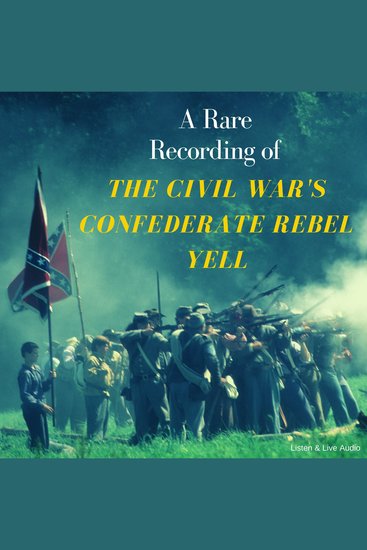
  • A Rare Recording of The Civil War's Confederate Rebel Yell - cover

    A Rare Recording of The Civil...

    Various Various

    • 0
    • 0
    • 0
    The Rebel Yell was a battle cry used by Confederate soldiers during the Civil War. The yell was hollered when soldiers were charging into battle, as a way to intimidate the enemy and to boost their own morale. There is some debate about how the Rebel Yell began. Confederate soldiers may have learned the yell from Native Americans, or simply imitated them. It is known that some Texas Confederate units combined Comanche war whoops into their version of the yell. Another claim is that it came from the screams traditionally made by Irish and Scottish Highlanders when they made a Highland charge during battle. According to Encyclopedia Virginia: "Distinctive noises made by soldiers were identified from the very beginning of the war, but the yell’s first appearance in combat may have come at the Battle of Manassas, on July 21, 1861, and it is strongly associated with the Confederate general Stonewall Jackson." Colonel Keller Anderson of Kentucky's Orphan Brigade said: "Then arose that do-or-die expression, that maniacal maelstrom of sound; that penetrating, rasping, shrieking, blood-curdling noise that could be heard for miles and whose volume reached the heavens--such an expression as never yet came from the throats of sane men, but from men whom the seething blast of an imaginary hell would not check while the sound lasted."
    Show book
  • How to Recognize Toxic Stress - cover

    How to Recognize Toxic Stress

    Olivia Werner

    • 0
    • 0
    • 0
    [How to Recognize Toxic Stress] delves deep into the invisible architecture of modern anxiety, illuminating the subtle ways our bodies and minds carry the weight of constant vigilance. With prose that flows like a gentle stream of consciousness, this groundbreaking exploration maps the delicate intersections between our physical responses and emotional landscapes. Through intimate observations of how stress settles into our shoulders on ordinary Tuesday mornings and nests in the spaces between breaths, the book reveals the profound wisdom of our bodies' ancient language. Drawing on cutting-edge research in neuroscience and psychology, it examines how our nervous systems have become unwitting hosts to a perpetual state of alertness, transforming what should be temporary visitors into permanent residents in our lives. The narrative weaves together personal insights with scientific understanding, creating a tapestry that helps readers recognize their own patterns of toxic stress while offering a compassionate framework for understanding these responses not as personal failings, but as natural adaptations to an increasingly demanding world.
    Show book
  • Dr Walton's Anger Management - cover

    Dr Walton's Anger Management

    James E. Walton

    • 0
    • 0
    • 0
    For many people, anger simply seems to take over their lives.  Chances are that you (or someone you know) have difficulty dealing with anger.  Unrestrained anger can lead to loss of control, concentration, and sleep.  It is also known to cause problems with decision making, not to mention severely damaging relationships.  Dr. Walton's Anger Management deals directly with stopping anger by combining the immediate proven effectiveness of clinical hypnosis with cutting-edge anger management strategies, psychological insights, and self-empowerment techniques. Together, they form a powerful and effective treatment for overcoming anger and its negative consequences.
    Show book
  • Climate Action for Busy People - cover

    Climate Action for Busy People

    Cate Mingoya-LaFortune

    • 0
    • 0
    • 0
    As unprecedented heat waves, storms of the century, and devastating fires impact cities across the country, the time to create climate resilient communities is now. While large-scale innovations in policy and technology are necessary to preserve the planet, the wisest and most lasting adaptation solutions originate at the local level. However, with something as large as the climate crisis, it can be hard to know where to begin. 


    Climate Action for Busy People is a hopeful and realistic roadmap for individuals and groups who want to boost climate preparedness and move the needle towards environmental justice. Drawing from her professional and personal success in climate adaptation and community organizing, Cate Mingoya-LaFortune begins with a brief history of why our communities look the way they do and how that affects how vulnerable we are to climate risks. Each chapter will help listeners scale up their actions, from identifying climate solutions that an individual or small group can pull off in a handful of weekends to advocating for change at the municipal level. It's not too late for people of all ages and skill levels to create climate safe neighborhoods. 


    Climate Action for Busy People is an invaluable guide for anyone who wants to make lasting and equitable improvements that will make their communities climate resilient.
    Show book
  • Victorian People - A Reassessment of Persons and Themes 1851–1867 - cover

    Victorian People - A...

    Asa Briggs

    • 0
    • 0
    • 0
    This text looks at the people, ideas and events between the Great Exhibition of 1851 and the Second Reform Act of 1867. From "John Arthur Roebuck and the Crimean War", and "Samuel Smiles and the Gospel of Work" to "Thomas Hughes and the Public Schools" and "Benjanmin Disraeli and the Leap in the Dark", Asa Briggs provides an assessment of Victorian achievements; and in doing so conjures up an enviable picture of the progress and independence of the last century. "For expounding this theme, this interaction of event and personality, Mr. Briggs is abundantly and happily endowed. He is always readable, often amusing, never facetious. He is widely read and widely interested. He has a sound historic judgment, and an unfailing sense for what is significant in the historic sequence and what is merely topical. . . . Above all, he is in sympathy with the age of which he is writing."—Times Literary Supplement
    Show book