Join us on a literary world trip!
Add this book to bookshelf
Grey
Write a new comment Default profile 50px
Grey
Subscribe to read the full book or read the first pages for free!
All characters reduced
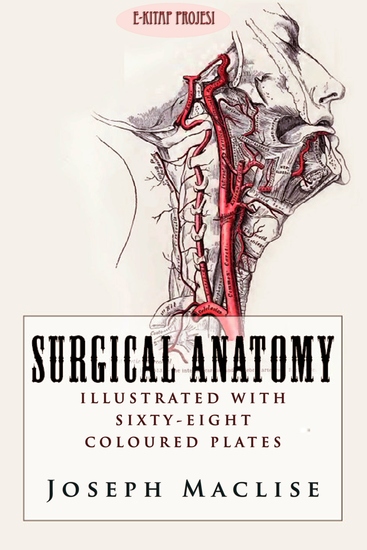
Surgical Anatomy - "Illustrated With Sixty-Eight Coloured Plates" - cover

Surgical Anatomy - "Illustrated With Sixty-Eight Coloured Plates"

Joseph Maclise

Publisher: E-Kitap Projesi & Cheapest Books

  • 0
  • 0
  • 0

Summary

The object of this work is to present to the student of medicine and the practitioner removed from the schools, a series of dissections demonstrative of the relative anatomy of the principal regions of the human body. Whatever title may most fittingly apply to a work with this intent, whether it had better be styled surgical or medical, regional, relative, descriptive, or topographical anatomy, will matter little, provided its more salient or prominent character be manifested in its own form and feature. The work, as I have designed it, will itself show that my intent has been to base the practical upon the anatomical, and to unite these wherever a mutual dependence was apparent.
That department of anatomical research to which the name topographical strictly applies, as confining itself to the mere account of the form and relative location of the several organs comprising the animal body, is almost wholly isolated from the main questions of physiological and transcendental interest, and cannot, therefore, be supposed to speak in those comprehensive views which anatomy, taken in its widest signification as a science, necessarily includes.

While the anatomist contents himself with describing the form and position of organs as they appear exposed, layer after layer, by his dissecting instruments, he does not pretend to soar any higher in the region of science than the humble level of other mechanical arts, which merely appreciate the fitting arrangement of things relative to one another, and combinative to the whole design of the form or machine of whatever species this may be, whether organic or inorganic. The descriptive anatomist of the human body aims at no higher walk in science than this, and hence his nomenclature is, as it is, a barbarous jargon of words, barren of all truthful signification, inconsonant with nature, and blindly irrespective of the cognitio certa ex principiis certis exorta.

Still, however, this anatomy of form, although so much requiring purification of its nomenclature, in order to clothe it in the high reaching dignity of a science, does not disturb the medical or surgical practitioner, so far as their wants are concerned. Although it may, and actually does, trammel the votary who aspires to the higher generalizations and the development of a law of formation, yet, as this is not the object of the surgical anatomist, the nomenclature, such as it is, will answer conveniently enough the present purpose.

The anatomy of the human form, contemplated in reference to that of all other species of animals to which it bears comparison, constitutes the study of the comparative anatomist, and, as such, establishes the science in its full intent. But the anatomy of the human figure, considered as a species, per se, is confessedly the humblest walk of the understanding in a subject which, as anatomy, is relationary, and branches far and wide through all the domain of an animal kingdom. While restricted to the study of the isolated human species, the cramped judgment wastes in such narrow confine; whereas, in the expansive gaze over all allying and allied species, the intellect bodies forth to its vision the full appointed form of natural majesty; and after having experienced the manifold analogies and differentials of the many, is thereby enabled, when it returns to the study of the one, to view this one of human type under manifold points of interest, to the appreciation of which the understanding never wakens otherwise. If it did not happen that the study of the human form (confined to itself) had some practical bearing, such study could not deserve the name of anatomical, while anatomical means comparative, and whilst comparison implies inductive reasoning.
Available since: 01/25/2024.
Print length: 600 pages.


Other books that might interest you

  • Decoding Data: A Beginner's Journey into Analytics - Navigating the World of Numbers for Actionable Insights - cover

    Decoding Data: A Beginner's...

    Ryan Mitchell

    • 0
    • 0
    • 0
    Embark on a transformative journey into the realm of data analytics with "Decoding Data: A Beginner's Journey into Analytics - Navigating the World of Numbers for Actionable Insights." This insightful book is tailor-made for beginners seeking to unravel the mysteries of data and harness its power for actionable insights. As the digital age continues to evolve, understanding data has become a crucial skill for professionals in various fields. Whether you're a business enthusiast, a student, or a curious mind eager to delve into the world of numbers, this book promises to be your guide through the fascinating landscape of analytics. 
    "Decoding Data: A Beginner's Journey into Analytics - Navigating the World of Numbers for Actionable Insights" skillfully demystifies complex analytics concepts, making them accessible to readers with no prior experience. From foundational principles to practical applications, each chapter is crafted to pique your interest and foster a deep understanding of how data can be translated into meaningful insights. Engaging examples and real-world scenarios bring the subject matter to life, ensuring that readers stay captivated throughout their learning journey. 
    As you progress through the pages, a desire to harness the power of data for decision-making will naturally emerge. The book seamlessly navigates through topics like data visualization, statistical analysis, and predictive modeling, empowering you to transform raw information into actionable strategies. By the end, you'll be equipped with the skills to decipher patterns, identify trends, and contribute to informed decision-making processes.
    Show book
  • Daily History Facts - cover

    Daily History Facts

    Anonymous

    • 0
    • 0
    • 0
    Every day, a little bit of history disappears into time, then we create more new history that requires attention and study. This book aims to preserve pieces of our historical record for posterity.
    Show book
  • Earthmusic - cover

    Earthmusic

    Paul Winter

    • 0
    • 0
    • 0
    Since the 1960s, Paul Winter has been in the vanguard of musicians whose art expresses special appreciation for the natural music of our world--wolf, whale, wind and water, combined with everything from Bach to Bossa Nova. In this visit Paul tells about the making of Missa Gaia, and his lifelong love affair with music that "presses your wonder button."
    Show book
  • Herding Immunity - The Startling History of Life Before and After Vaccines - cover

    Herding Immunity - The Startling...

    Stacy Mintzer Herlihy

    • 0
    • 0
    • 0
    A look at the long history of vaccines, yesterday, today, and still to come. 


    In Herding Immunity, Stacy Mintzer Herlihy explores the compelling history of vaccines and the equally long history of vaccination opposition. By connecting the contemporary anti-vax movement with its historical roots, Herlihy integrates modern conversations and reveals the profound impact vaccines have had on our society, highlighting the urgent need for societal change to ensure equitable vaccination for all.
    Show book
  • A Guide to Understanding Your Horse’s Personality - Gain Insight and Empathy for a Deeper Connection With Your Horse - cover

    A Guide to Understanding Your...

    Christina Holmbaeck

    • 0
    • 0
    • 0
    Are you ready to transform your horse's behavior and build a stronger, more trusting bond? "A Guide to Understand Your Horse’s Personality" is your ultimate guide to understanding and training every equine personality type, ensuring that both you and your horse thrive in your training journey. 
    Personalized training: Discover tailored techniques for engaging and training challenging, hesitant, fearful, and reserved horses. 
    Build trust and communication: Learn how to create a safe, supportive environment and master consistent, positive interaction. 
    Overcome common challenges: Find solutions to common training issues, and ensure steady progress with your horse. 
    Enhance your skills: Improve your training methods and develop a better understanding of your horse's unique needs. 
    Get practical tools that work: Each of the four horse types is supported by clear, practical exercises designed to match their specific needs. Whether your horse lacks confidence, has too much energy, or is hesitant to engage, you'll find step-by-step guidance to help you create a positive training experience. 
    Do you feel overwhelmed by your horse's challenging behavior? This book provides clear, step-by-step instructions and practical strategies that can help any horse owner – regardless of experience level – to achieve remarkable improvements. Whether your horse is reserved, hesitant or overly energetic, you'll find the guidance you need to succeed. 
    If you want to enhance your horse's training experience and build a more harmonious relationship – this book is for you.
    Show book
  • Environmental and Geological Sciences - Forces Shaping the World (3 in 1) - cover

    Environmental and Geological...

    Mike Crawford

    • 0
    • 0
    • 0
    Environmental and Geological Sciences: Forces Shaping the World is a comprehensive guide that examines the dynamic processes and forces responsible for shaping our planet. This 3-in-1 volume delves into the study of Seismology, Volcanology, and Limnology, providing readers with essential knowledge of how natural forces affect the Earth’s surface and its ecosystems. 
    In the first section, Seismology, readers will explore the science of earthquakes, the forces that generate seismic waves, and the tools used to measure and understand these powerful events. This section discusses the Earth’s internal structure, plate tectonics, and how seismic activity is monitored to predict and mitigate the impact of earthquakes, ultimately highlighting the influence of seismic forces on the environment. 
    Next, Volcanology offers an in-depth look at the study of volcanoes and volcanic activity. This section covers the geological processes that lead to the formation and eruption of volcanoes, as well as the environmental and societal consequences of volcanic events. Readers will gain insight into the types of volcanic eruptions, lava flows, and the role of volcanoes in shaping the Earth's landscapes over time. 
    The final section, Limnology, focuses on the study of inland aquatic environments, particularly lakes and rivers. Limnology explores the physical, chemical, and biological characteristics of freshwater ecosystems, as well as the human impact on these vital resources. From the study of water quality to the management of freshwater habitats, this section offers essential insights into how freshwater environments are influenced by natural processes and human activities.
    Show book