Join us on a literary world trip!
Add this book to bookshelf
Grey
Write a new comment Default profile 50px
Grey
Subscribe to read the full book or read the first pages for free!
All characters reduced
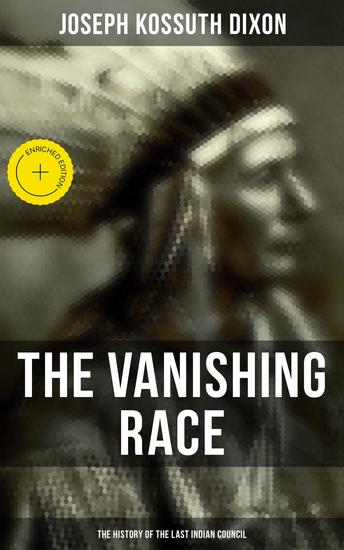
The Vanishing Race: The History of the Last Indian Council - Enriched edition - cover

The Vanishing Race: The History of the Last Indian Council - Enriched edition

Joseph Kossuth Dixon

Publisher: Musaicum Books

  • 0
  • 0
  • 0

Summary

Joseph Kossuth Dixon's 'The Vanishing Race: The History of the Last Indian Council' is a groundbreaking work that delves into the fascinating history of Native American tribes in the late 19th century. Through meticulous research and captivating storytelling, Dixon sheds light on the struggles and traditions of these marginalized communities, painting a vivid picture of their way of life before European colonization. The book's descriptive narrative and vivid imagery offer a unique insight into the cultural richness and resilience of Native American tribes. Written in a compelling and thought-provoking style, 'The Vanishing Race' stands as a significant contribution to Native American literature. Joseph Kossuth Dixon, a renowned ethnographer and photographer, drew inspiration from his firsthand encounters with Native American tribes to write this influential book. His passion for preserving and celebrating the heritage of Indigenous peoples shines through in every page, making 'The Vanishing Race' a must-read for history enthusiasts and those interested in Native American studies. I highly recommend 'The Vanishing Race' to readers who seek a profound understanding of Native American history and culture. Dixon's meticulous research and empathetic portrayal of the plight of Indigenous communities make this book a valuable resource for anyone interested in learning about this essential aspect of American history.

In this enriched edition, we have carefully created added value for your reading experience:
- Hand‐picked Memorable Quotes shine a spotlight on moments of literary brilliance.
- Interactive footnotes clarify unusual references, historical allusions, and archaic phrases for an effortless, more informed read.
Available since: 11/02/2018.
Print length: 178 pages.

Other books that might interest you

  • The Crowd - A Study of the Popular Mind - cover

    The Crowd - A Study of the...

    Gustave Le Bon

    • 0
    • 0
    • 0
    "The Crowd: A Study of the Popular Mind," written by Gustave Le Bon and first published in 1895, is a seminal work in the field of social psychology and the study of mass behavior. Le Bon explores the psychological underpinnings of crowd behavior, arguing that individuals, when part of a crowd, often lose their sense of personal responsibility and individuality. This transformation leads to collective behavior that is fundamentally different from the behavior of the individuals that constitute the crowd.Le Bon identifies several key characteristics of crowds: they are highly suggestible, prone to emotional contagion, and can be easily manipulated by leaders or prevailing ideas. He suggests that crowds operate on a more primitive and instinctual level, where rational thought is often overridden by emotion and a herd mentality. This, he argues, results in behaviors that are often irrational, impulsive, and sometimes violent.The book discusses various types of crowds, including anonymous crowds, organized crowds, and even criminal crowds, examining how their dynamics and psychological profiles differ. Le Bon's work also delves into the historical and social implications of crowd behavior, analyzing how mass movements have shaped political and social landscapes. He uses historical examples to illustrate his points, making connections between his theoretical insights and real-world events."The Crowd" has had a lasting impact on various fields, including sociology, psychology, political science, and even marketing and propaganda. Le Bon's ideas about the power of leaders to influence and control crowds have been both influential and controversial, sparking debates about the nature of mass behavior and the role of individual agency within it. Despite being over a century old, the book's insights remain relevant, offering a profound understanding of the dynamics of group behavior and the psychological mechanisms that drive collective actions.
    Show book
  • A History of Ancient Egypt’s Most Famous Sites - cover

    A History of Ancient Egypt’s...

    Editors Charles River

    • 0
    • 0
    • 0
    Africa may have given rise to the first humans, and Egypt probably gave rise to the first great civilizations, which continue to fascinate modern societies across the globe nearly 5,000 years later. From the Library and Lighthouse of Alexandria to the Great Pyramid at Giza, the Ancient Egyptians produced several wonders of the world, revolutionized architecture and construction, created some of the world’s first systems of mathematics and medicine, and established language and art that spread across the known world.  
    For almost four millennia, the Great Pyramids of Ancient Egypt have been widely hailed as the single greatest archeological feat man has ever accomplished. The Great Pyramid at Giza is the only one of the seven wonders of the ancient world to have survived into the modern age. Unlike so many pieces of the historical record which have been “re-discovered,” relatively recently (in the grand scheme of things,” in their four thousand years of existence, the Great Pyramids have never allowed themselves to be truly forgotten by the human civilization which has never ceased to regard them with wonder and awe. 
    Egypt also impressed its contemporaries. The 5th century B.C. Greek historian Herodotus wrote that Egypt was “the gift of the Nile” because the river made its soil so fertile and thus helped create one of the first great civilizations. Indeed, the land of Egypt so impressed the Greeks that when Alexander the Great conquered the Nile Valley in the 4th century B.C., he decided that he would build a new city on its soil and name it Alexandria. After Alexander, the city of Alexandria grew and became the most important city in the world for centuries as it watched and played a role in the rise and fall of numerous dynasties. The city also became home to one of the Seven Wonders of the Ancient World – the Lighthouse of Alexandria – and a center of culture and learning, which was exemplified by the Library of Alexandria.
    Show book
  • Anxious Attachment Recovery Made Simple - A Roadmap to Overcome Relationship Anxiety Build Secure Bonds and Rediscover Self-Worth - cover

    Anxious Attachment Recovery Made...

    Inner Growth Press, S. C. Rowse

    • 0
    • 0
    • 0
    Just as ships can struggle in stormy seas, many of us face relationship challenges. Anxious attachment can often be at the heart of these issues. But you don't have to endure heartache.Explore how anxious attachment quietly affects your bonds. Learn the keys to lasting, happy connections: self-awareness, good communication, and a solid self-esteem that brings security to you and your relationships.Inside, you'll explore a wide array of essential topics, including:- Identifying and understanding anxious attachment- Unpacking the intricate web of attachment styles and their profound impact on your romantic and platonic relationships- Cultivating self-awareness to illuminate your emotional landscape- Building effective communication skills that bridge hearts and minds- Elevating self-esteem and confidence to bask in the warmth of security- Strategies to conquer anxiety and jealousy, forging a path to serenity- Enhancing intimacy and fortifying the emotional bonds that tie you to others- Nurturing a love life that is not only healthy but deeply fulfillingThis guide is your ticket to brighter, happier relationships. Rescue them from storms and create new ones full of joy. Imagine a world without fear and anxiety, where security, love, and attraction thrive. Start your journey to lasting connections with this eye-opening audiobook.
    Show book
  • The Marauders - Standing Up to Vigilantes in the American Borderlands - cover

    The Marauders - Standing Up to...

    Patrick Strickland

    • 0
    • 0
    • 0
    This real-life Western tells the story of how citizens in a small Arizona border town stood up to anti-immigrant militias and vigilantes. 


    The Marauders uncovers the riveting nonfiction saga of far-right militias terrorizing the border towns of southern Arizona. In one of the towns profiled, Arivaca, rogue militia members killed a man and his nine-year-old daughter in 2009. In response, the residents organized and spent two years trying to push  the new militias out through boycotts and by urging local businesses to  ban  them. The militias and vigilante groups again raised the stakes, spreading Pizzagate-style conspiracy theories alleging that town residents were complicit in child sex trafficking, prompting fears of vigilante violence. 


    The Marauders flips the standard formula most often applied to stories about immigration and the far right. Too often those stories are told from the perspective of the ones committing the violence. While Strickland doesn't shy away from exploring those dark themes, the far right are not the protagonists of the book. Rather, the people targeted by hate groups, and the individuals who rose up to stop them in their tracks, are the heroes of this dramatic story.
    Show book
  • The Morals of Diet - The First Step - cover

    The Morals of Diet - The First Step

    Leo Tolstoy

    • 0
    • 0
    • 0
    Written in 1892, during the later years of his life, Leo Tolstoy’s The Morals of Diet reflects the profound spiritual transformation that reshaped his outlook after Anna Karenina and War and Peace. In the decades following his literary success, Tolstoy underwent a moral and religious awakening, renouncing wealth, privilege, and the comforts of aristocratic life. He sought a simpler, purer existence grounded in truth, humility, and nonviolence. This period gave rise to his moral essays — What I Believe, The Kingdom of God Is Within You, and The Morals of Diet (The First Step) — in which he strove to align daily actions with spiritual conscience. 
    The First Step emerges from this search for ethical coherence. Ostensibly an essay about vegetarianism, it is in fact a meditation on the nature of moral progress and the necessity of compassion. Tolstoy argues that abstaining from the killing of animals is the first, most tangible act of moral purification — “the first step” toward a life of genuine goodness. For him, cruelty, however subtle or socially accepted, degrades the human spirit. To refrain from violence, even in small forms, is to begin transforming one’s relationship to all living beings.
    Show book
  • Social Theory - Key Ideas and Concepts Shaping Sociological Thought - cover

    Social Theory - Key Ideas and...

    Fred Grandsen

    • 0
    • 0
    • 0
    Social theory provides a framework for understanding how societies function, how individuals interact, and how social structures shape human behavior. It encompasses a wide range of perspectives that seek to explain social order, change, and the relationships between individuals and institutions. By analyzing patterns in human behavior, power dynamics, and cultural influences, social theory helps us interpret the complexities of the modern world. Sociologists use these theories to examine issues such as inequality, globalization, identity, and technological change, offering insights that inform public policy, activism, and everyday life. 
    The origins of social theory can be traced back to early philosophical inquiries about society, morality, and governance. Thinkers such as Plato, Aristotle, and Confucius considered questions about justice, social order, and the ideal state. However, modern social theory emerged during the 19th and early 20th centuries in response to major social transformations such as industrialization, urbanization, and political revolutions. Pioneering sociologists, including Karl Marx, Emile Durkheim, and Max Weber, developed foundational theories to explain the impact of these changes on social life. Their work laid the groundwork for various theoretical traditions that continue to shape sociological inquiry today. 
    Social theories can be broadly categorized into macro and micro perspectives. Macro-level theories, such as structural functionalism and conflict theory, focus on large-scale social structures and institutions. These perspectives analyze how societies maintain stability, how power is distributed, and how systemic inequalities emerge. Micro-level theories, such as symbolic interactionism, examine individual interactions and the meanings people attach to their experiences. These approaches emphasize the role of language, symbols, and everyday social interactions in shaping identity and behavior.
    Show book