Join us on a literary world trip!
Add this book to bookshelf
Grey
Write a new comment Default profile 50px
Grey
Subscribe to read the full book or read the first pages for free!
All characters reduced
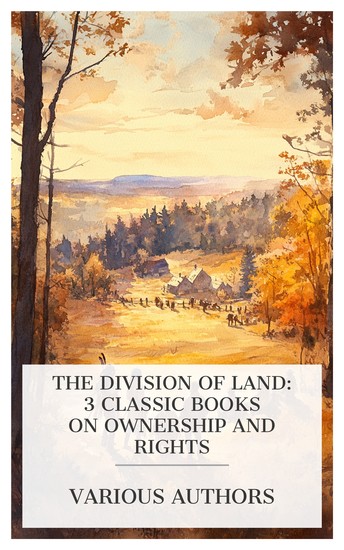
The Division of Land: 3 Classic Books on Ownership and Rights - Cessions of Land by Indian Tribes to the United States: Illustrated by Those in the State of Indiana Landholding in England etc - cover

The Division of Land: 3 Classic Books on Ownership and Rights - Cessions of Land by Indian Tribes to the United States: Illustrated by Those in the State of Indiana Landholding in England etc

Joseph Fisher, Charles C. Royce, Peter A. Speek

Publisher: e-artnow

  • 0
  • 0
  • 0

Summary

Embarking on a journey through the intricate tapestries of land ownership and rights, *The Division of Land: 3 Classic Books on Ownership and Rights* presents a thought-provoking collection that navigates complex themes of possession, legal frameworks, and societal impact. This anthology weaves together an array of literary styles, from analytical discourses to historical narratives, offering a panoramic view of land as both an asset and a prevailing social construct. Each piece within this collection brings its unique lens, contributing to a multidimensional exploration of how land is perceived, governed, and contested, transcending the mere legalistic perspective to delve into its profound cultural and historical significance. The contributors to this anthology, Charles C. Royce, Joseph Fisher, and Peter A. Speek, are brought together by their nuanced perspectives on land rights, and their works reflect their deep engagement with historical and cultural milieus. Through the lens of history and social reform, these authors collectively delve into the implications of land ownership, echoing the sentiments of movements concerned with equity and resource distribution. Their diverse backgrounds foster a rich dialogue that seamlessly merges past and present debates, offering readers insights into both historical context and contemporary relevance. This volume is an indispensable resource for readers eager to explore the myriad interpretations of land rights and ownership. It offers a unique opportunity to engage with a spectrum of intellectual discourses within a single, cohesive compendium. By melding distinct perspectives, the anthology invites readers to reflect on the diverse and layered narratives that shape our understanding of land, urging an appreciation for the complexity of issues at play while fostering critical thinking and informed discussion.
Available since: 03/04/2025.
Print length: 1044 pages.


Other books that might interest you

  • Sex Beyond "Yes" - Pleasure and Agency for Everyone - cover

    Sex Beyond "Yes" - Pleasure and...

    Quill R. Kukla

    • 0
    • 0
    • 0
    Every discussion of sexual ethics revolves around consent, but is this notion enough to help us understand good sex? How does the dominance of consent help or prevent us from negotiating the complexities of intimacy and pleasure? 


    Georgetown professor Quill R Kukla argues that the idea that consent is the gatekeeper between the realms of good and bad sex does not give us the tools we need to navigate pleasure and intimacy. They claim that traditional discussions of consent make no room for the reality that we can have good sex even though we may get drunk or high, or become forgetful with age, or be limited by social pressures and power relationships. 


    Kukla explores the ambiguous realms in which sexual agency requires much more than the ability to just say "yes" or "no" to sex. They confront moments of discomfort: How does consent work for people with dementia? Or in sex work, where sexual contracts challenge our traditional conceptions of ethical sex? How can we express our agency when exploring new kinks, where our hesitations and ambivalence are part of the thrill? Challenging listeners to think beyond reductive concepts of consent, gender, and freedom, Sex Beyond "Yes" reframes the communication and social support we need to establish sexual relationships founded on genuine respect, open discourse, and unhindered joy.
    Show book
  • How to Analyze People - Learn the Advanced Methods and Techniques of Speed Reading and Analyzing People - cover

    How to Analyze People - Learn...

    Kevin Hallstone

    • 0
    • 0
    • 0
    In this volume, our focus shifts slightly to the actual personality types; everyone should be aware of and susceptible to when they cross our paths. These are the people you probably don't want to know. 
    Why? They're people who really don't like other people. Well, they do, but what they like about people is exploiting, damaging, and controlling them. They like people for what they can do for them financially, in their careers, and in terms of their status in society. 
    We've covered some of the general personality types in Book One of our series. That information will have given you some insight into the people you meet and how to read them. But what I've saved for this volume is an examination of those who walk among us who are corrosive and psychologically compromised. Also, in this book, you'll be reading about the role of intuition in detecting the truth about situations and people and how to foster and use it to protect yourself and others from the excesses of the disorders described in this book. 
    We'll be focusing on personality disorders, the behaviors of those who are burdened with them, and how to see them coming. There are tell-tale signs early on in interactions with these people that can save you a lot of drama and chaos.  
    As you move along, you'll note an overlap between symptoms and behaviors. In the Cluster B personality disorders, we'll be looking at, the symptomatic overlap is not only common but expected. Further, those who fall under the headings in the cluster often have what is referred to as "co-morbidities." These are the double whammy types, who live with more than one personality challenge or disorder.
    Show book
  • The Song Dynasty - Economic and Technological Innovations - cover

    The Song Dynasty - Economic and...

    Jun Liu

    • 0
    • 0
    • 0
    The Song Dynasty (960–1279) emerged from the remnants of the fragmented Five Dynasties and Ten Kingdoms period, establishing a centralized government that would shape China for centuries. Unlike previous dynasties that relied heavily on military conquest, the Song prioritized administration, economic growth, and cultural development, laying the foundation for one of the most prosperous eras in Chinese history. 
    The dynasty is traditionally divided into two periods: the Northern Song (960–1127) and the Southern Song (1127–1279). The Northern Song was founded by Emperor Taizu, who implemented policies to weaken the power of military governors and strengthen civilian rule. This shift reduced the influence of warlords, allowing for a stable bureaucratic system. However, external threats, particularly from the Khitan Liao and later the Jurchen Jin, forced the court to focus on diplomacy and financial strategies rather than military expansion. Eventually, the Jin conquest of the north in 1127 led to the retreat of the Song court to the south, marking the beginning of the Southern Song period. Despite losing control over key northern territories, the Southern Song maintained a flourishing economy, driven by trade, technological advancements, and agricultural productivity. 
    The Song Dynasty’s political structure was characterized by a well-organized bureaucracy based on merit rather than aristocratic privilege. The expansion of the civil service examination system ensured that government officials were selected through rigorous academic testing rather than birthright. This system, rooted in Confucian ideals, emphasized knowledge of classical texts and governance principles, creating a scholar-official class that played a crucial role in state affairs. While this meritocratic system promoted stability, it also created a conservative bureaucracy resistant to radical reforms.
    Show book
  • The Life-Changing Art of Self-Brain Surgery - Connecting Neuroscience and Faith to Radically Transform Your Life - cover

    The Life-Changing Art of...

    W. Lee Warren M.D.

    • 0
    • 0
    • 0
    What if it were possible for you to make structural changes to your own brain so it’s healthier and less prone to depression, anxiety, grief, worry, and other issues that make you unhappy and keep you stuck?In this neuroscience-based, faith-infused, and immensely practical guide, Dr. W. Lee Warren, a practicing neurosurgeon, trauma survivor, and award-winning writer, reveals how to take control of your own mental, emotional, and physical healing by reordering your mind to change your brain-resulting in a radically transformed life that is healthier, happier, and more hopeful.Since the development of functional brain imaging in the early 2000’s, we now know that thoughts can direct structural changes in the brain as or more effectively than medicines or surgery and can do so more quickly. That means, whether we know it or not, we’re all brain surgeons.The Life-Changing Art of Self-Brain Surgery will help you:learn and master several types of “self-brain surgery” operations to move from floundering to flourishingheal from trauma, tragedy, and other types of hardshipovercome anxiety, depression, loneliness and other emotional and mental health strugglesconquer limiting or negative thinkingbreak old habits and create new onesbuild resilience and wellbeingbecome an empowered, hopeful person no matter what you’re facingWith the skill of a surgeon, the wounds of a trauma-survivor, the lessons of a scientist, and a hard-won faith that we are wired for happiness here on earth and not just in the hereafter, Dr. Warren walks readers into nothing less than a new way of life.
    Show book
  • Persian Corridor in World War II The: The History of the Allies’ Most Important Supply Route - cover

    Persian Corridor in World War II...

    Editors Charles River

    • 0
    • 0
    • 0
    Operation Barbarossa was the most fateful decision of World War II, and when it gave the Soviets common cause with the British (and subsequently the Americans), the purpose of the Lend-Lease Act changed in nature as well. The bulk of Germany’s formidable armed forces were committed to the offensive in the east, which relieved the pressure on the British and meant that a German attack on Britain or elsewhere in Western Europe was not going to happen, so keeping the Soviets in the war became the most essential goal of the supply program. 
    Getting supplies to the Soviets to help them resist the German armies became a strategic imperative, and Iran’s geography of bordering the Persian Gulf to the south and Soviet territory to the north brought Iran to the front and center in the strategic supply effort. The German invasion devastated much of European Russia, but also devastated Ukraine and Belarus, other member “republics” in the Soviet Union, and the portions of the Soviet Union that bordered on Iran were Armenia, Azerbaijan and east of the Caspian, Turkmenistan. 
    The Persian Corridor involved British and Dominion forces, as well as Soviet armed forces and personnel, but the operation and management of the Persian Corridor became largely an American show. Most of the immense amount of aid sent was for transshipment across Iran to the Soviets, but it also involved supplying British and Commonwealth forces in Iran, Iraq and elsewhere in the Middle East. Some was used to feed and supply Iran’s people, and some was used to modernize and maintain Iran’s infrastructure. There was also the need to supply the American troops working in the Persian Corridor. While 80% or so of the aid came from the U.S., there was also a significant amount of aid sent from Canada, Australia, South Africa and especially India. 
    Show book
  • A Rare Recording of President Franklin D Roosevelt's Fourth Inaugural Address - cover

    A Rare Recording of President...

    President Franklin D. Roosevelt

    • 0
    • 0
    • 0
    Franklin Delano Roosevelt (January 30, 1882 - April 12, 1945), also known as FDR, was the 32nd president of the United States, serving from 1933 until his death in 1945. The longest-serving U.S. president, he is the only president to have served more than two terms. His initial two terms were centered on combating the Great Depression, while his third and fourth saw him shift his focus to America's involvement in World War II. The following recording is from his fourth inaugural address delivered on January 20, 1945.
    Show book