Join us on a literary world trip!
Add this book to bookshelf
Grey
Write a new comment Default profile 50px
Grey
Subscribe to read the full book or read the first pages for free!
All characters reduced
Under Western Eyes - cover

Under Western Eyes

Joseph Conrad

Publisher: CLXBX

  • 0
  • 0
  • 0

Summary

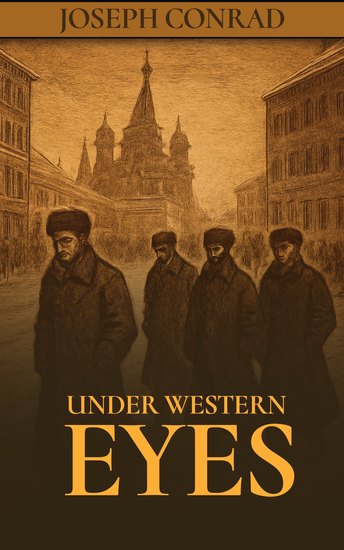
Under Western Eyes is Joseph Conrad's penetrating novel of political idealism, betrayal, and moral isolation, set against the turbulent world of early twentieth-century Russian revolutionary movements. Dark, introspective, and psychologically complex, the novel offers a profound exploration of conscience under the weight of political extremism.

The story follows Razumov, a reserved and ambitious university student in St. Petersburg whose quiet life is shattered when a revolutionary assassin seeks refuge in his room. Faced with an impossible moral dilemma, Razumov makes a choice that binds him irrevocably to the revolutionary cause he neither believes in nor fully understands. His decision leads to exile, surveillance, and a life governed by fear and self-betrayal.

Narrated by an English teacher living abroad, the novel unfolds through layered perspectives that emphasize misunderstanding, cultural distance, and moral ambiguity. Conrad deliberately distances the reader from certainty, mirroring Razumov's growing alienation and inner turmoil.

As Razumov becomes entangled with exiled revolutionaries in Geneva, Conrad exposes the contradictions of political idealism and the emotional cost of living under constant suspicion. The novel scrutinizes the destructive power of ideology—on individuals, relationships, and moral integrity.

Somber, ironic, and intensely reflective, Under Western Eyes stands alongside The Secret Agent as one of Conrad's most important political novels. It is a haunting meditation on guilt, responsibility, and the price of silence in a world dominated by ideological conflict.
Available since: 02/07/2026.
Print length: 393 pages.

Other books that might interest you

  • Collected Works of F Scott Fitzgerald - cover

    Collected Works of F Scott...

    F. Scott Fitzgerald

    • 0
    • 0
    • 0
    The Collected Works of F. Scott Fitzgerald includes the short stories: 
    The Great Gatsby
    The Curious Case of Benjamin Button
    The Camel's Back
    The Jelly-Bean 
    May Day
    Porcelain and Pink
    Tarquin of Cheapside
    Oh Russet Witch! 
    The Lees of Happiness 
    Mr. Icky
    Jemina, The Mountain Girl
    Show book
  • A Passage to India - cover

    A Passage to India

    E. M. forster

    • 0
    • 0
    • 0
    "I believe in teaching people to be individuals, and to understand other individuals."
    
    Regarded as one of the greatest novels of the 20th century, A Passage to India (1924) is a compelling portrait of a society in the grip of imperialism, exploring the tensions of British colonial rule in India and the deep complexities of cross‑cultural friendship.
    
    When inquisitive schoolteacher Adela Quested and her friend, the thoughtful Mrs. Moore, arrive in the Indian town of Chandrapore, they feel trapped by its insular and prejudiced British community. With the help of the charming and enthusiastic young physician, Dr. Aziz, the ladies set about discovering the "real India", but when an inexplicable incident at the distant Marabar Caves ignites a storm of suspicion and racial tension, Aziz finds himself at the centre of a scandal that rips through both Indian and British society, exposing the fragility of the understanding between them.
    Edward Morgan Forster (1879–1970) was an influential English novelist, essayist, and critic, known for his insightful observations on society and human relationships. He is often recognised as a prominent humanist writer, which reflects in both his literary works and his philosophical outlook; his books highlight the constraints that societal norms impose on individuals and advocate for greater empathy and understanding across class lines. His most famous novels include A Room with a View, Howards End, and A Passage to India, and his posthumously published novel Maurice revealed his identity as a gay man and his belief in the necessity of allowing individuals to live authentically.
    Show book
  • Anathema - From their pens to your ears genius in every story - cover

    Anathema - From their pens to...

    Alexander Kuprin

    • 0
    • 0
    • 0
    Alexander Kuprin was born in Narovchat, Penza in Russia on 7th September 1870. 
    At 3 his Father died and he and mother moved to Moscow. By 10 he was enrolled at the Second Moscow Military High School and there his interest in literature began. The Alexander Military Academy followed and two years later he was a sub-lieutenant and posted to an Infantry Regiment for a further four years. 
    Despite his duties he was a now a keen writer and published his first short story at this time. His military duties also garnered him experiences for his breakthrough work ‘The Duel’.  Leaving the military he left for Kiev to work for local newspapers.  He continued to publish both stories and novels and by 1901 he was in St Petersburg becoming part of a group that included Chekhov, Ivan Bunin, Maxim Gorky and Leonid Andreyev.  
    In the years that followed further controversial works and acclaim followed.  His comments on the regime meant he was also put under secret police surveillance.   
    As World War I erupted, Kuprin opened a military hospital but was then given command of an infantry company in Finland. He was soon discharged on grounds of ill health.  
    The October Revolution saw him praise Lenin, but he warned that the Bolsheviks threatened Russian culture and might cause further widespread suffering to the peasants.  As Civil War raged he took his family to Helsinki and then on to Paris. 
    Exile saw his talents decline further and his succumbing to alcoholism. He became lonely and withdrawn. The family's poverty increased his malaise.   
    In May 1937, the Kuprin’s returned to Moscow.  He now saw his work published but wrote almost nothing new.  In 1938 his health rapidly deteriorated.  Already suffering from a kidney problems and sclerosis, he had now developed cancer of the oesophagus.  
    Alexander Kuprin died on 25th August 1938.
    Show book
  • Antigone - Full Cast Drama - cover

    Antigone - Full Cast Drama

    Sophocles

    • 0
    • 0
    • 0
    "Antigone" is a Greek tragedy written by Sophocles in the 5th century BCE. The play is part of a trilogy, but only "Antigone," the third installment, has survived. The narrative revolves around Antigone, the daughter of Oedipus, who defies the king's decree and buries her brother Polynices, in defiance of the law. The king, Creon, orders that Polynices' body should remain unburied as punishment for his rebellion against the city. 
     
    Antigone's act of burial is not only an expression of familial loyalty but also an assertion of divine laws over human laws. She believes in the moral duty to honor her brother, even in death and is willing to face the consequences. Creon, however, sees her actions as an affront to his authority and issues a decree that anyone attempting to bury Polynices will be put to death. 
     
    As the plot unfolds, the clash between divine and human laws intensifies. Antigone is caught and brought before Creon, where she staunchly defends her actions. Creon remains resolute in his decision to punish her, regardless of her familial ties. The play explores themes of morality, duty, and the consequences of pride and authoritarian rule. 
     
    Tragedy unfolds as Antigone is sentenced to be entombed alive. The narrative weaves the fates of various characters, including Antigone, Haemon (Creon's son and Antigone's fiancé), and Eurydice (Creon's wife). The play culminates in a series of tragic events, leading to Creon's realization of his own tragic flaw and the devastating consequences of his decisions.
    Show book
  • The Whale Tooth - cover

    The Whale Tooth

    Jack London

    • 0
    • 0
    • 0
    In his tales of the South Seas, Jack London so often employs dark humor and grim irony in order to illuminate the clash of cultures. In The Whale Tooth, a white man becomes the victim of his own impulse to proselytize the benighted "heathen" on Melanesia.
    Show book
  • Birthday Girl - cover

    Birthday Girl

    Maria Krestovskaya

    • 0
    • 0
    • 0
    An everyday tragedy brought into stark relief and elevated to high drama by the skilled pen of Maria Krestovskaya, as she focuses her readers' attention on someone, whose life would have otherwise gone unnoticed.
    Show book