Join us on a literary world trip!
Add this book to bookshelf
Grey
Write a new comment Default profile 50px
Grey
Subscribe to read the full book or read the first pages for free!
All characters reduced
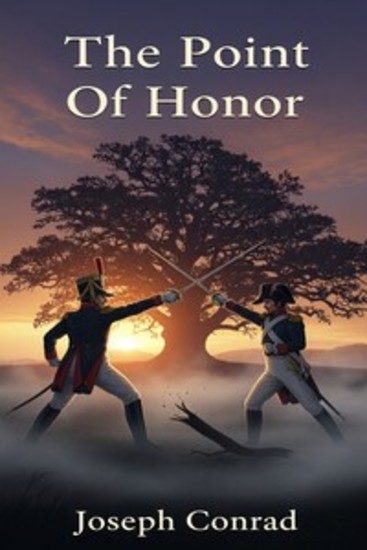
The Point Of Honor - cover

The Point Of Honor

Joseph Conrad

Publisher: Bu Classics Books

  • 0
  • 0
  • 0

Summary

A sharp and ironic exploration of the absurd lengths to which men will go to preserve their personal reputation. Set against the Napoleonic Wars, the narrative follows two officers locked in a lifelong rivalry over a perceived slight. It is a masterful study of obsession and the tragic consequences of misplaced pride.
Available since: 03/06/2026.
Print length: 124 pages.

Other books that might interest you

  • The Beautiful and Damned - cover

    The Beautiful and Damned

    F. Scott Fitzgerald

    • 0
    • 0
    • 0
    F. Scott Fitzgerald's The Beautiful and Damned chronicles the destructive marriage of Anthony Patch and Gloria Gilbert, gilded-age socialites. As they await a vast inheritance, their lives dissolve into indolence, alcoholism, and bitter resentment. Their beauty and charm mask a profound emptiness, revealing the corrosive effects of wealth and aimless desire. The novel explores the fleeting nature of youth and the tragic consequences of a life without purpose.
    Show book
  • The Chocolate Factory - cover

    The Chocolate Factory

    Mary-Lou Stephens

    • 0
    • 0
    • 0
    Love, friendship and dangerous secrets in the early years of Cadbury's Tasmanian factory. 
     
    It's 1921, and after years of working for Cadbury's at Bournville, Dorothy Adwell is on her way to a new adventure in the colonies, helping to establish the Firm's new Australian factory. A promotion and a fresh start are just what she needs after the horrors of the Great War and the loss of her beloved husband. During the long sea voyage, she meets Thomas and is immediately drawn to him. The war has left Thomas damaged, both mentally and emotionally, and Dorothy vows to help him - if only he will let her. 
     
    Maisie Greenwood is the oldest daughter of a war widow, living on a pittance in the Hobart suburb of the Glebe. Her mother's health is failing, and with two younger siblings depending on her the security of a job at the brand-new Cadbury's factory is a godsend. With Dorothy's mentorship and her budding romance with fellow worker Frank, life begins to look a little sweeter. 
     
    Cadbury's competitors have one goal: to steal the recipe for Dairy Milk, the most popular chocolate in the world. But the recipe is kept in a vault and the few who know it are legally bound to never divulge its secret. When chocolate spies target the new factory, Dorothy and Maisie become caught up in their plot. Can they protect the recipe, help those they love and fulfil their own dreams? 
     
    A tangled web of ambition and intrigue melts into a tale as delicious and rich as chocolate. 
     
    ‘An absolute treat – totally enthralling and completely and utterly satisfying. It’s another triumph for Mary-Lou Stephens.’ KAREN BROOKS, bestselling Australian author, on The Chocolate Factory
    Show book
  • Plain Jane - cover

    Plain Jane

    M. C. Beaton

    • 0
    • 0
    • 0
    Number 67 Clarges Street—a good address in London’s elegant Mayfair with a dubious past and a lovably eccentric staff—is where the Hart sisters are taking up residence for the season. Beautiful and socially ambitious Euphemia and her younger sister, Jane, enter a world of balls, coming-out parties, and courtship with the hope of finding suitable husbands. 
    But Number 67 has been deemed unlucky due to a long history of tragedy, including the mysterious death of a young and desirable past tenant named Clara. Little Jane, constantly overshadowed by her gorgeous sister, soon turns away from the London social scene and concentrates on solving the mystery behind Clara’s death. Her search leads to a discovery of danger, deceit, and romance as she works alongside the eligible and dashing Lord Tregarthan to unravel the baffling case.
    Show book
  • The Copy-Cat - And Other Stories - cover

    The Copy-Cat - And Other Stories

    Mary Eleanor Wilkins Freeman

    • 0
    • 0
    • 0
    The Copy-Cat and Other Stories is a late 19th-century collection exploring childhood, identity, and social dynamics. In the title story, plain Amelia Wheeler admires and imitates the beautiful Lily Jennings, navigating schoolyard rivalry, admiration, and the desire for acceptance. Freeman’s tales reveal the subtleties of human behavior, the complexities of growing up, and the humor, longing, and lessons embedded in everyday life and youthful interactions.
    Show book
  • Taras Bulba - cover

    Taras Bulba

    Nikolai Gogol

    • 0
    • 0
    • 0
    Taras Bulba by Nikolai Gogol is a powerful historical novella that captures the fierce spirit of the Cossack warriors and the turbulent conflicts of Eastern Europe in the 16th and 17th centuries. First published in 1835 and later expanded by the author, the story is a dramatic tale of loyalty, warfare, family bonds, and the intense struggle between personal emotions and duty to one's people. ⚔️📚
    
    The narrative follows Taras Bulba, a proud and formidable Cossack leader who lives for battle, honor, and the defense of his homeland and faith. When his two sons, Ostap and Andriy, return home after completing their education, Taras wastes no time introducing them to the harsh and heroic life of the Zaporozhian Cossacks. He takes them to the military camp where they must prove their courage and learn the brutal realities of war.
    
    As the Cossacks prepare to fight against foreign powers threatening their land, the brothers face trials that test their loyalty and character. Ostap embraces the Cossack code of honor and courage, while Andriy becomes torn between his duty to his people and a powerful personal passion that leads him down a very different path. Their choices bring both glory and tragedy, forcing Taras Bulba to confront the ultimate conflict between fatherly love and unwavering devotion to his nation.
    
    Gogol's vivid storytelling paints a dramatic picture of Cossack culture—its fierce independence, deep camaraderie, and relentless determination in the face of oppression. The novel is rich with scenes of battle, brotherhood, and the rugged landscapes of the Ukrainian steppe, bringing to life a society driven by honor, tradition, and faith.
    
    At its heart, Taras Bulba is a story about sacrifice, loyalty, and the powerful forces that shape identity and destiny. Gogol blends historical realism with epic storytelling to create a narrative that explores the complexities of patriotism, family, and the tragic consequences of divided loyalties.
    
    Widely regarded as one of Gogol's most celebrated works, Taras Bulba remains a compelling classic of world literature. Through its unforgettable characters and dramatic events, the novella offers readers a timeless reflection on courage, honor, and the enduring struggle for cultural and national identity.
    Show book
  • Jerusalem Delivered - cover

    Jerusalem Delivered

    Torquato Tasso

    • 0
    • 0
    • 0
    The First Crusade provides the backdrop for a rich tapestry of political machinations, military conflicts, martial rivalries, and love stories, some of which are complicated by differences in religion. The supernatural plays a major role in the action. Partly on this account, and partly because of the multilayered, intertwined plots, the poem met with considerable contemporary criticism, so Tasso revised it radically and published the revision under a new name, La Gerusalemme Conquistata, or "Jerusalem Conquered," which has remained virtually unread, a warning to authors who pay attention to the critics.The original poem influenced Edmund Spenser, whose unfinished epic, The Faerie Queene, is still more complicated in plot than Tasso's poem and, being an allegory, affords the supernatural an even greater share in the action. In Milton's Paradise Lost, the council in hell (first half of Book II) owes much to Tasso's similar scene in Book IV. (Someone with sufficient background in Old English might profitably compare the tirade of Satan in Book IV to the remarkably similar speech of Satan in the Anglo-Saxon Genesis.) Moreover, Milton's decision to write in English rather than in Latin, then the language of international discourse, was due in part to his visit to Tasso's patron, Giovanni Battista Manso, who advised him as he had advised Torquato Tasso before him, to dignify his native language by employing his talents in bold defiance of custom and precedent. Had Petrarch had the benefit of Manso's advice, his great epic, The Africa, might now eclipse his off-hour doodlings, the sonnets about Laura.The text is the Gutenberg Project's version, corrected in certain places by consulting editions, also in the public domain, published in 1749, 1844, 1845, and 1901; A Dictionary of the Italian and English Languages, by Joseph Baretti (Venice, 1795); The Oxford English Dictionary; and an edition of La Gerusaleme liberata itself (Paris: Victor Masson, 1836).(Summary by Thomas A. Copeland)
    Show book